
Built for Sun, Sand and Storm: Why Rotomoulded Components Power Harsh Outdoor Solar Systems
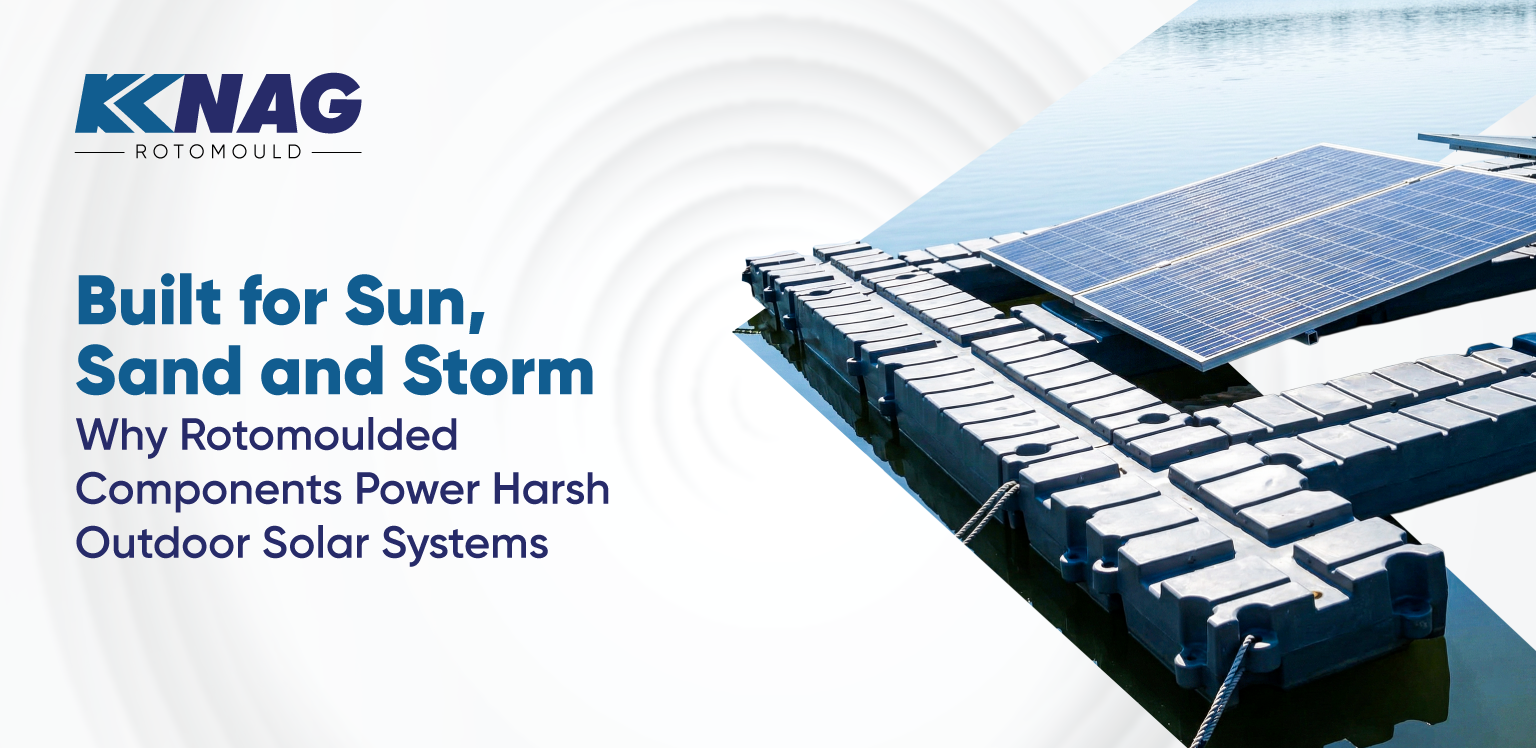
Solar installations are increasingly being deployed in some of the most unforgiving environments on earth, from desert solar parks exposed to extreme heat and sandstorms to coastal projects facing salt-laden air and cyclonic winds. Equipment in these locations is expected to operate continuously for decades with minimal maintenance access, making failure not just costly but operationally disruptive.
Table of Contents
Unlike conventional infrastructure, solar assets often sit fully exposed with no structural protection from the elements. Enclosures, battery housings, cable management systems, and auxiliary components must withstand thermal cycling, ultraviolet radiation, particulate abrasion, and accidental mechanical loads while maintaining safety and performance.
This reality has pushed engineers and project developers to move beyond traditional materials and fabrication methods. Rotomoulded components have emerged as a highly practical solution for outdoor solar environments because they combine structural robustness, corrosion immunity, and design adaptability in a single seamless form, enabling infrastructure that can endure harsh conditions without complex assembly or frequent replacement. As demand grows for durable outdoor solar plastic components, rotational moulded parts for solar farms are increasingly being specified for enclosures, ballast systems, and protective housings across utility-scale and off-grid installations.
Understanding the rotomoulding process and materials
Rotomoulding, or rotational moulding, is a manufacturing process used to produce hollow polymer components with uniform wall thickness. In this process, polymer powder is placed into a mould that is heated and rotated along multiple axes. The material coats the interior of the mould evenly, forming a seamless structure.
Common materials used in rotomoulding include linear low-density polyethylene (LLDPE) and other polyethylene grades formulated for outdoor use. These materials can be compounded with additives to enhance ultraviolet stability, impact resistance, and environmental durability.
Unlike some other moulding processes, rotomoulding does not rely on high pressure. This allows for the production of stress-free parts, which is beneficial for exposure to long-term outdoor conditions.
Rotomoulded components and their benefits for solar installations
Rotomoulded solar components offer several characteristics that make them suitable for outdoor solar environments.
Weather and UV resistance
Solar installations are continuously exposed to sunlight, making UV-resistant solar components essential. Rotomoulded parts can be manufactured using UV-stabilised polymers that resist degradation, colour fading, and embrittlement caused by prolonged ultraviolet exposure.
In addition to UV resistance, weather-resistant solar components must withstand rain, humidity, temperature fluctuations, and dust. Rotomoulded components maintain performance across a wide range of environmental conditions, supporting reliable operation in diverse climates.
Impact resistance and durability
Outdoor solar infrastructure may be exposed to accidental impacts during installation, maintenance, or extreme weather events. Rotomoulded components are known for their impact resistance due to their uniform wall thickness and flexible polymer structure.
This durability helps reduce cracking or failure when components are subjected to mechanical stress, contributing to longer service life and reduced replacement requirements.
Seamless and corrosion-free construction
Rotomoulding produces seamless components without joints or welds. This reduces potential weak points where moisture ingress or material failure could occur.
Polymer-based rotomoulded components are also corrosion-resistant, making them suitable for environments where metal components may degrade due to moisture, salinity or chemical exposure.
Design flexibility for outdoor applications
Rotomoulding enables the production of large hollow components, double-walled structures, and fully enclosed geometries that are difficult or impractical to manufacture using injection or blow moulding. This capability is particularly valuable for solar installations requiring integrated ballast tanks, equipment housings with internal ribs, cable routing channels and mounting features moulded into a single seamless unit. Such profiles reduce the need for assembly, eliminate leak paths, and improve structural stability in outdoor environments.
Insert moulding for integrated assemblies
Another advantage of rotomoulding for solar infrastructure components is the ability to incorporate metal inserts, threaded bushings, and mounting fixtures directly during the moulding process. This insert moulding capability allows brackets, fasteners, and reinforcement elements to be embedded into the polymer structure without secondary assembly.
For solar installations, this is particularly valuable because many components require secure mounting to frames, support structures or electrical equipment. Integrating inserts during moulding reduces the need for drilling, welding or post-processing while improving alignment and assembly efficiency. It also enhances structural reliability because loads are distributed through the moulded part rather than concentrated at externally attached fittings.
By enabling integrated mounting points and reinforced attachment areas, rotomoulded components simplify installation and reduce assembly complexity for solar infrastructure systems deployed in remote or large-scale solar farm environments.
Real-world applications of rotomoulded components in solar environments
Rotomoulded components are used across a range of solar-related applications that require outdoor durability.
These include:
- Protective enclosures for inverters and control units
- Housings for battery storage systems used in off-grid or hybrid installations
- Protective covers for junction boxes and electrical interfaces
- Ballast and support elements for ground-mounted solar systems
- Mounting structures and float modules for floating solar installations
In floating solar projects, rotomoulded polymers are particularly valuable because they offer buoyancy, corrosion resistance, and long-term stability in water environments. Rotomoulded floatation structures and mounting bases can support photovoltaic panels while resisting UV exposure, wave action, and continuous moisture exposure.
In many cases, these components are designed to be lightweight yet robust, simplifying installation while maintaining protection. Similar durability requirements are seen in products such as rotomolded marine buoys, where resistance to UV exposure, water, and mechanical stress is essential, demonstrating the suitability of the manufacturing process for harsh outdoor environments.
Why rotomoulded components support the future of solar infrastructure
As solar installations continue to expand into diverse and challenging environments, material solutions must support long-term reliability and reduced maintenance demands. Rotomoulded components for solar applications align with these requirements by offering stable structural behaviour despite prolonged exposure to heat, UV radiation, moisture, and airborne contaminants.
Rotomoulded polymers are electrically non-conductive and inherently corrosion-free, which eliminates grounding concerns and galvanic issues when used alongside metal frames and fasteners. Their low thermal conductivity and colour-through material also help limit surface heating and paint degradation, supporting safer handling and reduced maintenance in exposed solar installations.
From a system perspective, the use of weather-resistant solar components contributes to improved resilience of solar installations. As infrastructure scales and exposure conditions vary, rotomoulded components are likely to remain a relevant option for supporting outdoor solar systems while contributing to sustainability goals through long service life, low maintenance requirements, and recyclability at the end of use systems.
Conclusion
Harsh outdoor environments place demanding requirements on solar infrastructure components. Exposure to sunlight, weather, and mechanical stress necessitates materials that can maintain performance over extended periods.
Rotomoulded components offer a combination of durability, UV resistance, and design flexibility that addresses these challenges. Through their application in outdoor solar infrastructure components, rotomoulded solutions support reliable operation and long-term functionality across a wide range of solar environments.
To explore customised rotomoulded solutions for your solar projects, connect with K. K. Nag Private Limited’s engineering team for application-specific guidance and development support.
Featured Blogs
Built for Sun, Sand and Storm: Why Rotomoulded Components Power Harsh Outdoor Solar Systems
Solar installations are increasingly being deployed in some of the most unforgiving environments on earth, from desert solar parks exposed to extreme heat and sandstorms to coastal projects [...]

Why Advanced In-House Tool Rooms Are Essential for Modern Manufacturing
In today’s manufacturing environment, product development delays are often caused not by design limitations but by tooling bottlenecks. As industries move toward faster innovation cycles, higher product customisation [...]
EPS in Air Cooler and Air Conditioner Packaging: Cushioning Heavy, Delicate Units
Air coolers and air conditioners present a unique packaging challenge. These appliances are often bulky and heavy, yet they house delicate components, such as coils, compressors and electronic [...]

The Role of EPS in Cold Chain Packaging: Ensuring the Safe Transit of Pharmaceuticals
The pharmaceutical industry depends heavily on reliable cold chain systems to maintain product efficacy and patient safety. Many medicines, vaccines, and biological products are highly sensitive to temperature [...]
Get in Touch with Us
We look forward to connecting with you!


