
Rotomoulded Road Barriers: Enhancing Safety on Indian Highways
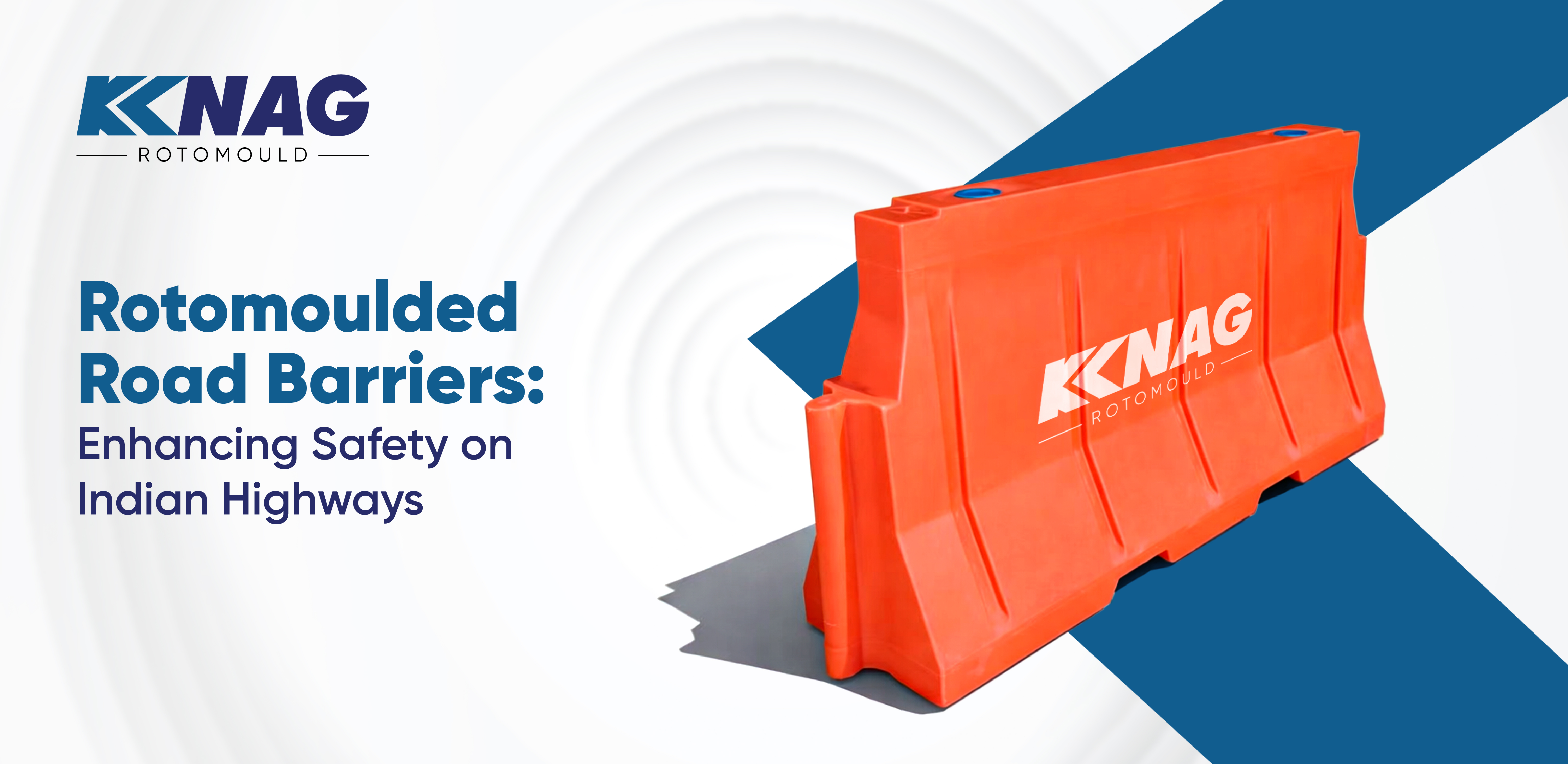
Road safety remains a critical concern across India’s expanding highway network. Rapid urbanisation, rising vehicle ownership and increased freight movement have significantly raised traffic volumes, intensifying exposure to collision risk across both urban and intercity corridors. While infrastructure development has progressed at scale, safety outcomes continue to depend on how effectively roads and traffic systems are designed to manage risk under dynamic, real-world operating conditions.
Table of Contents
- 01. Importance of road safety on Indian highways
- 02. Need for effective road barriers to reduce accidents
- 03. What are rotomoulded road barriers?
- 04. Benefits of rotomoulded road barriers
- 05. Role in highway safety infrastructure in India
- 06. Growing demand with infrastructure development
- 07. Conclusion
In this environment, road safety barriers play a critical functional role by guiding vehicle movement, separating traffic streams and reducing collision severity. Their importance is particularly evident in Temporary Traffic Control scenarios such as construction zones, lane diversions, maintenance activities and event-related traffic management, where road geometry and traffic behaviour change frequently. These locations require safety systems that can be deployed quickly, reconfigured with minimal effort and removed without affecting permanent infrastructure.
It is therefore essential to distinguish clearly between permanent and temporary barrier systems. On Indian National Highways and NHAI projects, permanent medians and containment barriers are subject to high-containment requirements and are typically specified as concrete profiles such as New Jersey or F-shape barriers, or as metal beam crash barriers. Rotomoulded road barriers are not intended to replace these permanent systems. Instead, they are engineered specifically for temporary traffic control applications, where flexibility, rapid deployment and operational adaptability are key performance requirements.
As highway authorities, contractors and planners focus on safer and more resilient road networks, rotomoulded road barriers have been widely used for several years as a practical solution aligned with the operational realities of Indian highway construction and traffic management.
Importance of road safety on Indian highways
Indian highways connect economic centres, industrial corridors and rural regions, making them essential to national mobility. At the same time, these roads often carry a mix of heavy commercial vehicles, passenger cars, two-wheelers and pedestrians. This diversity increases the likelihood of accidents, particularly in areas with high speeds, construction activity or lane diversions.
Road safety is not limited to signage and enforcement. Physical infrastructure elements such as medians, dividers and crash barriers influence how vehicles behave during sudden manoeuvres or impact events. Effective highway safety barriers can prevent vehicles from crossing into opposing traffic, reduce run-off-road incidents and guide drivers through work zones.
Need for effective road barriers to reduce accidents
Traditional road barriers made from concrete or metal have long been used on Indian highways. While they provide rigidity, they also come with limitations. Rigid barriers can cause severe vehicle damage during impact and may increase injury risk at lower speeds. Metal barriers often present practical challenges on Indian highway projects due to theft for scrap value and the need for repeated replacement. Concrete barriers, while robust, are heavy and costly to transport, creating logistical constraints during installation, relocation and temporary traffic management.
This has led to growing interest in alternative road safety barriers that are theft-proof (zero scrap value) and logistically efficient (stackable and light when empty. The goal is not only to stop vehicles but to manage collision forces in a way that reduces harm to occupants and other road users.
Furthermore, highway safety barriers must be easy to deploy, relocate and maintain, particularly in construction zones and temporary traffic diversions.
What are rotomoulded road barriers?
Rotomoulded road barriers are polymer-based, hollow safety barriers manufactured using rotational moulding. They are designed for impact mitigation and vehicle guidance in temporary traffic control environments.
This process creates seamless, uniform products with consistent wall thickness, making them well-suited for outdoor and high-impact applications.
Unlike rigid barriers, rotomoulded road barriers are designed to absorb and dissipate impact energy. Many designs can be filled with water or sand to increase stability after installation, adding significant mass, typically in the range of 100 to 500 kilograms, depending on barrier size. This added mass allows the barrier to utilise inertia and friction to mitigate impact forces, while remaining lightweight during transportation and placement when empty.
Their modular construction allows individual units to be linked together to form continuous safety systems along highways, bridges and work zones.
Benefits of rotomoulded road barriers
One of the key benefits of rotomoulded road barriers is impact absorption. The material behaviour allows barriers to deform under force, reducing the severity of collisions and lowering the risk of vehicle rebound into traffic.
These barriers are typically manufactured using UV-stabilised polyethylene, most commonly linear low-density polyethylene (LLDPE). They are resistant to corrosion, moisture and prolonged ultraviolet exposure, making them suitable for India’s varied climatic conditions. From coastal highways to high-temperature inland regions, rotomoulded barriers maintain functional performance over extended periods. In practice, K. K. Nag uses UV8 or UV16 stabilisation ratings in its barrier formulations, which are designed to withstand Indian summer conditions for five years or more without significant fading or surface cracking.
Ease of handling also supports their adoption. Rotomoulded road barriers are logistically efficient because they are lightweight and stackable when empty, reducing transport volume and handling effort on site. Unlike metal barriers, they have negligible scrap value, which makes them effectively theft-proof in Indian operating conditions. These characteristics make them particularly suitable for temporary installations such as road repairs, diversions and event traffic management, where frequent movement and redeployment are required.
Visibility and adaptability further enhance safety. Rotomoulded barriers can be produced in high-visibility colours and integrated with reflective elements, improving driver awareness during day and night conditions.
Role in highway safety infrastructure in India
Highway safety infrastructure in India is evolving alongside broader infrastructure initiatives. National highway expansion, expressway projects and smart highway developments require safety solutions that are scalable and adaptable.
Rotomoulded road barriers for Indian highways are increasingly used in median separation, lane delineation and protection of work zones. Their modular design allows authorities to adjust layouts as traffic patterns change, without dismantling permanent structures.
Rotomoulded road barriers can be designed to align with relevant IRC and MoRTH safety guidelines applicable to temporary traffic control and work zone management, ensuring consistency with nationally recognised highway safety frameworks.
Growing demand with infrastructure development
India’s focus on infrastructure development is expected to continue through the coming decade. Programmes aimed at improving road connectivity and safety are placing greater emphasis on modern safety systems.
As highway projects increase in scale and complexity, the demand for road safety barriers that combine performance, durability and operational flexibility is rising. Rotomoulded road barriers address many of these requirements, making them a relevant component of future highway safety planning.
The use of rotational moulding products in infrastructure applications reflects a broader shift towards engineered polymer solutions that can meet safety objectives while supporting efficient deployment.
Conclusion
Enhancing safety on Indian highways requires more than expanding road networks. It depends on the thoughtful integration of safety infrastructure that can respond to real-world driving conditions. Rotomoulded road barriers offer a balanced approach by combining impact management, durability and adaptability.
As highway safety infrastructure in India continues to evolve, solutions that support both permanent and temporary safety needs will remain essential. Rotomoulded road barriers represent one such solution, contributing to safer travel environments nationwide.
Featured Blogs

Built for Sun, Sand and Storm: Why Rotomoulded Components Power Harsh Outdoor Solar Systems
Solar installations are increasingly being deployed in some of the most unforgiving environments on earth, from desert solar parks exposed to extreme heat and sandstorms to coastal projects [...]

Why Advanced In-House Tool Rooms Are Essential for Modern Manufacturing
In today’s manufacturing environment, product development delays are often caused not by design limitations but by tooling bottlenecks. As industries move toward faster innovation cycles, higher product customisation [...]

EPS in Air Cooler and Air Conditioner Packaging: Cushioning Heavy, Delicate Units
Air coolers and air conditioners present a unique packaging challenge. These appliances are often bulky and heavy, yet they house delicate components, such as coils, compressors and electronic [...]

The Role of EPS in Cold Chain Packaging: Ensuring the Safe Transit of Pharmaceuticals
The pharmaceutical industry depends heavily on reliable cold chain systems to maintain product efficacy and patient safety. Many medicines, vaccines, and biological products are highly sensitive to temperature [...]
Get in Touch with Us
We look forward to connecting with you!


