
Engineering EPS Packaging for Diagnostic Equipment
Summary
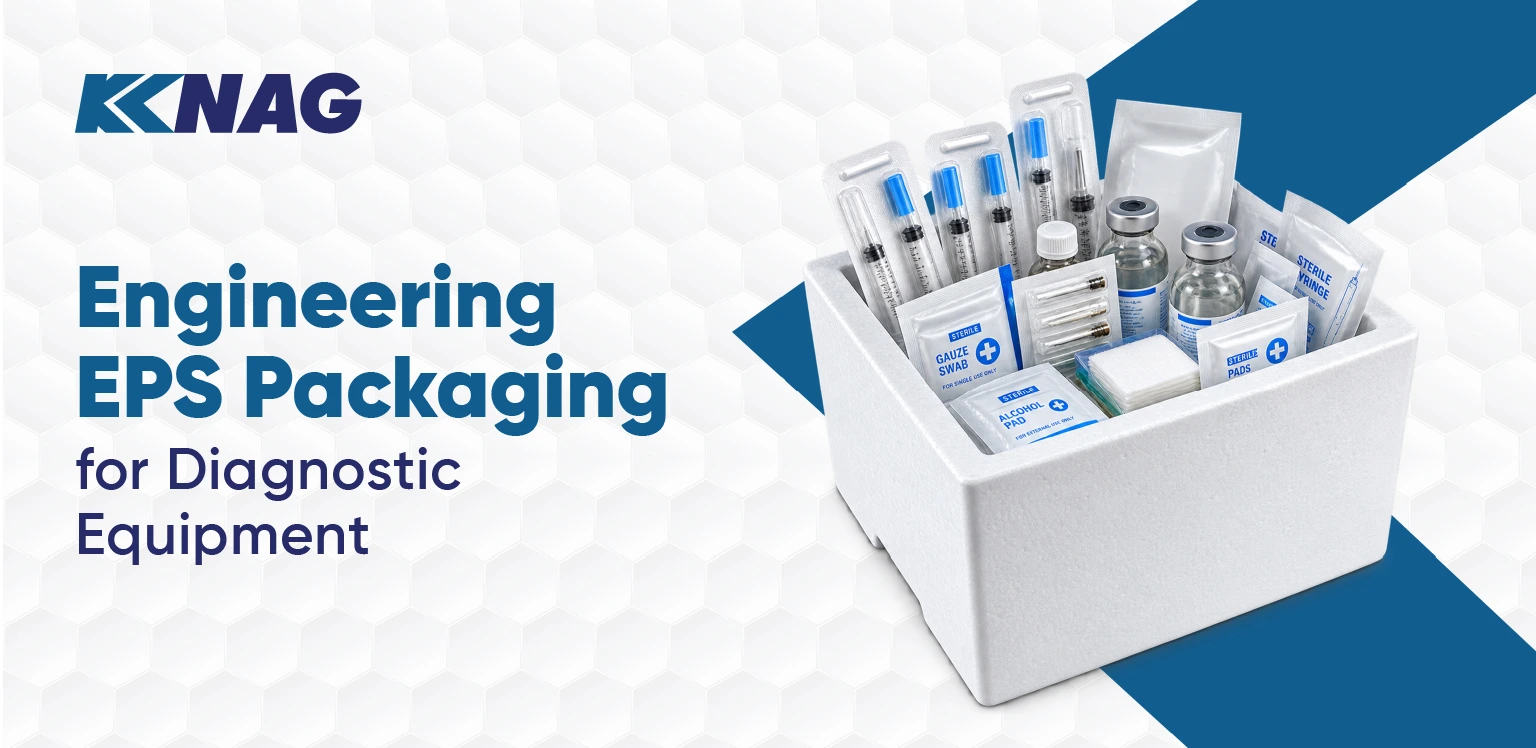
Custom EPS packaging protects sensitive diagnostic equipment from shock, vibration and temperature changes in transit. Precision-moulded cushioning, thermal insulation and secure positioning keep lightweight medical devices safe.
When shipping delicate diagnostic equipment or sensitive lab instruments, failure during transit is simply not an option. These devices represent significant financial investments for hospitals, laboratories and diagnostic centres. More importantly, delayed or damaged equipment halts critical patient care, invalidates diagnostic testing and disrupts clinical workflows.
In transit across global supply chains, medical devices face severe mechanical stress, temperature fluctuations and structural vibration. For hospital procurement teams, pharmaceutical logistics managers and packaging engineers, selecting the correct protective packaging for diagnostics is a critical decision.
Expanded Polystyrene (EPS), commonly referred to as Thermocole in India, is widely used for protective packaging applications.
This blog explores the technical nuances of custom EPS packaging for medical devices, examining how advanced polymer engineering preserves dimensional accuracy and regulatory compliance across complex healthcare supply chains.
Table of Contents
- 01. What is EPS?
- 02. What Value Does EPS Packaging Bring to Diagnostic Logistics?
- 03. Packaging Value Matrix for Key Healthcare Stakeholders
- 04. Meeting Strict Healthcare and Regulatory Compliance Standards
- 05. Advanced Polymer Packaging Solutions By K. K. Nag
- 06. Sustainability in Focus: Leading Circular Packaging
- 07. Conclusion
What is EPS?
EPS is a rigid, lightweight, closed-cell foam plastic. It is produced by expanding solid polystyrene beads containing pentane as a blowing agent, using steam to inflate the beads up to 40 to 50 times their original volume.
EPS is widely used across industries, from protective packaging for consumer electronics and home appliances to structural thermal insulation in construction, geofoam in civil engineering, safety helmet liners and pharmaceutical packaging.
What Value Does EPS Packaging Bring to Diagnostic Logistics?
Diagnostic equipment differs fundamentally from standard commercial electronics. A single industrial analyser can integrate delicate components such as micro-optics, sensitive circuitry and precision-calibrated modules, each vulnerable to shock and vibration during transit.
When these instruments are moved through freight hubs and regional distribution networks, they encounter three primary physical threats:
- Transient Impact Drops: Manual handling, forklift manoeuvres and loading dock drops generate severe kinetic shock pulses. Unprotected optical systems may be susceptible to alignment changes under significant shock loads.
- Continuous Transit Vibration: Truck and air-freight vibration can contribute to structural fatigue, loosening of internal components and damage to sensitive connections when the packaging system is not adequately designed for the distribution environment.
- Structural Displacement: If a packaging enclosure deforms or permits internal movement, the device can collide with the outer container wall, leading to cosmetic damage or complete mechanical failure.
To counter these risks, packaging manufacturers must deploy shock-absorbing packaging materials engineered to absorb and dissipate kinetic forces before they reach the payload. EPS can provide a useful combination of cushioning, low weight, thermal insulation and design flexibility for selected diagnostic equipment packaging applications.
Superior Shock Protection
The unique structure of EPS provides exceptional mechanical protection for laboratory equipment packaging.
When a package experiences an impact, the closed-cell structure absorbs energy primarily through the buckling and plastic deformation of the polystyrene cell walls. This progressive cell-wall collapse spreads the impact load over a longer duration and a larger surface area, reducing the peak force transmitted to the packaged device.
Precision-engineered Load Bearing
High-density EPS maintains a high strength-to-weight ratio, allowing it to bear significant loads without excessive compression. Packaging designers can fine-tune the density of EPS to match the specific mass and drop-test requirements of a particular device, ensuring optimal protection without adding unnecessary weight.
Dimensional Accuracy and Custom Contour Moulding
In healthcare packaging solutions, a generic “one-size-fits-all” approach is inadequate. Generic foam inserts or loose-fill materials allow machinery to shift during transit, leading to internal collision or surface abrasion.
EPS can be shaped to match complex contours, external ports, optical nozzles and glass displays. By holding the device securely in place, custom EPS inserts significantly reduce internal movement and help minimise load stresses on fragile components.
Because EPS is predominantly composed of air, it adds minimal weight to diagnostic machinery, helping keep air-freight and courier shipping costs down.
Cold-Chain Integrity and Hygiene Control
While physical protection is essential, healthcare supply chains also demand strict environmental and biological controls.
Thermal Insulation for Sensitive Calibration
Many diagnostic systems incorporate delicate thermal sensors, liquid-handling pathways or integrated reagent packs that can be affected by extreme temperatures. Because EPS consists largely of trapped air, it has low thermal conductivity. This helps buffer sensitive internal components against ambient temperature spikes during tarmac handling or warehouse storage.
Clean Handling and Hygienic Standards
Medical environments demand high hygiene standards. EPS is generally chemically inert, non-toxic, odourless and non-hygroscopic, though properties can vary by grade and formulation. It naturally resists moisture ingress, helping prevent mould and fungal growth. For electronic diagnostic instruments vulnerable to electrostatic discharge (ESD), packaging engineers can utilise specialised anti-static EPS formulations designed to safely dissipate static charges, in line with ESD-protective packaging standards such as IEC 61340-5-3.
Packaging Value Matrix for Key Healthcare Stakeholders
| Target Audience | Primary Operational Priority | How Custom EPS Packaging Delivers |
| Hospitals and Lab Managers | Immediate device availability; zero downtime upon delivery. | Helps preserve calibration and supports readiness for deployment on arrival. |
| Biomedical Engineers | Protection of delicate optics, sensors and microfluidics. | Custom-moulded cavities lock fragile parts in place without structural strain. |
| Pharma and Biotech Logistics | Low freight costs, cold-chain stability. | Extremely lightweight design reduces shipping costs while maintaining thermal protection. |
| Packaging Manufacturers | Manufacturing consistency, scalability and strict QA standards. | Consistent mould tooling ensures dimensionally accurate packaging inserts that integrate smoothly with automated packing lines. |
Meeting Strict Healthcare and Regulatory Compliance Standards
Medical packaging must conform to stringent global healthcare regulations to protect sensitive internal components and maintain sterile laboratory environments. High-grade EPS packaging fulfils key international compliance requirements:
- Transit Durability: Custom-moulded EPS packaging is engineered to absorb shock, impact and vibration during transit, in line with test methods commonly used in the industry such as ISTA and ASTM D4169 protocols.
- Chemical Safety: EPS is generally non-toxic and non-hygroscopic and formulations can be selected to help minimise the risk of chemical contamination on sensitive components. Specific biocompatibility or chemical safety claims should be verified against the applicable regulation for the intended application.
- Environmental and Chemical Restrictions (RoHS and REACH): EPS formulations can be manufactured to be free of heavy metals, substances of very high concern (SVHCs) and ozone-depleting CFCs/HCFCs, supporting compliance with European and global hazardous substance directives.
- Quality and Process Consistency (ISO 9001 / ISO 13485): Quality management systems aligned with ISO 9001:2015 or, where applicable to medical-device applications, ISO 13485:2016 support consistent manufacturing processes, quality controls and regulatory requirements.
Advanced Polymer Packaging Solutions By K. K. Nag
When selecting high-performance, customised protective packaging, choosing an experienced engineering partner is essential. K. K. Nag has established itself as an experienced manufacturer of expanded polymer solutions in India. With over six decades of expertise, we have relentlessly delivered high-performance healthcare packaging solutions.
Operating out of multiple ISO and CII GreenCo-certified facilities, K. K. Nag offers end-to-end capabilities, from in-house design and tooling for custom-moulded diagnostic device packaging to durable, precision-engineered EPS containers.
Sustainability in Focus: Leading Circular Packaging
A common misconception in modern supply-chain management is that EPS packaging is inherently unrecyclable due to its non-biodegradable nature. In reality, EPS is 100% mechanically recyclable and highly efficient from a resource-conservation perspective. As a thermoplastic, EPS can be crushed, densified, melted and re-granulated multiple times without losing its core material properties.
Recognising that the primary challenge with EPS waste is its bulky volume, K. K. Nag built a seamless collection and recycling ecosystem through RecyCole, India’s first structured, large-scale EPS recycling initiative.
The RecyCole initiative has successfully diverted over 1,500 tonnes of EPS waste material away from landfills and prevented more than 12,000 tonnes of greenhouse gas emissions by reprocessing post-industrial and post-consumer EPS packaging back into production loops.
Conclusion
Expanded Polystyrene remains a dependable, cost-effective and highly adaptable material for sensitive equipment packaging. By combining high dynamic cushioning, thermal resistance and precise contour moulding, custom EPS packaging ensures that critical diagnostic instruments arrive at hospitals and laboratories fully calibrated, undamaged and ready to perform life-saving work.
K. K. Nag enables medical equipment manufacturers and pharmaceutical managers to safeguard their products, streamline logistics costs and support transit safety across global healthcare supply chains.
FAQ
Q1. What makes EPS medical packaging suitable for diagnostic equipment?
Ans: EPS medical packaging is lightweight, mouldable and capable of absorbing impact energy, making it suitable for protecting diagnostic equipment during storage and transport. Custom-fit EPS inserts can provide cushioning, separation and stable positioning for sensitive instruments while offering low moisture absorption and thermal insulation.
Q2. How does EPS packaging protect sensitive diagnostic instruments during shipping?
Ans: EPS packaging protects sensitive diagnostic instruments by cushioning them against shock, vibration and compression during handling and transportation. Custom cavities keep components securely positioned, reducing movement and contact that could cause surface damage or affect delicate assemblies.
Q3. What are the key medical device packaging materials used for diagnostic devices?
Ans: Medical device packaging materials vary according to the equipment, handling conditions and regulatory requirements. Common options include EPS, EPP, EPE, corrugated board, plastics and protective films. The material is selected based on cushioning, moisture protection, thermal requirements, cleanliness and the device’s packaging configuration.
Q4. Why do manufacturers prefer EPS medical packaging over other cushioning materials?
Ans: Manufacturers prefer EPS medical packaging because it combines lightweight construction, shock absorption and moisture resistance. Among medical device packaging materials, EPS can be moulded to diagnostic equipment geometry, minimising movement and absorbing impact during transportation.
Q5. How is EPS packaging engineered to meet medical device industry standards?
Ans: EPS packaging is engineered around the device, its transport conditions and applicable packaging requirements. For terminally sterilised medical devices, ISO 11607-1 addresses packaging materials and systems, while ISO 11607-2 covers validation of forming, sealing and assembly processes. Protective packaging must be evaluated according to its intended application.
Q6. What are the packaging requirements for medical devices?
Ans: Medical device packaging requirements depend on the device, sterilisation method, storage conditions and intended distribution environment. For terminally sterilised devices, ISO 11607 addresses material selection, sterile barrier systems and packaging-system performance, including physical protection during storage and transport.
Q7. Can EPS packaging be customized for different types of medical and laboratory equipment?
Ans: Yes. EPS can be moulded or shaped into product-specific cavities to accommodate different equipment geometries, dimensions and protection requirements. Custom designs can support diagnostic instruments, laboratory equipment and other sensitive devices by controlling movement and providing targeted cushioning. K. K. Nag’s custom packaging approach can incorporate application-specific tooling and material optimisation where required.

Featured Blogs
Rotomoulded Septic Tanks and Bio-Toilets for Modern Sanitation
Rotomoulded septic tanks and bio-toilets are seamless, polymer-based sanitation systems engineered through rotational moulding. Used across rural, urban and industrial sites, they replace concrete structures by offering lightweight [...]

How EPP Improves Automotive Acoustics and NVH Performance
Summary: EPP automotive components help manage automotive NVH by reducing vibration transfer, controlling panel resonance, filling cavities and preventing buzz, squeak and rattle. As a lightweight material, EPP [...]

How to Calculate Savings from Switching to Reusable Polymer Solutions
Many businesses compare a disposable box with reusable packaging by looking only at the price of one unit. A corrugated box may appear cheaper than an EPP container [...]
How K. K. Nag Builds Circularity into Polymer Manufacturing
The way manufacturers evaluate polymer products is changing. The question is no longer limited to whether a material can be recycled. Businesses are also considering how long [...]
Get in Touch with Us
We look forward to connecting with you!


