
How Engineering-Led Packaging Makes Industrial Products Export-Ready
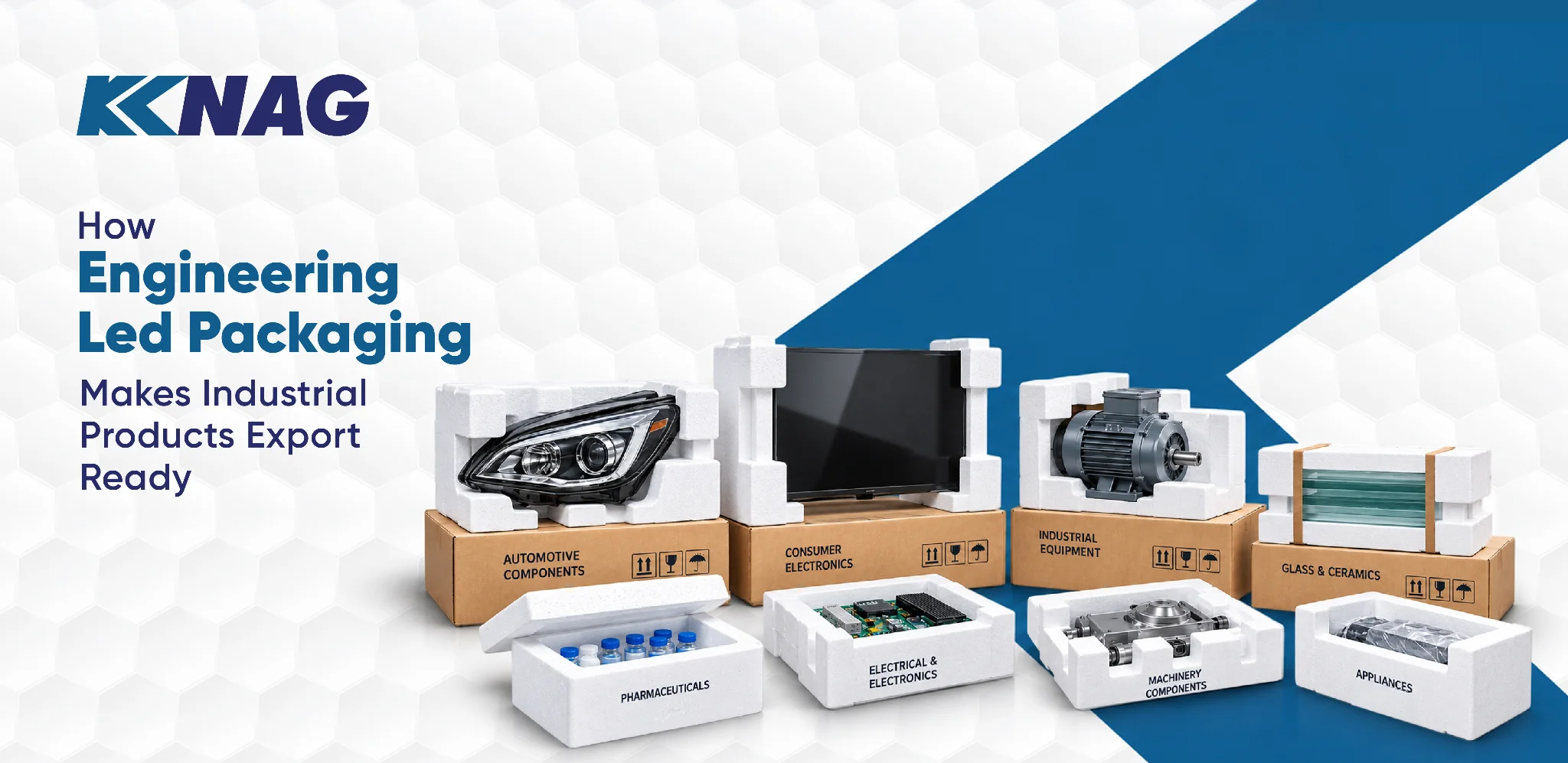
India’s manufacturing sector is becoming progressively export-orientated, with engineering goods remaining the country’s largest merchandise export segment. According to Engineering Export Promotion Council (EEPC India), India’s engineering exports reached USD 116.67 billion in FY 2024–25, pointing to the growing demand for reliable global supply chains and export-quality manufacturing.
For manufacturers of high-value industrial products, export readiness extends far beyond production quality and documentation. Products must also withstand the mechanical, environmental and handling challenges of international shipping without damage, delays or compliance issues.
Thus, industrial protective packaging can become an engineering function rather than a packing activity. Well-designed export packaging solutions help preserve product integrity, improve handling efficiency, support export compliance and provide reliable transit protection across global supply chains.
Table of Contents
- 01. What Makes an Industrial Product Export-Ready
- 02. Why High-Value Products Need Engineered Packaging
- 03. Transit Risks During International Shipping
- 04.Why Customised Packaging Performs Better
- 05. How Custom EPS Packaging Supports Export Movement
- 06. How Custom EPS Packaging Supports Export Movement
- 07. Operational and Sustainability Benefits
- 08. How K. K. Nag Supports Export Packaging
- 09. Conclusion
- 10. FAQs
What Makes an Industrial Product Export-Ready
Export readiness is often associated with customs documentation and regulatory approvals. Still, for precision-engineered products, it also involves preparing them to move safely through warehousing, palletisation, container loading, multimodal transport, port handling and final delivery.
Every transfer exposes products to vibration, impact, compression, humidity fluctuations and repeated handling. According to the U.S. Commercial Service, export packaging should be designed around the shipping environment rather than the product alone, taking into account breakage risks, moisture exposure, pilferage, handling intensity and shipment weight.
Why High-Value Products Need Engineered Packaging
Industrial machinery, automotive components, electrical equipment, medical devices and precision instruments often feature tight dimensional tolerances, delicate finishes and complex assemblies. Even minor transit damage can lead to rejected consignments, production downtime, reverse logistics, warranty claims and costly replacements.
- Repeated vibration during road, rail and sea transport
- Shock loads during loading, unloading and container handling
- Compression from pallet stacking and container loads
- Internal movement causing abrasion and impact damage
- Temperature fluctuations, humidity and condensation
- Dust, contamination and corrosive marine environments
Compared with domestic transport, international shipping involves more handling stages, longer transit durations and greater stacking loads. Purpose-built industrial protective packaging absorbs external forces, restricts product movement and helps reduce damage, assisting exporters in maintaining product quality throughout the logistics journey.
Transit Risks During International Shipping
According to the International Safe Transit Association (ISTA), packaged products experience continuous vibration, repeated shock, compression and environmental changes throughout road, rail, sea and warehouse operations. Packaging should therefore be validated under simulated transport conditions before commercial deployment. Common transit risks include:
- Repeated vibration during road, rail and sea transport
- Shock loads during loading, unloading and container handling
- Compression from pallet stacking and container loads
- Internal movement causing abrasion and impact damage
- Temperature fluctuations, humidity and condensation
- Dust, contamination and corrosive marine environments
When clearance exists inside a package, vibration creates repeated friction and impact between the product and the packaging. Engineering-led customised packaging minimises unnecessary movement, providing superior transit protection and reducing cosmetic as well as functional damage.
Why Customised Packaging Performs Better
Unlike standard packaging, customised packaging is engineered around the product’s geometry, centre of gravity, weight distribution and logistics route. This approach immobilises the product, distributes loads more evenly and reduces impact energy transferred during transport.
Effective industrial protective packaging incorporates:
- Product-specific cavity designs for accurate positioning
- Controlled energy absorption to minimise transmitted forces
- Optimised load distribution to eliminate reduce pressure points
- Cushioning density matched to product weight
- Secure restraint to prevent vibration-induced movement
Besides helping reduce damage, right-sized packaging enhances cube utilisation, allowing exporters to maximise container space and lower freight costs.
How Custom EPS Packaging Supports Export Movement Transportation
Custom EPS packaging is widely used for export applications because Expanded Polystyrene (EPS) combines lightweight construction with effective cushioning performance. Its closed-cell structure compresses under impact, dissipating energy before it reaches the packaged product.
EPS also offers:
- High impact absorption
- Dimensional stability
- Low moisture absorption
- Thermal insulation
- Product-specific mouldability
These properties make custom EPS packaging suitable for industrial machinery, automotive parts, electronics, electrical equipment, medical devices, industrial valves and other high-value products requiring reliable transit protection.
Export Compliance and Packaging Validation
Protective packaging must meet both performance and regulatory requirements. Depending on the destination, packaging material and transport mode, exporters may need to comply with specific packaging, handling and shipping requirements.
- ISPM 15 requirements for wooden packaging materials
- ISTA transit testing protocols
- ISO 780 handling symbols
- Product identification, labelling and shipment traceability requirements
Performance validation through drop, vibration, compression and environmental testing helps verify that packaging can withstand real-world international shipping conditions while supporting overall export compliance.
Operational and Sustainability Benefits
Engineering-led industrial protective packaging delivers measurable operational improvements beyond product protection. Better packaging design reduces transit damage, warehouse handling issues, replacement shipments and excess packaging material while improving load stability.
According to McKinsey & Company, packaging optimisation and improved cube utilisation can contribute to significant cost savings, particularly by increasing the amount of product that can be transported per container or truck. For exporters, this translates into improved damage reduction, lower logistics costs and more sustainable supply chain operations.
How K. K. Nag Supports Export Packaging
Powered by 60+ years of manufacturing expertise, K. K. Nag develops customised packaging solutions using EPS and EPP for diverse industrial applications. Its capabilities include in-house tooling, mould development, value engineering, prototype development and build-to-print manufacturing.
Every solution is engineered around product geometry, handling conditions and export requirements to deliver effective transit protection, optimise material usage and support reliable international shipping for high-value industrial products.
Conclusion
Export competitiveness depends on more than manufacturing excellence. High-value industrial products must also withstand the mechanical and environmental challenges of global logistics while meeting evolving export compliance requirements.
By combining engineering-led design with custom EPS packaging and application-specific export packaging solutions, manufacturers can reduce transit damage, improve handling efficiency and help products reach global customers safely. With more than six decades of manufacturing expertise, K. K. Nag helps industries develop customised packaging solutions that support reliable exports and long-term supply chain performance.
FAQs
01. What is customised packaging for industrial exports?
Ans: Customised packaging is designed around a product’s size, weight, geometry and transport conditions to provide better transit protection, minimise movement and reduce the risk of damage during international shipping.
02. Why is custom EPS packaging used for export packaging solutions?
Ans: Custom EPS packaging offers effective excellent impact absorption, lightweight construction, moisture resistance and dimensional stability. It can be moulded to securely hold high-value industrial products during export transit.
03. Why is industrial protective packaging important for international shipping?
Ans: Industrial protective packaging safeguards products from shock, vibration, compression, moisture and handling-related damage during transportation. It helps maintain product stability and reduce the risk of damage throughout international shipping and distribution.
04. How does customised packaging support improve export compliance?
Ans: Well-designed customised packaging supports export compliance by accommodating shipping labels, traceability requirements, handling symbols, testing standards and destination-specific packaging regulations.

Featured Blogs
How K. K. Nag Builds Circularity into Polymer Manufacturing
The way manufacturers evaluate polymer products is changing. The question is no longer limited to whether a material can be recycled. Businesses are also considering how long [...]
Returnable EPP Dunnage for Class-A Painted Automotive Parts
Class-A painted automotive parts are the visible surfaces of a vehicle where even minor scratches, scuffs or dents can compromise appearance and perceived quality. Class-A painted automotive parts [...]
How Engineering-Led Packaging Makes Industrial Products Export-Ready
India's manufacturing sector is becoming progressively export-orientated, with engineering goods remaining the country's largest merchandise export segment. According to Engineering Export Promotion Council (EEPC India), India's engineering exports [...]
EPP Dunnage Solutions for High-Value Glass
Summary EPP glass dunnage is a lightweight, reusable packaging solution that protects high-value glass from impact, scratches, edge damage and movement during transport through custom-fit cushioning and separation. [...]
Get in Touch with Us
We look forward to connecting with you!


