
Why D2C and E-Commerce Brands in Germany Are Considering EPP Protective Packaging
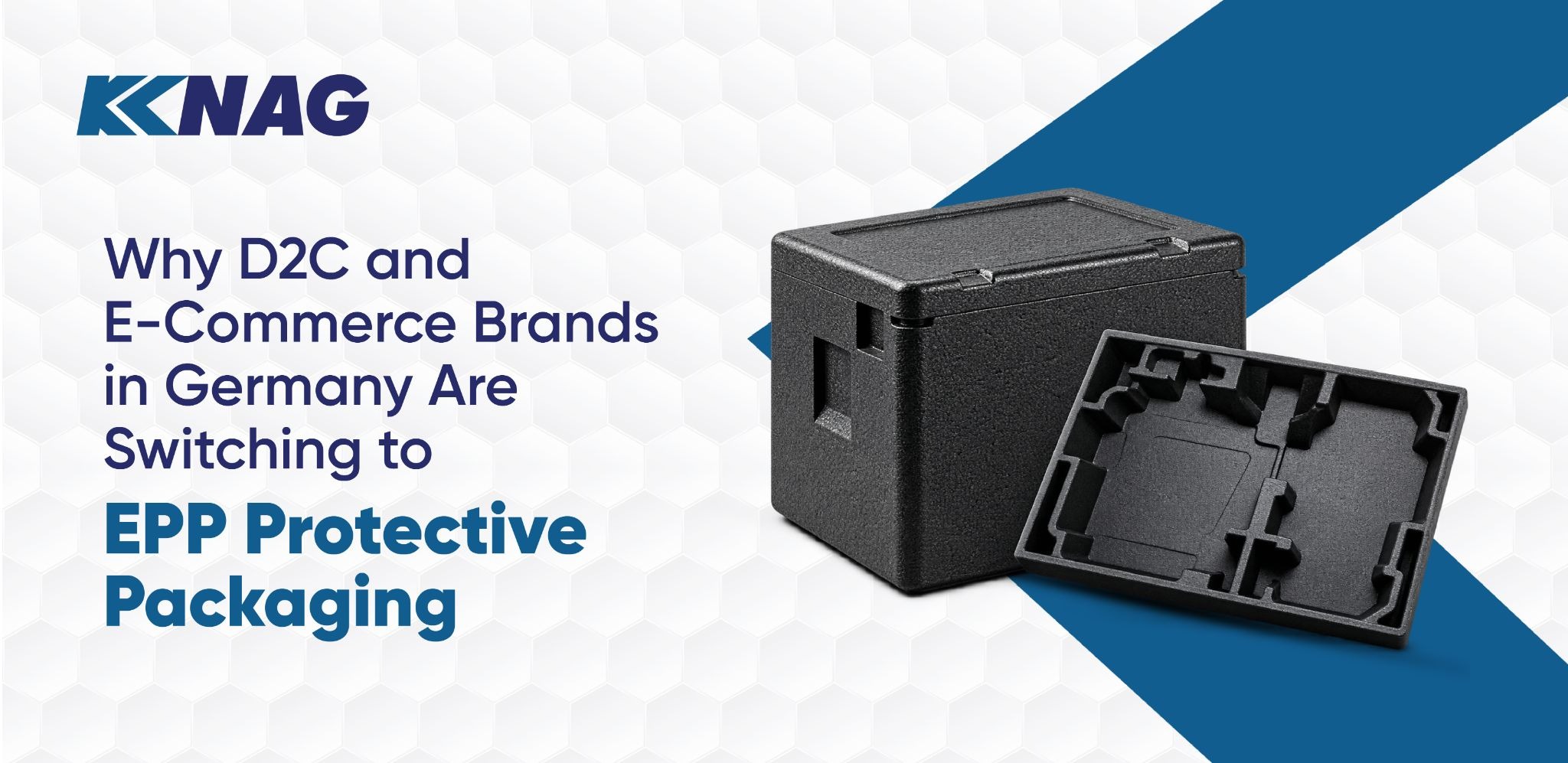
This blog explores how EPP packaging helps German D2C and e-commerce brands reduce product damage, optimise shipping costs and support reuse. It compares EPP with EPS, covers right-sized packaging and German packaging regulations and highlights K. K. Nag’s custom EPP solutions.
A damaged product delivery can quickly turn into a costly setback for e-commerce brands, leading to returns, replacements and additional shipping expenses. Protective packaging is therefore an important part of the fulfilment process.
For Germany’s growing D2C and e-commerce market, choosing the right packaging is important for protecting products during storage, transportation and last-mile delivery.
Expanded Polypropylene (EPP) is gaining attention for its lightweight structure, impact absorption and potential for reuse in e-commerce protective packaging. However, it is not suitable for every application. Comparing its properties with EPS packaging can help businesses identify the right material for their products and distribution needs.
Table of Contents
- 01. Why Protective Packaging Matters for Germany’s D2C Brands
- 02. What Makes EPP Suitable for Protective Packaging?
- 03. Can Lightweight EPP Packaging Help Reduce Shipping Costs?
- 04. EPP vs EPS Packaging: Which Is More Suitable for E-Commerce?
- 05. Reusable EPP Packaging for Repeat-Purchase Categories
- 06. How Germany’s Packaging Regulations Influence Material Selection
- 07. When Should D2C Brands Consider EPP Protective Packaging?
- 08. K. K. Nag’s Expertise in Custom EPP Protective Packaging
- 09. Conclusion
- 10. FAQs
Why Protective Packaging Matters for Germany’s D2C Brands
Unlike traditional retail, where customers can inspect products before purchasing, e-commerce brands depend on packaging to protect products throughout the delivery journey.
A parcel may pass through several sorting facilities, conveyor systems and delivery vehicles before reaching its destination. During this process, it can experience vibration, compression, sudden movement and accidental drops.
For products such as electronics, household appliances, premium accessories and specialised consumer goods, inadequate cushioning may result in damaged components or packaging. For D2C brands, the consequences extend beyond replacement costs.
A damaged delivery can affect customer satisfaction, increase reverse-logistics expenses and create additional packaging waste when products need to be reshipped. This makes packaging selection a practical business decision rather than simply a question of choosing the lowest-cost material.
Understanding Last-Mile Damage Risks
Last-mile delivery is the final stage of a product’s journey from a distribution centre to the customer.
While damage can occur at any point in transit, repeated handling and unexpected impacts are important considerations when designing protective packaging. The level of protection required depends on several factors:
- Product weight, dimensions and fragility
- Expected drop heights and handling conditions
- Cushioning material and its density
- Packaging geometry and product fit
- Number of handling and transportation cycles
Rather than assuming one material will prevent damage, brands should evaluate the complete packaging design under representative transit conditions by conducting standardised packaging performance tests, such as ISTA drop, vibration, and compression protocols—to validate real-world protection before mass deployment.
What Makes EPP Suitable for Protective Packaging?
Expanded Polypropylene (EPP) is a closed-cell bead foam manufactured from polypropylene (PP).
During production, expanded polypropylene beads are moulded together to form lightweight components with application-specific shapes and densities.
One of EPP’s useful characteristics is its ability to absorb impact energy and recover from certain levels of deformation. This makes suitable EPP grades relevant for packaging applications involving repeated handling.
For e-commerce businesses, three material characteristics are particularly worth considering.
1. Impact Absorption and Recovery
When a packaged product is dropped or experiences a sudden impact, the cushioning material helps manage the forces transmitted to the product. EPP can absorb impact energy through deformation of its cellular structure. Depending on the grade, density and loading conditions, it may recover sufficiently to provide cushioning during subsequent impacts.
This behaviour can be useful for reusable protective inserts, particularly when products travel through multiple handling cycles. However, cushioning performance must be evaluated against the product’s fragility, expected impact conditions and packaging geometry.
2. Lightweight Construction
EPP has a low-density cellular structure, which allows protective components to be manufactured without adding substantial packaging weight.
This can be valuable for brands shipping products in large volumes, particularly where the existing packaging uses relatively heavy protective materials. The actual weight advantage depends on the alternative material, required cushioning performance and final packaging dimensions.
3. Design Flexibility
EPP can be moulded into customised shapes that support products at selected contact points. For example, a protective insert may be designed to support the corners of an electronic device while maintaining clearance around more sensitive components.
This approach can help control product movement inside the package without relying entirely on loose-fill materials. The geometry must still be validated to ensure the product remains adequately protected during transit.
Can Lightweight EPP Packaging Help Reduce Shipping Costs?
Shipping costs are a major consideration for e-commerce businesses, particularly those dealing with frequent deliveries and returns. A lighter packaging solution may help reduce shipment weight, but the effect on transportation costs depends on how the logistics provider calculates charges.
For example, DHL Express uses volumetric weight when a shipment occupies more space than its actual weight would otherwise suggest. This means that reducing packaging weight alone may not lower shipping costs if the outer dimensions remain unchanged.
EPP may support shipping efficiency when its lightweight structure is combined with a compact packaging design that maintains the required level of product protection.
Why Right-Sized Packaging Matters
Consider a relatively small electronic product placed inside a large carton with several layers of cushioning.
Although the product is protected, the package may occupy more space than necessary.
A customised EPP insert could be designed around the product’s dimensions, providing support at critical areas while helping optimise the overall package layout. Where the redesign reduces external package dimensions, it may also reduce volumetric weight.
However, any potential savings should be assessed against tooling costs, packaging volume, material requirements and the carrier’s actual pricing structure. For brands comparing options, the goal should be to achieve the necessary protection with an efficient combination of material weight and package size.
EPP vs EPS Packaging: Which Is More Suitable for E-Commerce?
Expanded Polystyrene (EPS) and Expanded Polypropylene (EPP) are both lightweight polymer foams used in protective packaging. Although they may appear similar, their behaviour under loading and repeated handling (depending on the application and design) can differ.
EPS packaging is widely used for applications that require effective cushioning, relatively low material weight and economical protective components. EPP is often considered for applications where impact recovery, durability and repeated use are important.
| Factor | EPP (Expanded Polypropylene) | EPS (Expanded Polystyrene) |
|---|---|---|
| Material | Polypropylene (PP) foam | Polystyrene (PS) foam |
| Weight | Lightweight, depending on moulded density | Lightweight, depending on moulded density |
| Impact behaviour | Suitable grades can recover after certain impacts | Offers cushioning but may retain deformation after substantial loading |
| Repeated handling | Can be suitable for reusable packaging | Often selected for single-use protective applications |
| Customisation | Can be moulded into application-specific inserts | Can also be moulded into customised protective shapes |
| Initial cost | May involve higher material or production costs | Can be economical for high-volume protective packaging |
| Recycling | Mechanically recyclable where suitable facilities exist | Mechanically recyclable where suitable facilities exist |
Neither material should be selected on general properties alone. EPS may remain a cost-effective choice for one-way distribution, while EPP may offer benefits when components need to withstand repeated handling or multiple transport cycles.
For manufacturers and packaging engineers, the comparison should consider equivalent protective performance, material density, tooling investment and the expected number of uses.
Reusable EPP Packaging for Repeat-Purchase Categories
For some D2C businesses, the packaging journey does not necessarily end after the first delivery.
Products may be returned for inspection, repair, replacement or refurbishment. Subscription-based services and selected rental or replenishment models may also involve recurring distribution between facilities and customers. These situations create opportunities to evaluate reusable packaging.
EPP’s resilience and ability to withstand repeated handling make it a candidate for protective inserts in certain returnable systems.
For example, a company shipping sensitive electronic equipment between its service centre and customers may benefit from a reusable protective insert designed around the product. Rather than replacing the insert after each journey, the company may be able to reuse it over multiple cycles, provided its condition and protective performance remain acceptable.
However, reuse is not automatically practical for every D2C model. A successful system must consider:
- Whether customers can conveniently return the packaging
- The cost of collecting and transporting empty packaging
- Inspection, cleaning and storage requirements
- The number of achievable reuse cycles
- Packaging loss, damage and replacement rates
For one-way deliveries, reusable EPP packaging may offer limited commercial benefits unless a practical collection and return system is in place.
How Germany’s Packaging Regulations Influence Material Selection
Packaging decisions in Germany are also influenced by European regulations and growing attention to packaging waste.
The European Union’s Packaging and Packaging Waste Regulation (EU) 2025/40 (PPWR) has applied since 12 August 2026 across EU Member States, including Germany. It introduces requirements relating to packaging recyclability, waste prevention, packaging minimisation and reuse in specified applications.
For e-commerce businesses, one important provision concerns excessive packaging and empty space. From the applicable future compliance deadline, certain e-commerce, grouped and transport packaging must meet a maximum empty-space ratio of 50%, subject to the regulation’s methodology and exemptions.
This creates an additional reason for brands to review packaging dimensions and reduce unnecessary space. Custom-moulded EPP inserts may support packaging optimisation where they allow products to be protected within appropriately sized outer packaging. However, using EPP does not automatically make a package compliant with the regulation.
Compliance must be evaluated at the packaging-system level, considering design, material composition, recyclability, labelling and applicable reuse requirements. Similarly, EPP’s ability to be recycled does not guarantee that it will be collected or recycled through every municipal waste stream in Germany. Brands should assess the actual recycling and recovery routes available for their packaging.
When Should D2C Brands Consider EPP Protective Packaging?
EPP may be worth evaluating when the product requires more than basic cushioning.
Applications that could benefit include:
- Sensitive Electronics: Custom-moulded EPP inserts may help limit movement and manage impacts around sensitive components.
- Premium Consumer Products: Products requiring precise positioning during transport may benefit from fitted cushioning designs.
- Returnable Equipment: Businesses shipping tools, devices, or service equipment repeatedly may be able to use EPP protective inserts across multiple journeys.
- Reusable Logistics Packaging: Closed-loop distribution systems may benefit from EPP’s combination of low weight, impact resilience and durability.
However, EPS, corrugated fibreboard, moulded pulp or other protective materials may be more appropriate for certain products and distribution models. The best choice depends on the required protection, total packaging cost, shipping conditions and end-of-life considerations.
K. K. Nag’s Expertise in Custom EPP Protective Packaging
K. K. Nag Private Limited brings over six decades of polymer engineering experience, with its EPP moulding expertise dating back to 1995. As one of the established EPP foam manufacturers in India, the company develops custom-moulded EPP solutions for applications including protective industrial dunnage, automotive components and specialised equipment.
Its capabilities include in-house tooling, mould development, design support and application-specific manufacturing. These services can help businesses develop protective inserts around product dimensions, expected handling conditions and reuse requirements.
K. K. Nag also identifies ISO 9001, ISO 14001, ISO 45001 and IATF 16949 among its quality and management-system accreditations. The applicability of individual certifications should be confirmed against the relevant manufacturing facility and certification scope.
For German businesses finding overseas EPP manufacturing partners, engineering capabilities, documentation, packaging validation, lead times and import logistics should all form part of the supplier assessment.
Conclusion
As Germany’s e-commerce market grows, protective packaging is becoming an important part of product delivery, cost management and customer experience. In closed-loop supply chains and high-value shipments, EPP provides a clear commercial advantage by replacing single-use foam with multi-trip, returnable dunnage that drastically lowers long-term packaging replacement costs and shipping damage rates.
Ultimately, the decision to use EPP should depend on the product’s fragility, shipping conditions, packaging geometry and whether reuse is operationally practical. For brands exploring alternatives to conventional protective packaging, working with experienced manufacturers can help translate these requirements into customised designs.
K. K. Nag supports the development of engineered EPP components for businesses seeking application-specific protective packaging solutions.
Explore K. K. Nag’s EPP manufacturing capabilities or connect with the team to discuss your protective packaging requirements.
FAQs
1. Is EPP Better More Suitable Than EPS for E-Commerce Packaging?
EPP may be suitable for applications requiring repeated impact recovery and reuse, while EPS can be an economical choice for one-way protective packaging. The decision depends on product sensitivity, cushioning requirements, cost and expected handling conditions.
2. Can EPP Packaging Reduce Shipping Costs?
EPP’s lightweight structure may help reduce packaging weight compared with certain heavier alternatives. However, actual shipping savings depend on the final package dimensions, chargeable weight and carrier pricing.
3. Is EPP Packaging Reusable?
EPP protective inserts can be designed for repeated use. The achievable number of cycles depends on material grade, loading, handling conditions and whether a practical return system is available.
4. Is EPP Packaging Recyclable in Germany?
EPP is a thermoplastic foam that can be mechanically recycled using suitable processes. Actual recyclability depends on material contamination, local collection arrangements and access to appropriate recycling facilities.

Featured Blogs
Why D2C and E-Commerce Brands in Germany Are Considering EPP Protective Packaging
This blog explores how EPP packaging helps German D2C and e-commerce brands reduce product damage, optimise shipping costs and support reuse. It compares EPP with EPS, covers [...]
Role of EPP Solutions in Mining and Construction Equipment Cabins
EPP supports mining and construction equipment cabin performance through impact absorption, vibration damping and thermal insulation. Its lightweight structure helps improve operator comfort while supporting noise [...]
HVAC Duct Insulation Solutions: How EPP Supports Energy-Efficient Systems
EPS duct insulation helps reduce heat transfer and support temperature stability in HVAC systems. Its lightweight structure, thermal insulation properties and design flexibility make it a [...]
Rotomoulded Septic Tanks and Bio-Toilets for Modern Sanitation
Rotomoulded septic tanks and bio-toilets offer lightweight, corrosion-resistant solutions for decentralised sanitation. Their seamless polymer construction and adaptable designs make them suitable for wastewater management across [...]
Get in Touch with Us
We look forward to connecting with you!

