
How EPO Supports Lightweight and Durable Drone Component Design
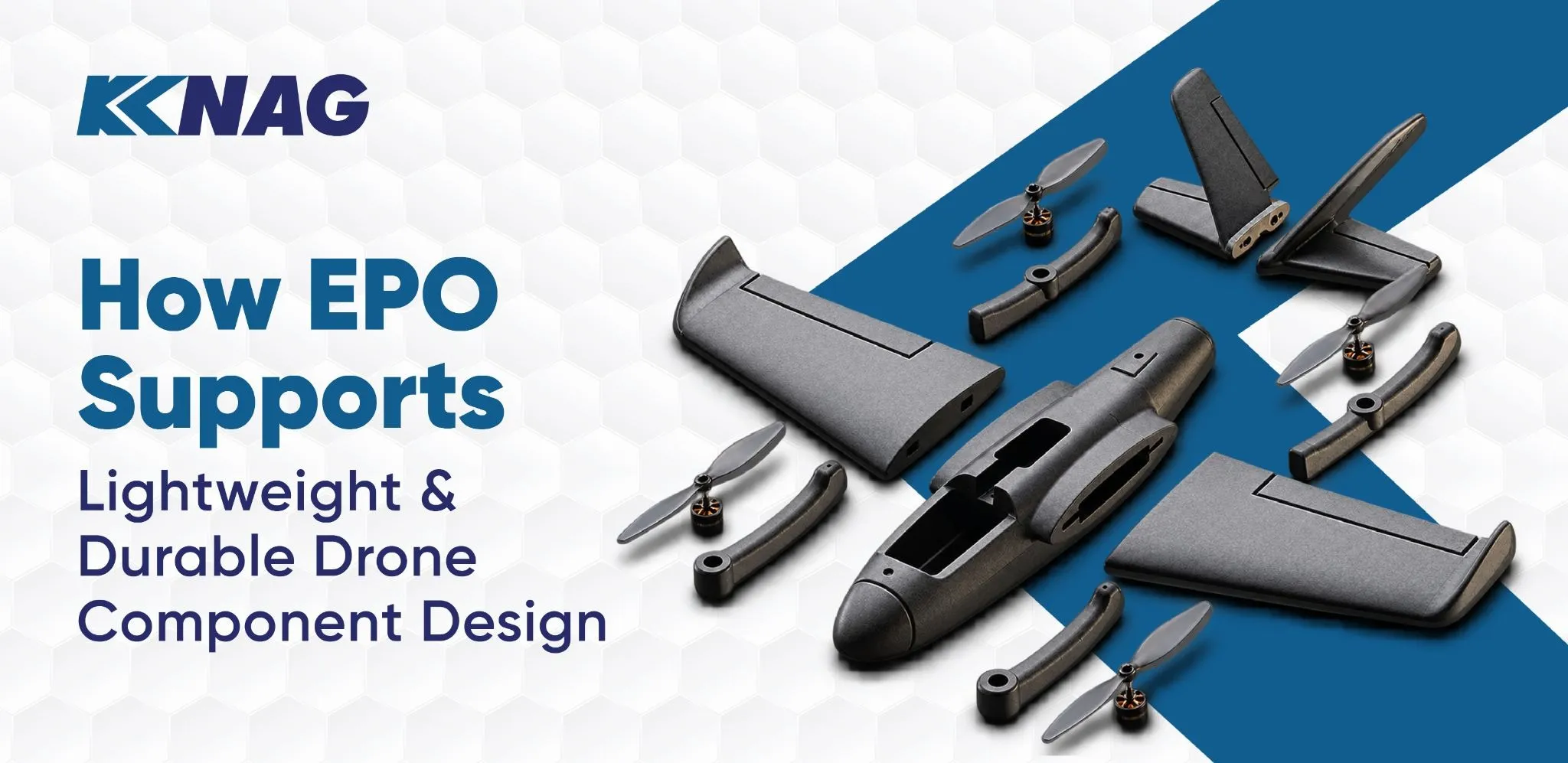
EPO foam can support lightweight drone designs through moulded wing sections, fuselage components and aerodynamic parts. Its formulation-dependent stiffness, impact behaviour and dimensional stability can help manufacturers balance component weight and structural requirements.
Table of Contents
- 01. What Is Expanded Polyolefin (EPO) and How Is It Used in Drone Design?
- 02. Why Lightweight Components Matter in Drone Performance
- 03. How EPO Supports Thin-Section and Structurally Stable Components
- 04. Impact Resistance During Handling, Landing and Operation
- 05. Design Flexibility for Complex Aerodynamic Shapes
- 06. Where Can EPO Be Used in Drone Components?
- 07. Surface Quality and Dimensional Consistency in Moulded EPO Parts
- 08. EPO vs EPP for Drones: Which Material Should Manufacturers Choose?
- 09. Factors to Consider When Selecting Foam for UAV Manufacturing
- 10. K. K. Nag’s Expertise in Custom EPO and EPP Drone Components
- 11. Conclusion
Every gram matters when designing a drone. A heavier airframe can increase the power required for flight, while a lighter structure that lacks sufficient rigidity may struggle to withstand operational loads. For drone manufacturers, finding the right balance between weight, strength and durability is an important part of material selection.
Expanded Polyolefin (EPO) is one material being considered for this balance. Its lightweight cellular structure, mouldability and grade-dependent stiffness make it relevant for certain wings, fuselage sections and other aerodynamic components.
However, using EPO for drones requires more than choosing a lightweight foam. Engineers must also consider component geometry, impact loading, dimensional stability and how the foam integrates with the rest of the airframe.
Understanding these factors helps manufacturers determine where EPO may be suitable and when alternatives such as Expanded Polypropylene (EPP) deserve consideration.
What Is Expanded Polyolefin (EPO) and How Is It Used in Drone Design?
Expanded Polyolefin (EPO) is a term used for certain engineered cellular foam solutions. Commercial EPO products may use different formulations, including hybrid bead-foam systems designed to combine rigidity with impact resistance. Unlike a single, universally defined polymer grade, EPO should be assessed according to the specific material formulation and its technical datasheet.
When evaluating foam materials for drone manufacturing, engineers often consider EPO foam for Unmanned Aerial Vehicle (UAV) applications over conventional foams such as standard Expanded Polystyrene (EPS) because EPS can be brittle and prone to cracking upon impact, while overly flexible foams may deform under aerodynamic loads. Suitable EPO grades bridge this gap by offering higher structural stiffness, smoother moulded surface finishes for reduced drag and greater resilience against handling damage without adding excessive mass.
Through precision EPO foam moulding, these solutions can be shaped into lightweight UAV components that form part of an aircraft’s outer body or aerodynamic structure. Common applications include EPO foam drone wings, drone fuselage materials, nose sections and other custom moulded UAV components where controlling weight and achieving complex geometry are critical.
However, EPO is not necessarily suitable as a standalone load-bearing material. Depending on the airframe design, additional reinforcement or integration with an internal structural frame may be required.
Why Lightweight Components Matter in Drone Performance
Drone performance depends on several interconnected factors, including airframe weight, aerodynamic efficiency, propulsion, battery capacity and payload.
A heavier structure can increase the energy required to maintain flight, particularly when the additional mass does not contribute to payload capacity or structural performance. For battery-powered drones, managing weight is therefore an important design consideration.
Using lightweight drone materials such as suitable EPO grades may help reduce the mass of selected airframe components. However, any potential improvement in flight endurance depends on the overall aircraft configuration.
For example, reducing the weight of a fuselage section may create some additional mass allowance for batteries, sensors or other equipment. Whether this results in longer flight time or greater payload capacity requires aircraft-level evaluation.
The objective is not simply to use the lightest available material but to achieve the required structural and aerodynamic performance at an appropriate weight.
How EPO Supports Thin-Section and Structurally Stable Components
Drone components often include narrow profiles, curved surfaces and sections with limited space for material. Wing edges, body covers and aerodynamic transitions are examples where design flexibility can be important.
Depending on the selected formulation and moulding conditions, EPO can offer useful stiffness for relatively thin moulded sections. This makes it a material worth checking for components where maintaining shape is important alongside reducing weight. However, thin-section performance is influenced by more than foam density. Engineers must consider:
- Minimum mouldable wall thickness
- Local stiffness and loading conditions
- Component geometry and support points
- Material density and bead fusion quality
- Temperature exposure and dimensional changes
For example, a thin wing section may require reinforcement around areas experiencing bending or torsional loads.
A suitable foam grade can contribute to the component’s overall design, but structural stability must be validated under the loads expected during flight and handling.
Impact Resistance During Handling, Landing and Operation
Drone components may experience impacts during transportation, assembly, landing and occasional accidental contact with surrounding objects. These events can place sudden loads on nose sections, wing tips and other exposed parts of the airframe.
Suitable EPO formulations may absorb part of the impact energy through deformation of their cellular structure. This behaviour can help manage impact loads in certain applications, although recovery and damage resistance depend on foam formulation, density, component thickness and impact conditions.
For example, an EPO drone component used in a nose section may be designed to provide cushioning around a particular region of the airframe. However, the foam should not be assumed to protect sensitive electronics or prevent structural damage under all collision conditions.
Repeated impacts, severe loading and environmental exposure can affect performance over time. For manufacturers developing durable drone components, impact testing under representative operating conditions remains essential.
Design Flexibility for Complex Aerodynamic Shapes
Drone airframes often combine curved surfaces, tapered sections and carefully positioned internal features. Producing these shapes reliably can be challenging, particularly when multiple components must fit together accurately.
EPO foam moulding offers flexibility in developing custom drone foam components around specific design requirements. This can be useful for:
- Curved wing profiles and aerodynamic transitions
- Fuselage contours and external covers
- Recesses for selected internal components
- Alignment features and assembly interfaces
- Modular sections designed for replacement
Within an airframe, these custom moulded UAV components serve distinct functional roles. Centre wing bodies house core electronics and join the main lifting surfaces to the fuselage, while nose sections shield forward sensors and absorb impact energy during landing or accidental contact. Wing tips help manage airflow and reduce induced drag at the outer edges, and tail components provide directional stability and flight control.
For example, EPO foam drone wings can be moulded around a defined aerodynamic profile rather than shaped individually from larger foam blocks. While this approach can aid repeatability across production batches when tooling, material formulation and processing parameters are carefully controlled, moulding alone does not automatically guarantee consistent aerodynamic accuracy. Factors such as bead fusion, post-moulding shrinkage and surface texture can still affect airflow, meaning each finished component must be validated for dimensional accuracy, assembly fit and overall aerodynamic performance.
Where Can EPO Be Used in Drone Components?
The suitability of EPO drone parts depends on the type of aircraft and the function of each component.
1. Wings and Wing Sections
Drone wing foam must meet requirements related to weight, geometry and the loads experienced during flight. EPO may be considered for moulded wing sections where relatively thin profiles and defined surface contours are important.
Depending on the wing design, internal spars, composite reinforcement or other structural elements may be needed to provide the required bending and torsional stiffness.
2. Fuselage and Body Sections
Fuselage components can contain electronics, batteries, wiring and mounting interfaces while contributing to the aircraft’s external shape. Drone airframe foam made using suitable EPO formulations may support lightweight body sections and customised internal geometry.
3. Nose Sections and Wing Tips
Nose foams and wing tips are exposed areas that may experience impacts during handling or landing.
Moulded EPO components may provide a combination of lightweight construction and application-specific geometry.
Their impact performance should be evaluated according to the expected operating conditions and the level of protection required.
4. Tail and Other Aerodynamic Components
Tail sections and aerodynamic covers may also benefit from custom-moulded foam construction where the design requires low weight and defined contours.
The chosen material must provide adequate stiffness and dimensional stability for the component’s function.
Surface Quality and Dimensional Consistency in Moulded EPO Parts
The surface of a drone component is not just a visual consideration. Surface geometry, dimensional accuracy and consistency between parts can influence assembly quality and aerodynamic performance.
Moulded EPO may offer advantages over manually shaped foam components when the required geometry can be reproduced using suitable tooling and controlled production conditions.
However, surface finish depends on several factors, including bead size, mould surface, processing conditions and material formulation.
Similarly, dimensional consistency is affected by cooling, shrinkage and the geometry of the moulded part.
For manufacturers developing moulded EPO components, design validation should therefore include dimensional inspection, assembly trials and assessment of the finished surface.
Where higher surface accuracy is required, additional finishing or alternative construction methods may need to be considered.
EPO vs EPP for Drones: Which Material Should Manufacturers Choose?
Expanded Polyolefin (EPO) and Expanded Polypropylene (EPP) are both evaluated among foam materials for drone manufacturing, though they should not be treated as interchangeable solutions. EPP is a polypropylene-based bead foam commonly associated with impact energy absorption and recovery under repeated loading conditions. Depending on its formulation, EPO may offer a different balance of stiffness, rigidity and surface characteristics for lightweight UAV components.
The comparison below outlines general design considerations when evaluating both options for custom drone foam components. Actual performance depends on the specific material grade, foam density, component geometry and processing conditions.
| Factor | EPO | EPP |
|---|---|---|
| Material composition | Formulation-dependent expanded polyolefin or hybrid foam | Expanded polypropylene (PP) |
| Weight | Lightweight, depending on grade and density | Lightweight, depending on grade and density |
| Stiffness | Certain grades may be suitable where greater rigidity is required | Depends on grade, density and part design |
| Impact behaviour | Can absorb impacts, with recovery dependent on formulation | Suitable grades can offer repeated impact recovery |
| Thin-section moulding | May be considered for defined thin profiles, subject to processing limits | Possible with suitable grades, geometry and moulding processes |
| Surface finish | Depends on bead structure, tooling and processing | Depends on bead structure, tooling and processing |
| Typical design consideration | Geometry, stiffness and dimensional requirements | Impact resilience and repeated handling requirements |
For example, a drone manufacturer developing EPO foam drone wings or thin aerodynamic profiles may assess EPO foam for UAV applications where stiffness and shape retention are priorities. Another manufacturer building a training platform exposed to frequent landing impacts may prefer to evaluate EPP for its potential in repeated energy absorption.
However, these points serve as application-based guidelines rather than universal rules. The final selection for custom moulded UAV components should always be validated through grade-specific testing, structural design requirements and expected service conditions.
Factors to Consider When Selecting Foam for UAV Manufacturing
Choosing foam for UAV manufacturing involves evaluating how the material performs as part of the complete airframe.
Some important selection criteria include:
- Density and Component Weight: The foam should support the aircraft’s mass requirements without compromising necessary performance.
- Stiffness and Structural Support: Thin or load-bearing sections may require specific grades, geometry changes or reinforcement.
- Impact Resistance: The material should be assessed for expected landing, handling and accidental impact environmental exposure conditions.
- Dimensional Stability: Components must maintain acceptable fit and shape under anticipated temperature and loading conditions.
- Surface Requirements: Aerodynamic surfaces may require defined tolerances, moulded finish and additional quality checks.
- Tooling and Production Volume: Custom moulding should be evaluated against development cost, production requirements and design complexity.
- Environmental Exposure: Outdoor operation may require consideration of UV exposure, moisture, chemicals and temperature variations.
These factors are particularly important when developing custom drone components, as the requirements of a training UAV can differ significantly from those of a commercial inspection or delivery platform.
K. K. Nag’s Expertise in Custom EPO and EPO Foam Wings
With over 60 years of experience in polymer engineering, K. K. Nag Private Limited develops customised moulded foam components for industrial applications, including UAVs and drones. Our drone component portfolio includes centre wing bodies, nose foams, fuselage sections, wing tips, tail foams and boom foams, manufactured using EPP and EPO materials. We support drone manufacturers with in-house tooling, mould development, prototyping and application-specific production capabilities.
These capabilities are particularly valuable for components requiring customised geometry, integration with surrounding airframe structures and repeatable production.
To illustrate our tooling and process capabilities in drone component manufacturing, we previously developed a complex Expanded Polypropylene (EPP) nose foam using specialised mould tooling and multiple development trials. It is important to note that this specific project was executed using EPP rather than Expanded Polyolefin (EPO). While this case study demonstrates our hands-on experience in overcoming complex geometry and shrinkage challenges with EPP, the underlying mould engineering, prototyping and trial validation processes directly translate to custom EPO component development. For manufacturers exploring EPO specifically, we work closely with your engineering teams to confirm suitable EPO material grades, dimensional tolerances, validation methods and production feasibility before moving into full-scale tooling.
Conclusion
EPO offers a material option for drone manufacturers seeking to balance lightweight construction, moulded geometry and application-specific durability. Its suitability is particularly worth evaluating for wings, fuselage sections and other aerodynamic components where component shape and weight are important.
However, material selection must consider more than density alone. Stiffness, impact behaviour, dimensional stability, reinforcement requirements and actual operating conditions all influence performance.
For manufacturers developing UAV foam components, working with an experienced moulding partner can help translate these requirements into production-ready designs.
K. K. Nag supports the development of customised EPO and EPP foam components for drone applications through its engineering and manufacturing capabilities.
Explore K. K. Nag’s drone component capabilities or connect with the team to discuss your custom EPO and EPP requirements.
FAQs
1. Can EPO Be Used for Lightweight Drone Wings?
Yes, EPO can be considered for moulded wing components. However, structural requirements may call for additional reinforcement, particularly where bending and torsional loads are significant.
2. Can EPO Drone Components Be Custom Moulded?
Yes. Custom moulding can produce application-specific shapes, recesses and assembly features. The achievable geometry and tolerances depend on the formulation, tooling and manufacturing process.
3. What Factors Affect the Performance of EPO Drone Components?
Component performance depends on the selected material grade, foam density and part geometry, alongside whether internal reinforcement is integrated into load-bearing sections. Processing conditions during moulding and exposure to operating environments such as temperature shifts, moisture and ultraviolet (UV) light also directly influence structural stability.
4. Can EPO Foam Be Used in Commercial UAV Applications?
Yes, Expanded Polyolefin (EPO) can be considered for commercial Unmanned Aerial Vehicle (UAV) platforms, though suitability depends on the overall aircraft design and the specific function of the component. Manufacturers must assess structural load requirements and confirm performance through representative testing and validation results.
5. What Is the Difference Between EPO Foam and Conventional Foam for Drone Manufacturing?
Expanded Polyolefin (EPO) typically refers to engineered or hybrid bead-foam formulations designed to balance rigidity, surface quality and impact resistance, whereas conventional foams such as standard Expanded Polystyrene (EPS) may exhibit different brittleness or stiffness profiles. However, exact performance differences vary by formulation and should only be compared using specific material grades and verified technical datasheets.

Featured Blogs
How EPO Supports Lightweight and Durable Drone Component Design
EPO foam can support lightweight drone designs through moulded wing sections, fuselage components and aerodynamic parts. Its formulation-dependent stiffness, impact behaviour and dimensional stability can help manufacturers [...]
Why D2C and E-Commerce Brands in Germany Are Considering EPP Protective Packaging
This blog explores how EPP packaging helps German D2C and e-commerce brands reduce product damage, optimise shipping costs and support reuse. It compares EPP with EPS, [...]

Role of EPP Solutions in Mining and Construction Equipment Cabins
EPP supports mining and construction equipment cabin performance through impact absorption, vibration damping and thermal insulation. Its lightweight structure helps improve operator comfort while supporting noise [...]
HVAC Duct Insulation Solutions: How EPP Supports Energy-Efficient Systems
EPS duct insulation helps reduce heat transfer and support temperature stability in HVAC systems. Its lightweight structure, thermal insulation properties and design flexibility make it a [...]
Get in Touch with Us
We look forward to connecting with you!

