
Bharat NCAP’s Impact on Bumper and Door Panel Materials
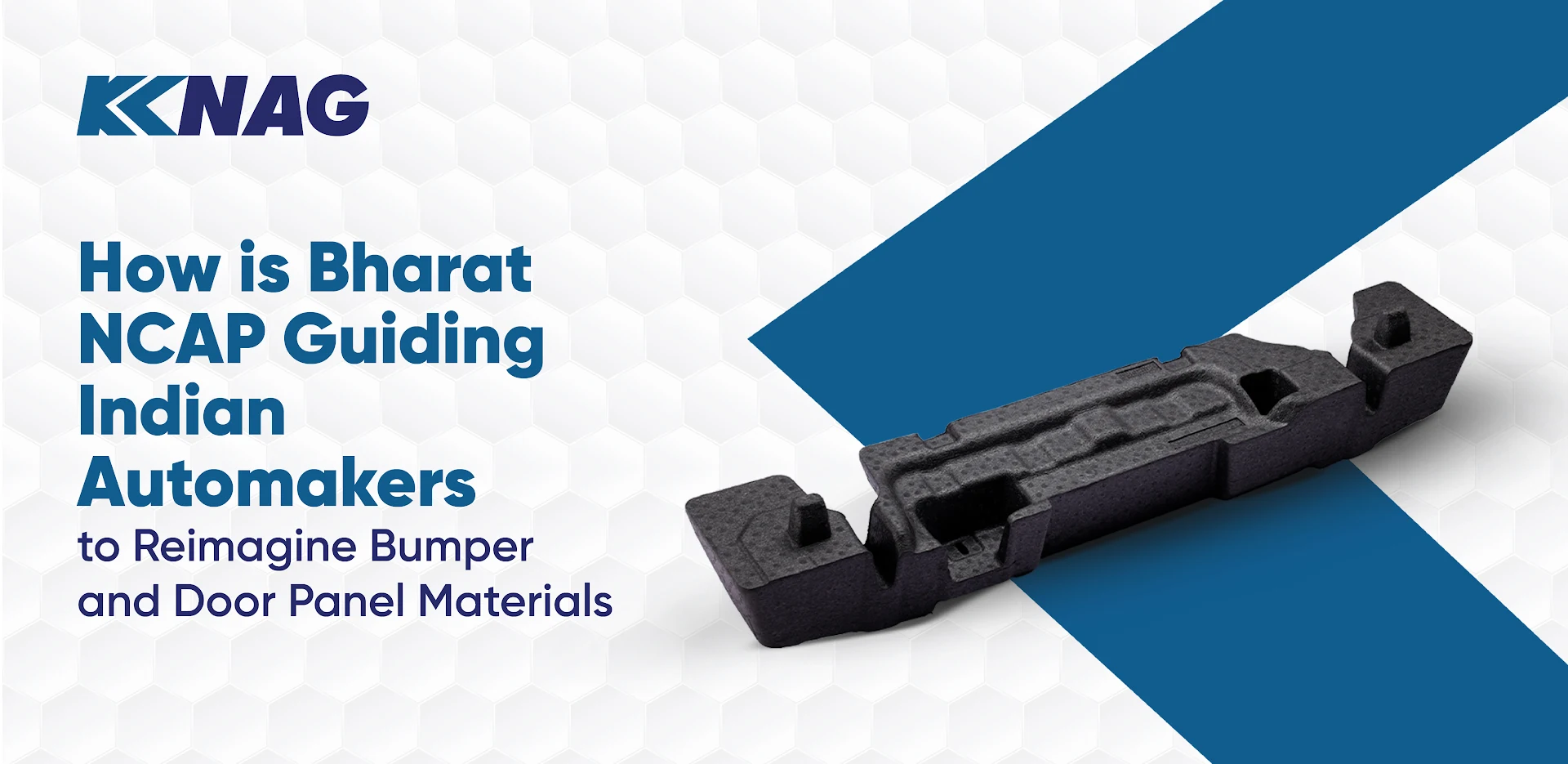
The New Car Assessment Program or Bharat NCAP was launched in 2023 by the Ministry of Road Transport and Highways, marking an important shift for Indian automotive manufacturing. The programme is based on Automotive Industry Standard-197 (AIS-197) and evaluates passenger vehicles through standardised crash tests for adult occupant protection, child occupant protection and safety assist technologies.
This has triggered a change in how Original Equipment Manufacturers (OEMs), Tier 1 suppliers and every automotive components manufacturer in the Indian supply chain evaluate safety-related materials. Bumpers, door panel inserts, side impact zones and energy absorbers now need to support defined crash performance expectations, not only cost, fitment and packaging goals.
Expanded Polypropylene foam (EPP) has emerged as a relevant solution in this case. Its low density, energy absorption, shape recovery and moulding flexibility make it suitable for automotive parts where impact management and lightweighting are both important.
This article explains:
- What Bharat NCAP star ratings mean for OEM material choices
- How EPP energy absorbers in bumpers support adult occupant protection
- The role of AIS-098 and AIS-100 in safety discussions
- How Tier 1 suppliers in Pune and Chennai can switch material specifications
Table of Contents
- 01. Bharat NCAP Crash Testing Standards: An Overview
- 02. What do Bharat NCAP Star Ratings Mean?
- 03. How EPP Energy Absorbers Improve Adult Occupant Protection Scores
- 04. AIS-098 and AIS-100: Pedestrian Safety Standards & EPP’s Role
- 05. How Tier-1 Suppliers in Pune and Chennai Can Switch Material Specifications
- 06. Where Automotive Safety and Material Innovation Meet
Bharat NCAP Crash Testing Standards: An Overview
Bharat NCAP uses AIS-197 as the standard for evaluating vehicle crash safety. The programme applies to M1 category vehicles with a gross vehicle weight of less than or equal to 3,500 kg. The tests include:
| Crash Test | Test Speed | Safety Relevance |
| Offset Deformable Barrier frontal impact test | 64 km/h | Assesses frontal crash performance |
| Mobile Deformable Barrier side impact test | 50 km/h | Assesses side impact protection |
| Pole side impact test | 29 km/h | Assesses localised side impact protection |
These tests make material selection more critical. Front-end structures, bumper cores and door assemblies must help absorb and distribute impact energy in a controlled manner.
Key Insight: Bharat NCAP does not rate materials directly. It rates vehicle safety performance. However, the materials used in impact zones can influence how effectively a vehicle manages crash energy.
What do Bharat NCAP Star Ratings Mean?
AIS-197 defines minimum qualifying points for star ratings under Adult Occupant Protection and Child Occupant Protection. The maximum available score is 32 points for Adult Occupant Protection and 49 points for Child Occupant Protection. The system works as follows:
| Star Rating | Minimum Adult Occupant Score | Minimum Child Occupant Score | Material Selection Implication |
| 1 Star | 4 / 32 | 9 / 49 | Basic compliance-led design |
| 2 Stars | 10 / 32 | 18 / 49 | Improved structural and restraint performance |
| 3 Stars | 16 / 32 | 27 / 49 | Better energy management in crash zones |
| 4 Stars | 22 / 32 | 35 / 49 | Stronger focus on controlled deformation |
| 5 Stars | 27 / 32 | 41 / 49 | Advanced crash protection with safety assist qualifiers |
For OEMs, these thresholds make safety engineering more measurable. For suppliers, there is a stronger need to offer parts that support crash performance, weight reduction and repeatable production quality.
How EPP Energy Absorbers Improve Adult Occupant Protection Scores
Adult occupant protection scores under Bharat NCAP are heavily influenced by how effectively a vehicle manages crash energy before it reaches the passenger compartment. During frontal, side and pole impacts, components such as bumper absorbers, door inserts, knee bolsters and interior energy-management structures help reduce the forces transmitted to occupants. Better energy absorption can contribute to lower injury measurements recorded by crash test dummies, which in turn supports stronger Adult Occupant Protection (AOP) performance.
Expanded polypropylene (EPP) foam is widely used in these applications because it combines low weight with excellent energy absorption characteristics. Unlike many rigid materials that transfer a larger portion of impact energy, EPP is designed to compress under load and dissipate energy through its cellular structure. An additional advantage is its ability to recover much of its original shape after lower-severity impacts, making it suitable for components that may experience repeated loading events during vehicle use.
From an engineering perspective, EPP offers a combination of properties that make it attractive for crash-management systems. Its density can be tailored to meet specific performance targets, allowing designers to balance weight reduction with energy absorption requirements. This flexibility enables manufacturers to create moulded components that fit complex vehicle geometries while maintaining consistent protective performance.
AIS-098 and AIS-100: Pedestrian Safety Standards & EPP’s Role
AIS-197 encompasses several standards that contribute to vehicle safety evaluation. These include AIS-098 and AIS-100.
AIS-098 specifies the test procedures and performance requirements for occupant protection in offset frontal impact crashes. The standard evaluates how well a vehicle’s structure absorbs and distributes crash energy. It also assesses the effectiveness of restraint systems such as seat belts and airbags in reducing the risk of injury to occupants.
AIS-100 focuses on pedestrian protection and establishes requirements aimed at reducing injuries to pedestrians and other vulnerable road users in the event of a collision. This standard assesses the design of vehicle front-end components, including the bumper, bonnet, and windshield area, to minimise the severity of impact-related injuries.
In the context of pedestrian and vulnerable road user protection, EPP can support front-end design objectives through:
- Softer impact management behind bumper fascia
- Controlled deformation in impact-prone zones
- Lightweight front-end packaging flexibility
- Reduced reliance on heavy cushioning structures
- Better suitability for complex moulded absorber shapes
How Tier-1 Suppliers in Pune and Chennai Can Switch Material Specifications
Pune and Chennai are two of India’s most significant automotive manufacturing hubs. Suppliers in these regions are likely to see growing demand for materials that support Bharat NCAP-aligned vehicle programmes.
A practical switch to EPP-based parts can follow this path:
- Identify bumper, door and side impact parts where energy absorption is required.
- Compare existing material performance against OEM safety and weight targets.
- Define density, geometry, fitment and compression behaviour requirements.
- Develop prototype parts for vehicle packaging and assembly checks.
- Validate tooling, cycle time and repeatable moulding feasibility.
- Align the final part specification with OEM crash performance targets.
Early involvement is important. When EPP is considered during the design stage, suppliers can optimise geometry, moulding feasibility, assembly fitment and material usage together.
Where Automotive Safety and Material Innovation Meet
Bharat NCAP is pushing Indian automakers to look more closely at bumper and door panel materials. The rating system has made crash performance more visible, which means material choices in impact zones now carry greater engineering importance.
As safety expectations rise, experienced EPP foam manufacturers in India will play a stronger role in helping suppliers move from basic part supply to performance-led component development.
With 30+ years of polymer processing experience, K. K. Nag brings deep expertise in expanded polypropylene foam. Leveraging our strong moulding knowledge, we provide customised solutions to support OEMs and supplying partners seeking reliable, performance-focused polymer solutions.
Get in touch to learn more about our EPP solutions or visit https://kknag.com/.
Featured Blogs
EPP Dunnage Solutions for High-Value Glass
Glass is one of the most demanding materials to transport. Whether it is an automotive windshield with embedded sensors, a large-format façade panel destined for a high-rise, a [...]
Rotomoulded Floating Barriers for Marine and Inland Water Applications
Floating barriers are used across ports, marinas, reservoirs and industrial facilities to mark restricted zones, separate operational areas and manage floating debris. However, the conditions in these environments [...]
The Role of EPS Trays in Plant Tissue Culture and Agri-Biotech
Plant tissue culture and agri-biotech laboratories across India operate under exacting operational parameters. Micropropagation demands stringent contamination control, precise moisture management and root-zone thermal isolation. Traditional nursery [...]
Engineering EPS Packaging for Diagnostic Equipment
When shipping delicate diagnostic equipment or sensitive lab instruments, failure during transit is simply not an option. These devices represent significant financial investments for hospitals, laboratories and diagnostic [...]
Get in Touch with Us
We look forward to connecting with you!


