
How K.K. Nag’s In-House Mould Making Capability Gives B2B Business a Speed and Cost Advantage
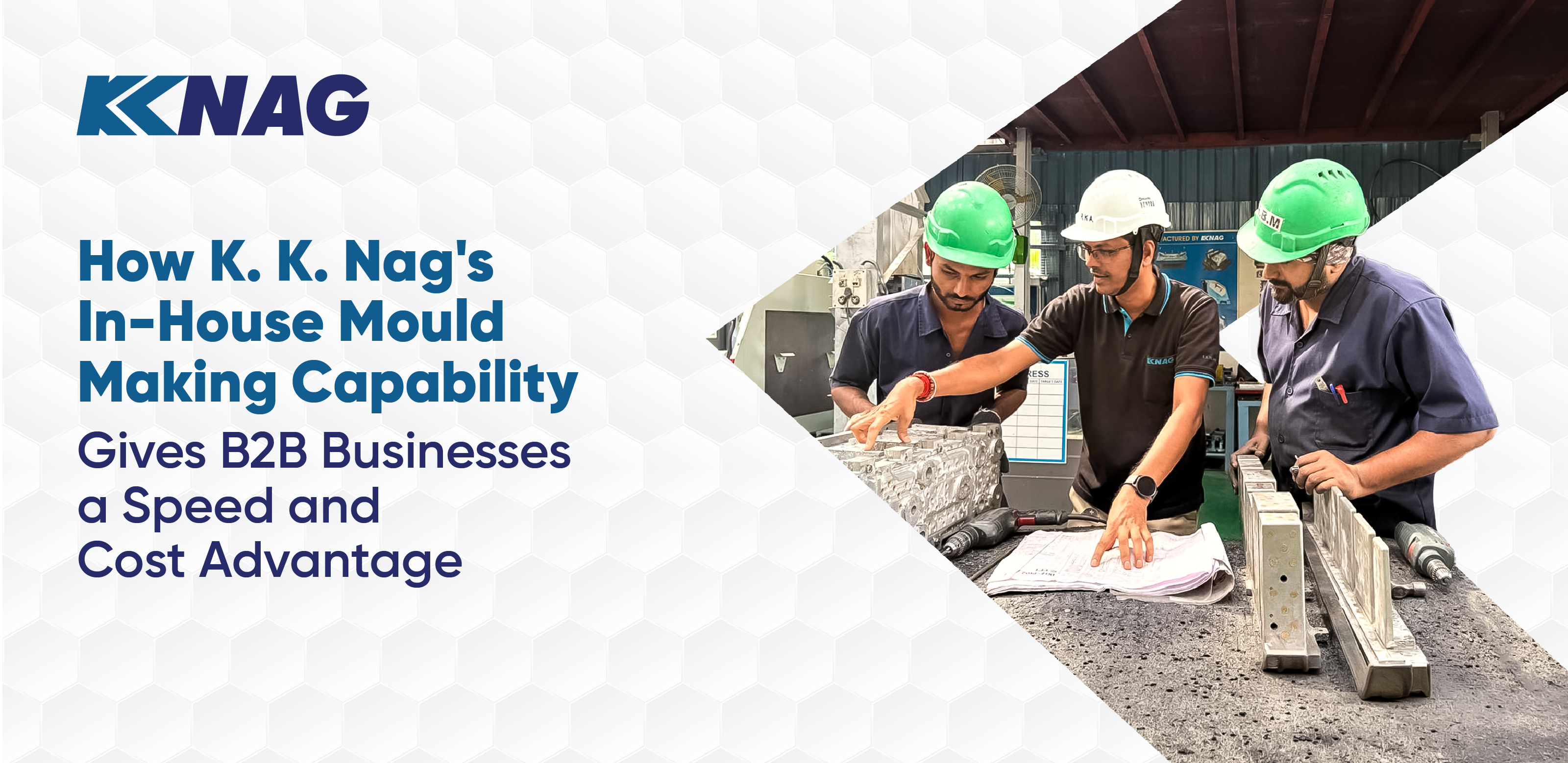
In B2B manufacturing, the real cost of outsourced tooling rarely shows up on a single invoice. It appears in delayed revisions, misaligned samples, longer approval cycles and the friction between design and production. This is why in-house mould making capability, spanning tool development, prototyping and production support, is becoming a more important factor for businesses sourcing customised polymer engineered products across EPP, EPS and Rotomoulding applications.
Table of Contents
- 01. Why In-House Mould Making Matters
- 02. What Outsourced Mould Making Often Costs B2B Businesses
- 03. How K. K. Nag Moves from Design to Production Faster
- 04. Why IP Protection Improves with In-House Tooling
- 05. Where the Advantage Applies Across EPP, EPS and Rotomoulding
- 06. Case Study Signals from Real Projects
- 07. Conclusion
Why In-House Mould Making Matters
In B2B manufacturing, speed is rarely won at the final production stage. It is won much earlier, when design, tooling and production move as one system.
When mould development sits outside the manufacturer’s control, product timelines can stretch, revisions can slow down and workflow disconnects can affect final output. For businesses working with polymer engineered products, that delay can influence launch readiness, working capital and customer commitments.
In practical terms, this capability includes in-house tool development, prototype support, mould refinement and production-linked troubleshooting. It also provides engineering input on feasibility, dimensional accuracy, insert placement, wall behaviour and manufacturability, helping customers move from concept to dependable production with stronger control.
For K. K. Nag, this matters across customised packaging, EPP applications, EPS solutions and Rotational moulding products, where geometry, wall behaviour, inserts, fit and repeatability all depend on tooling quality from the very beginning. The in-house Tool Room supports mould design, rapid modifications, prototyping support, production tooling, maintenance and optimisation, as well as application-specific tooling development. This allows product requirements to be addressed with stronger control at every stage, from early design decisions to stable production output.
What Outsourced Mould Making Often Costs B2B Businesses
Many manufacturers outsource mould making to reduce infrastructure investment.
They do not need to invest in full tooling capability, specialised teams or tool-room management. On paper, that can seem efficient. In practice, the cost often shifts to the customer.
The first cost is time. When mould making is outsourced, each design change usually travels through another layer of coordination. That means more waiting for drawings, approvals, prototype feedback and tooling modifications. A change that could have been discussed across one team often becomes a multi-step vendor loop.
The second cost is alignment. An external tool maker may deliver an acceptable mould, but not always with the same production priorities as the manufacturer who will run it daily. Details such as insert placement, part release, wall consistency and assembly compatibility are easier to resolve when design and mould-making teams work in one system.
The third cost is iteration risk. If the first sample reveals a problem, outsourced tooling often means extra revision time, added handling and more back-and-forth before production stabilises. For B2B businesses launching application-specific parts, this can delay approvals and raise indirect costs.
This is where strong value engineering services create practical business value. The real advantage is not only in making a mould. It is in making the right mould faster, with fewer rounds of correction.
How K. K. Nag Moves from Design to Production Faster
K. K. Nag works through an integrated path: design, prototype, mould and production. That matters because the stages are connected in real manufacturing. A prototype is not useful if it cannot move efficiently into tooling. A mould cannot be considered production-ready if it ignores assembly, repeatability or end-use handling.
The strength of this process lies in the people behind it. K. K. Nag’s skilled engineering and tooling teams bring hands-on experience in precision tooling, close-tolerance components and complex mould development. Their understanding of polymer behaviour, part geometry, shrinkage control and production repeatability helps convert design intent into manufacturable products with fewer delays.
This expertise becomes especially important in EPS and EPP components, where small tooling decisions can affect the final part. Tooling direction, parting line, cavity design, core profile, ejector position, filling gun placement, cooling layout and core vent selection all influence how consistently the material fills, fuses and releases from the mould. K. K. Nag’s Tool Room can address these decisions early, rather than correcting them after sampling failures.
The team also works with reverse engineering and value engineering inputs. Customer samples can be converted into CAD drawings and 3D models, while difficult features such as undercuts can be handled through loose pieces or modified tool design. This helps customers move from an existing product, imported part or concept sample to a manufacturable local solution.
An in-house capability improves this flow in three practical ways.
- First, design feedback becomes faster. The mould-making team can review part geometry with the production team while the concept is still being refined. That reduces avoidable tooling errors later.
- Second, prototypes become more meaningful. Instead of serving as isolated design samples, they become checkpoints for manufacturability. This helps customers validate whether the final part can actually be produced at the required scale and quality.
- Third, production ramp-up becomes smoother. The tooling team is already part of the same system, so mould refinement, troubleshooting and final adjustments can happen with less delay.
A typical outsourced route often moves like this: design handover, vendor queue, mould development, sample review, revision request, rework and then production approval. An in-house route can compress that into a more coordinated progression because the teams are already connected. For B2B businesses, that often means faster decisions rather than just faster machining.
This integrated path also creates direct cost advantages. Customers can reduce the expense of repeated external revisions, lower prototype-to-tool transition delays and avoid the added handling cost that comes when tooling corrections are pushed outside the production system. Faster stabilisation also helps reduce scrap, rework and production inefficiencies during the early stages of launch.
In practical terms, customers can save through:
- fewer revision loops
- lower rework during sampling
- faster approval to production movement
- reduced scrap during ramp-up
- less downtime caused by tooling mismatch
- fewer issues caused by incorrect venting, ejection or filling layout
- reduced cost of late-stage tool modification
Why IP Protection Improves with In-House Tooling
For businesses developing proprietary parts, tooling control is also an intellectual property issue. A mould does not only create a part. It contains the engineering logic of the part. Geometry, fit, dimensional intent and often the customer’s application advantage are built into it.
When tooling moves across multiple external parties, more people gain access to that product logic. Even with agreements in place, every extra hand-off introduces exposure. In-house mould making reduces that risk by limiting how widely a design must travel before production begins.
This becomes especially relevant for sectors working on differentiated packaging, proprietary housings, product-specific inserts or customised floating systems. Customers are not just protecting a component. They are protecting the commercial value built into that component.
There is also a financial side to IP protection. When proprietary tooling logic moves across multiple external parties, the customer is exposed not only to confidentiality risk but also to the cost of duplicated development, avoidable redesign and weaker control over future product changes.
Where the Advantage Applies Across EPP, EPS and Rotomoulding
The benefits of in-house mould making are not limited to one process.
In EPP, where impact behaviour, fit and repeatability matter, close integration between tool design and part performance is critical.
Therefore business evaluating EPP foam manufacturers in India consider development capability.
EPP tooling demands stronger control because EPP parts are often used in impact protection, automotive fitments, tool kits, battery dunnage, drone components and lightweight engineered cores. K. K. Nag’s Tool Room works on EPP moulds with aluminium LM25 castings, higher wall thickness requirements and process-specific elements such as ejectors, filling guns, cooling coils, brass vents and loose inserts. These choices help improve dimensional consistency, part release and repeatability.
In EPS, precision matters in protective packaging, fish boxes and shaped inserts. The closer the mould development process is to application needs, the easier it becomes to deliver reliable fit and consistent cushioning performance.
EPS tooling requires a different technical approach. K. K. Nag’s EPS mould capability supports applications such as radomes, high-precision trays and packaging components where light weight, cavity accuracy, antistatic properties, surface finish and consistent fusion matter. EPS moulds need careful control over core vents, cavity layout, wall thickness, parting lines and filling behaviour. These details help avoid packaging mismatch, surface defects, poor fusion and repeated approval delays.
In Rotomoulding, the advantage becomes even more significant . Large hollow parts, custom dimensions, integrated features and application-specific forms all benefit when mould decisions stay close to manufacturing. This is especially true for rotational moulding products where durability, wall behaviour and handling performance must all align.
Rotomoulding tooling requires decisions around cast aluminium moulds, fabricated steel moulds, draft angles, split lines, venting, surface finish, support frames, clamps and hinges. K. K. Nag’s tooling capability supports both complex designs and rugged large-format parts, helping customers balance product performance, tooling cost, production volume and long-term durability.
In EPP applications, better tooling control can reduce fit-related correction costs and improve repeatability across protective or functional parts. In EPS applications, it can lower the risk of packaging mismatch and avoid repeated changes in shaped inserts. In Rotomoulding, closer control over tooling can reduce delays in large hollow-part development, improve part consistency and lower the cost of correcting application-specific features later in the cycle.
This is where K. K. Nag’s project experience strengthens the claim. EPS radomes, antistatic EPS detonator trays, EPP automotive tool kits, EPP drone parts, EPP lithium-ion battery dunnage and rotomoulded composters or floaters all show how process-specific tooling expertise translates into real business value.
Case Study Signals from Real Projects
K. K. Nag’s in-house mould making capability is best understood through the kind of projects it has already delivered across EPS, EPP and rotomoulded polymer applications. These are not standard part-supply examples. They show how precision tooling, material understanding and product engineering can help B2B customers reduce cost, avoid delays and solve hidden operational problems.
One strong EPS example comes from the telecom sector, where a global telecommunications customer needed to replace imported two-feet radomes with a locally manufactured alternative in India. The earlier import model increased cost, extended lead times and created logistics dependency. K. K. Nag developed an EPS-based solution with a thermoformed PC and PP film, supported by custom mould development, repeated trials and process changes. The result was a localised radome that met mechanical, electrical and RFID performance standards, reduced import reliance and scaled to 2,500 units per month after field approval. For the customer, the saving was not only in part cost. It also came from avoided import delays, lower logistics complexity, better supply continuity and reduced exposure to overseas sourcing risks.
Another EPS case involved tight-spec tray packaging for detonators used by a global explosives manufacturer. The customer had been importing EPS trays from Chile and China, which made the product expensive and difficult to source reliably. The application required antistatic properties, 200 micro-pinhole cavities, strict tolerances and compatibility with robotic handling systems. K. K. Nag’s team designed high-accuracy brass cavity inserts, optimised cooling layouts and stabilised shrinkage behaviour to achieve the required precision. This helped the customer shift from import dependence to an India-made solution while avoiding the hidden costs of production disruption, fixture mismatch, robotic handling errors and long procurement cycles.
EPP projects show the same tooling and engineering depth in high-performance applications. For Force Motors, K. K. Nag developed an EPP tool kit that replaced loose leather-bag storage. The earlier system caused tool collision, noise, damage and poor organisation. The custom-fit EPP tool kit gave every tool a dedicated slot, eliminated movement during transit and enabled one standardised design across three vehicle models. This reduced the risk of tool damage, simplified inspection and avoided the cost of maintaining multiple tool-kit variants.
In another EPP project, a global drone organisation needed seven complex components, starting with a highly challenging nose foam. The part required strict tolerances, intricate undercuts and profiles that were considered difficult to achieve in EPP moulding. K. K. Nag developed a five-cylinder mould, introduced an air booster and vent valve and completed six iterative trials within eight weeks. The approved part led to an order for six additional components, showing how advanced tooling can convert a difficult prototype into a scalable business opportunity.
The lithium-ion battery dunnage project further demonstrates cost avoidance through precision. A battery manufacturer needed impact protection, lighter handling and dust-free fitment for high-value battery packs. K. K. Nag optimised EPP density, modified tools to control shrinkage and developed a fully assembled dunnage system with belts, foam sheets and polypropylene parts. The result improved battery protection, operator handling and fitment accuracy. More importantly, it helped avoid hidden costs linked to battery damage, dust ingress, ergonomic strain and packaging inefficiency.
Across these projects, the value of in-house mould making is clear. It allows K. K. Nag to respond faster, refine tooling closely, control precision better and reduce the trial-and-error burden for customers. For B2B businesses, that translates into lower development risk, fewer outsourced dependencies, reduced rework, shorter lead times and stronger long-term cost efficiency.
Conclusion
For B2B businesses, the value of in-house mould making is not limited to faster execution. It also reduces hidden costs across development, sampling, revision and production ramp-up. When tooling control stays close to design and manufacturing, customers benefit from fewer delays, lower rework, better production stability and stronger protection of proprietary product logic.
K. K. Nag’s in-house approach helps reduce those gaps by connecting design, prototype development, mould preparation and production in one system. That creates a practical speed advantage, supports stronger IP protection and improves responsiveness across EPP, EPS and Rotomoulding applications.
For businesses sourcing customised polymer engineered products, the real question is not only who can produce the part. It is who can move the part from concept to dependable production with the least friction. That is where an integrated mould-making capability becomes a genuine business advantage.

Featured Blogs
How to Calculate Savings from Switching to Reusable Polymer Solutions
Many businesses compare a disposable box with reusable packaging by looking only at the price of one unit. A corrugated box may appear cheaper than an EPP container [...]
How K. K. Nag Builds Circularity into Polymer Manufacturing
The way manufacturers evaluate polymer products is changing. The question is no longer limited to whether a material can be recycled. Businesses are also considering how long [...]
Returnable EPP Dunnage for Class-A Painted Automotive Parts
Class-A painted automotive parts are the visible surfaces of a vehicle where even minor scratches, scuffs or dents can compromise appearance and perceived quality. Class-A painted automotive parts [...]
How Engineering-Led Packaging Makes Industrial Products Export-Ready
India's manufacturing sector is becoming progressively export-orientated, with engineering goods remaining the country's largest merchandise export segment. According to Engineering Export Promotion Council (EEPC India), India's engineering exports [...]
Get in Touch with Us
We look forward to connecting with you!


