
Role of EPP Solutions in Mining and Construction Equipment Cabins
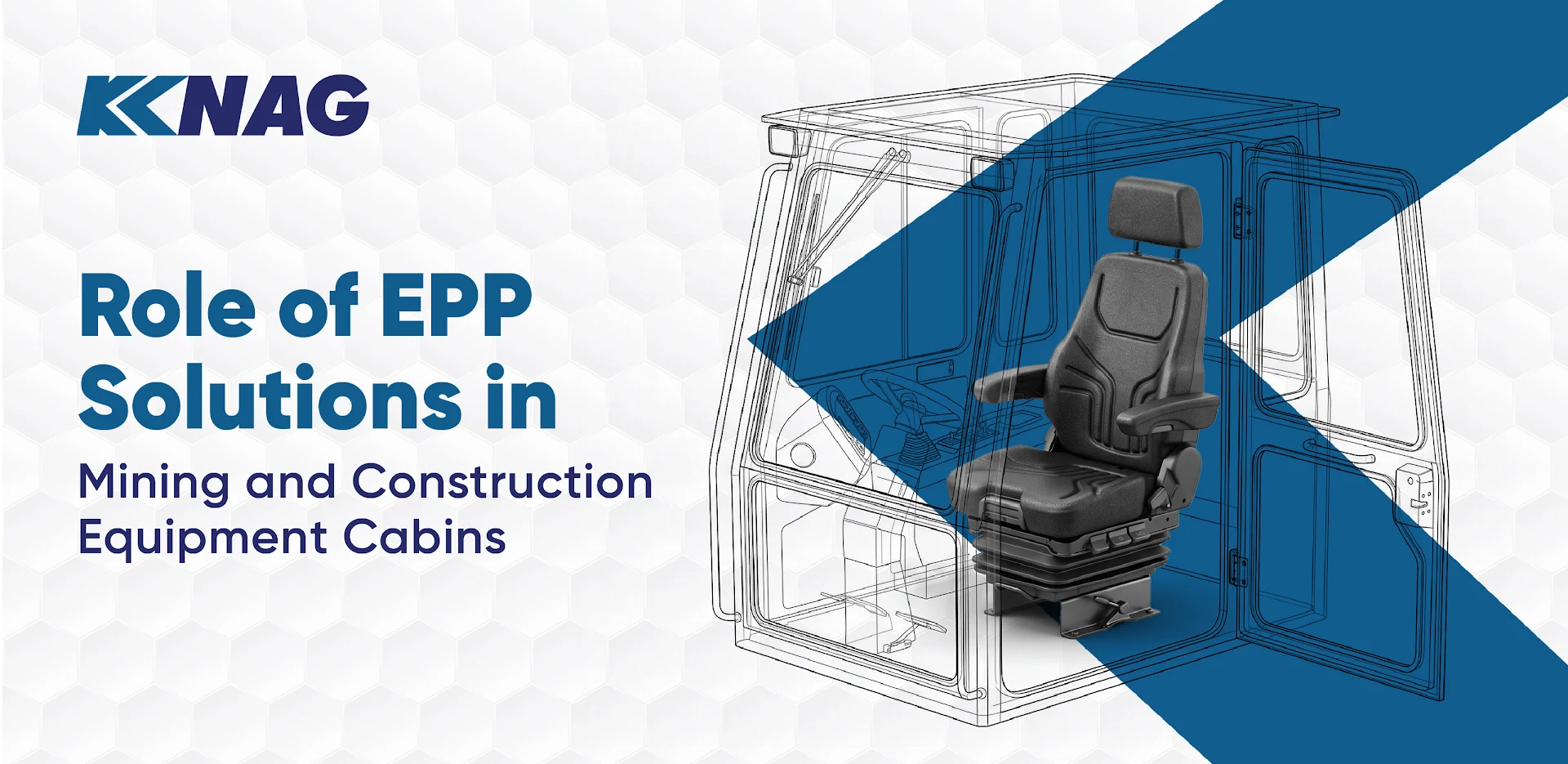
Expanded Polypropylene (EPP) offers lightweight and impact-absorbing material solutions for mining and construction equipment cabins. From seat cores and headrests to other interior components, EPP can support cabin design by combining durability, design flexibility and potential thermal insulation benefits. This blog explores how EPP can contribute to operator comfort and cabin performance in demanding industrial environments.
Operators in mining and construction equipment can spend several hours inside the same cabin, often while the machine is exposed to uneven terrain, vibration and changing temperatures. This makes cabin design important not only for machine performance but also for the operator’s day-to-day comfort.
Heavy machinery operating in mining and construction environments subjects equipment cabins to continuous mechanical stress, elevated noise levels and sustained vibration.
When these field conditions go unchecked, sustained fatigue can impair operator focus and physical well-being.
Equipment manufacturers are prioritising cabin ergonomics and structural performance to tackle tough field conditions. Using EPP solutions for construction equipment and specialised EPP components for mining equipment helps improve operator comfort and cabin functionality.
Table of Contents
- 01. Technical Challenges in Heavy Equipment Cabins
- 02. Role of Expanded Polypropylene (EPP) in Modern Machinery
- 03. Enhancing Operator Comfort Through Specialised EPP Cores
- 04. Improving Cabin Performance and Structural Functionality
- 05. Advantages of EPP Over Traditional Interior Materials
- 06. Applications in Heavy Equipment Cabins
- 07. EPP Engineering by K. K. Nag
- 08. Future Opportunities for EPP in Industrial Mobility
- 09. Conclusion
- 10. FAQs
What Challenges Do Mining and Construction Equipment Cabins Face?
Cabins in off-highway, earthmoving and mining machinery serve as primary control centres operating under demanding environmental conditions. Designing an ergonomic interior while maintaining structural integrity presents several key engineering challenges:
- Vibration and Impact Stress: Uneven terrain and machine operation can transmit vibration and impact forces through the chassis and into the cabin.
- Acoustic and Thermal Strain: Uninsulated cabins allow engine hum, hydraulic noise and outside temperature extremes to reach the operator, creating a harsh working environment over long shifts.
- Noise and Temperature: Engine noise, hydraulic systems and external temperature variations can affect cabin comfort during long operating shifts.
- Weight and Assembly Constraints: Heavy metal brackets and rubber inserts add bulk, lowering energy efficiency and slowing assembly.
How Does EPP Improve Heavy Equipment Cabins?
Expanded Polypropylene (EPP) is an engineered, closed-cell bead foam recognised for its low bulk density, multi-impact absorption capabilities and thermal insulation properties. Unlike conventional rigid plastics or heavy rubber components, EPP can help in absorbing dynamic impact energy and help it return to its original geometry without significant structural breakdown.
As lightweight materials for heavy machinery gain traction across industrial design, EPP serves as a versatile engineering medium. When integrated into multi-layer cabin linings, EPP also provides effective airborne noise isolation. Furthermore, EPP is recyclable, aligning with sustainable manufacturing practices across the industrial sector.
How EPP Improves Operator Comfort
Operator ergonomics directly influence daily productivity and equipment safety. Integrating customised EPP cores inside cabin seating systems and touchpoints helps dissipate micro-vibrations before they reach the operator:
- Seat Core: Moulded EPP seat bases provide structural support and consistent weight distribution, helping reduce physical strain during prolonged shifts.
- Headrest Core: Moulded inserts combine shock absorption with ergonomic contouring to support head and neck stability.
- Armrest: Internal foam structures offer cushioned support while remaining resilient against daily wear and tear.
- Sun Visor Core: The material provides dimensional stability and thermal resistance, keeping the overhead assembly slim and sturdy.
Improving Cabin Performance and Structural Functionality
Beyond operator ergonomics, advanced construction equipment cabin solutions utilise EPP as structural fillers and insulation layers to optimise overall cabin performance:
- Headliner: EPP inserts can be lightweight and thermally insulating if designed into a headliner properly.
- Floor Spacer: Custom-moulded EPP spacers can help fill gaps and provide lightweight support, depending on the application.
- Door Panel Inner Filler: EPP inserts can be designed to fit selected door panel cavities and support application-specific impact absorption requirements.
- Pillar Liner: Internal EPP liners shield structural steel pillars, providing energy dissipation and clean interior aesthetics.
Advantages of EPP Over Traditional Interior Materials
Transitioning to mining equipment interior components fabricated from EPP provides distinct technical benefits compared to traditional materials like solid plastics, polyurethane foams or heavy metal brackets.
Material Performance Comparison
| Performance Parameter | Traditional Materials (Polyurethane / Solid Plastics) | Industrial EPP Solutions |
|---|---|---|
| Energy and Impact Absorption | May deform permanently under heavy impact; limited multi-impact memory | High multi-impact recovery; retains structural geometry |
| Vibration Dissipation | Tends to transmit low-frequency structural vibration | Absorbs mechanical vibration and dampens acoustic resonance |
| Weight Efficiency | Higher bulk density adding to overall cabin mass | Its low density can help reduce component weight. |
| Moisture and Chemical Resistance | Polyurethane can absorb moisture over time; susceptible to oil degradation | High resistance to moisture, hydrocarbons, oils and industrial chemicals |
| Design Flexibility | Complex geometries often require multi-part assemblies | Complex shapes and internal cable channels can be moulded in a single process |
EPP Engineering by K. K. Nag
Designing safer and more efficient off-highway machinery requires custom component engineering tailored to specific cabin architectures. Backed by over 60 years of process innovation and 30+ years of specialized expertise in Expanded Polypropylene (EPP) moulding, K. K. Nag Private Limited partners directly with heavy equipment original equipment manufacturers (OEMs) to transform complex interior concepts into production-ready EPP parts.
Driven by internal operational excellence frameworks (KOpEx), the company melds in-house design engineering, precision tooling and advanced bead-foaming processes to manufacture custom-moulded components capable of enduring harsh field conditions. From rapid prototyping to scalable just-in-time (JIT) production, these industrial EPP solutions help OEMs deliver quieter, safer and more ergonomically advanced machinery cabins.
Future Applications of EPP in Heavy Equipment
As heavy machinery shifts toward electrification and autonomous operation, cabin design prioritises lightweighting, thermal and energy efficiency:
- Mass Reduction: Cuts parasitic weight to support overall machine efficiency and battery range objectives.
- Thermal and Acoustic Control: Insulates HVAC systems and dampens noise levels in electric and hybrid cabins.
- Targeted Performance: Matching EPP properties to cabin demands helps optimise long-term operational performance and operator comfort.
Conclusion
Modern mining and construction cabins require more than basic durability; they demand lightweight materials that actively protect operators from harsh field conditions. Replacing heavy, single-function interior parts with multi-functional EPP components gives equipment manufacturers a direct path to superior acoustic isolation, thermal management and shock absorption, all within a unified, production-ready framework.
Looking for customised EPP components for mining or construction equipment? K. K. Nag develops application-specific EPP solutions for demanding cabin and interior requirements. Contact our team to discuss your requirements.
FAQs
01. What is EPP and why is it used in machinery cabins?
Expanded Polypropylene (EPP) is an engineered bead foam used in cabin interiors to absorb impacts, isolate vibrations and insulate against heat and noise.
02. How does EPP improve operator comfort during long shifts?
EPP seat cores, headrests and armrests absorb continuous chassis vibration and reduce physical impact, helping minimise operator fatigue and muscle strain.
03. What cabin performance benefits do EPP components provide?
EPP inner fillers and headliners act as acoustic and thermal barriers, significantly reducing noise transmission and helping maintain stable cabin temperatures.
04. How does EPP compare to traditional materials like polyurethane or solid plastics?
Unlike rigid plastics or traditional foam, EPP recovers its shape after repeated impacts, resists chemicals and offers higher durability, helping reduce noise transmission at lower component weight.
05. Can EPP components be customised for specific cabin designs?
Yes, K. K. Nag Private Limited custom-engineers moulded EPP parts with complex geometries and integrated channels to fit the exact structural specifications of machinery manufacturers.

Featured Blogs
Role of EPP Solutions in Mining and Construction Equipment Cabins
Expanded Polypropylene (EPP) offers lightweight and impact-absorbing material solutions for mining and construction equipment cabins. From seat cores and headrests to other interior components, EPP can support [...]
HVAC Duct Insulation Solutions: How EPP Supports Energy-Efficient Systems
Heating, Ventilation and Air Conditioning (HVAC) efficiency depends on more than chillers, heat pumps or air-handling units. The duct network carrying conditioned air also needs to manage heat [...]
Rotomoulded Septic Tanks and Bio-Toilets for Modern Sanitation
Rotomoulded septic tanks and bio-toilets are seamless, polymer-based sanitation systems engineered through rotational moulding. Used across rural, urban and industrial sites, they replace concrete structures by offering lightweight [...]
How EPP Improves Automotive Acoustics and NVH Performance
Summary: EPP automotive components help manage automotive NVH by reducing vibration transfer, controlling panel resonance, filling cavities and preventing buzz, squeak and rattle. As a lightweight material, EPP [...]
Get in Touch with Us
We look forward to connecting with you!


