
How EPP Improves Automotive Acoustics and NVH Performance
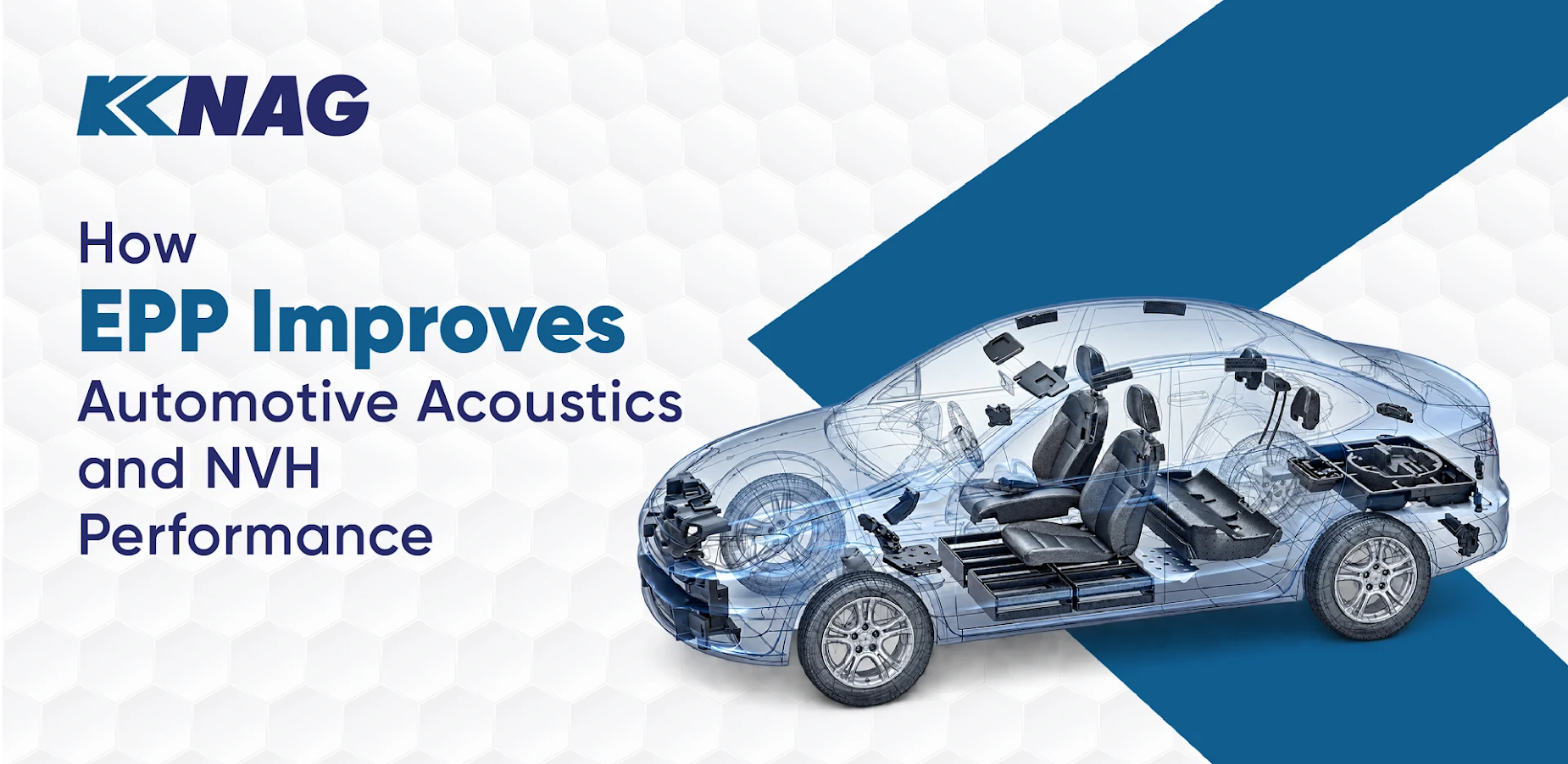
Summary: EPP automotive components help manage automotive NVH by reducing vibration transfer, controlling panel resonance, filling cavities and preventing buzz, squeak and rattle. As a lightweight material, EPP foam for automotive applications allows OEMs to address these NVH challenges without relying solely on heavy damping and insulation materials.
Table of Contents
Modern vehicles face a growing NVH challenge. Road and tyre noise, panel vibrations, wind noise and small rattles can become more noticeable as powertrains get quieter, particularly in electric vehicles. At the same time, adding heavy insulation or damping materials can work against vehicle lightweighting and efficiency targets .
Original Equipment Manufacturers (OEMs) now address noise at the component level through how each part is shaped, mounted and tuned. Expanded Polypropylene (EPP) has a defined role in this approach. As a closed-cell moulded foam, EPP automotive components interrupt vibration paths, stiffen panels, fill cavities and hold hardware securely at a fraction of the mass.
Why NVH Has Become a Central Design Target
Noise, Vibration and Harshness (NVH) covers three distinct concerns:
- Noise: Airborne sound measured in decibels.
- Vibration: Physical energy felt through the seat, floor and steering column.
- Harshness: Subjective quality covering how abrupt or unpleasant an event feels.
| Noise Source | Path | What Has Changed |
| Powertrain | Structure-borne and airborne | Quieter in electric platforms, removing the masking effect over other sources |
| Road and tyre | Structure-borne through suspension and floor | Dominant contributor depending on vehicle speed and condition |
| Wind | Airborne through seals, glass and apertures | More noticeable as background noise drops |
| Auxiliary systems | Airborne and structure-borne | Pumps, compressors and thermal management become audible |
| Buzz, squeak and rattle | Structure-borne contact | Small rattles become disproportionately noticeable |
In electric platforms, removing engine masking moves background noises to the foreground. NVH targets have tightened, meaning acoustic packages must achieve more while weighing less.
How Lightweighting Changed the Noise Problem
Heavy barriers block airborne sound, but generous weight budgets no longer exist. Stricter efficiency targets and the need to preserve EV driving range have made weight reduction a core vehicle-design priority. Rather than adding mass to block sound, development teams use lightweight automotive materials to manage transmission paths. This shift favours customised solutions that:
- Break the mechanical connection between vibrating surfaces and the cabin
- Raise panel stiffness to resonate outside problem frequency bands
- Fill cavities that amplify sound
- Prevent contact between adjacent parts
- Deliver secondary functions such as impact absorption in the same part
How Does EPP Support Acoustic Performance?
EPP is a bead-based closed-cell foam. It is not a porous absorber and should not replace open-cell foams or felts for absorbing airborne sound. Instead, EPP foam for automotive applications provides value through path control.
| NVH and Structural Challenge | EPP Solution | Measurable Result |
| Structure-Borne Vibration Transfer Vibration travelling through metal into trim panels radiates directly into the cabin as noise. |
Placed as an isolation layer between structural surfaces and interior trim components. | Reduces vibration transfer and interrupts structure-borne acoustic paths. |
| Panel Resonance and Road Noise Large, flat sheet-metal surfaces resonate under road inputs, increasing cabin noise. |
Integrated moulded EPP supports to add localized structural stiffness. | Shifts resonant frequencies away from excitation bands to quiet the cabin without adding heavy steel or bitumen mass. |
| Acoustic Cavities and Moisture Exposure Hollow vehicle body spaces amplify sound, and damp areas (like wheel arches) risk moisture ingress. |
Contoured closed-cell EPP inserts designed to fill structural voids and block air paths. | Eliminates sound-amplifying cavities while resisting water absorption in damp locations. |
| Buzz, Squeak, and Rattle (BSR) Loose onboard items and components shift during vehicle movement, creating noise. |
Precision-moulded EPP cavities engineered to hold tools and components firmly in place. | Prevents part movement and eliminates BSR noises (e.g., K. K. Nag’s quiet tool kit standardized across Force Gurkha, Trax, and Urbania models). |
| Rigid NVH Tuning Constraints Fixed material properties make it difficult to balance stiffness, weight, and shock absorption without redesigning tooling. |
Variable bead density moulding allowing engineers to tune performance using the same tool geometry. | Lower density provides lightweight cushioning/vibration isolation; higher density delivers structural stiffness and heavy impact resistance. |
Where EPP Fits Across the Vehicle
Automotive acoustic solutions using EPP rely on multiple parts addressing local paths:
- Door Panels:
EPP inner fillers occupy cavity volume, support trim against resonance and integrate pelvic pusher foams for side-impact protection.
- Floor Systems:
Spacers maintain floor height accuracy while decoupling carpet from pan vibration.
- Trunk and Boot Components:
Floor supports, parcel shelf cores and tool caddies eliminate loose-item noise and reinforce lightweight structures.
- Interior and Roof:
Headliners, seat cores, pillar liners and steering pads absorb energy and remove contact points without added weight.


- Wheel House Regions:
Liner inserts reduce road noise and resist stone impact in wet environments.
What EPP Offers Automotive OEMs
The relative importance of each consideration depends on the programme. A commercial vehicle cabin and a premium electric passenger platform will weigh these differently.
- Mass Reduction: Weight saved can be reallocated to batteries or safety features.
- Multi-functionality: A single moulding addresses impact, structure and NVH.
- Tunability: Density and geometry are adjusted without process changes.
- Durability and Environmental Tolerance: Moisture-resistant EPP recovers shape after impact.
- Recyclability: EPP supports circular material goals through dedicated recycling streams.
How an EPP Part Is Developed Against NVH Targets
K. K. Nag introduced EPP moulding to India in 1990 and supplied its first production parts in 1992. With over 30 years of EPP legacy, the company provides complete design and manufacturing processes aligned with Advanced Product Quality Planning (APQP) and Production Part Approval Process (PPAP) requirements to help ensure parts meet customer specifications.
- 1. Brief and Design Review: Setting acoustic, packaging and load targets.
- 2. Density and Geometry Selection: Choosing bead density, wall sections and rib patterns.
- 3. Prototyping: Testing machined samples or soft tooling in-vehicle.
- 4. Validation: Confirming performance against customer test methods[cite: 1, 2].
For the Mahindra XUV700, K. K. Nag engineered an EPP solution reducing component mass from 1.4 kg to 380 g while passing 2,000-cycle durability tests.
Conclusion
Automotive NVH outcomes often depend on small but critical component decisions, including material density, geometry, fitment and interaction with surrounding structures. With more than three decades of EPP moulding expertise, K. K. Nag works with OEMs to develop application-specific components that meet defined packaging, performance and validation requirements.
Planning an automotive EPP component? Speak with K. K. Nag about your design brief, NVH objectives and production needs.
FAQs
01. What are EPP automotive components and where are they used?
They are moulded Expanded Polypropylene parts used in door fillers, floor spacers, headliners, parcel shelves and wheel house inserts to provide structural, safety and acoustic benefits.
02. How do automotive NVH solutions differ from sound insulation?
Insulation blocks airborne noise, whereas automotive NVH solutions control vibration transmission paths at the component level to reduce weight.
03. Does EPP foam absorb sound?
No, EPP foam for automotive applications is closed-cell. It reduces noise by dampening vibrations, stiffening panels and filling cavities rather than absorbing airborne sound.
04. Why are lightweight automotive materials important for acoustic performance?
Lightweight automotive materials manage noise via structural design instead of heavy mass layers, preserving EV range and fuel efficiency.
05. Can EPP foam for automotive applications be tuned to specific NVH targets?
Yes, moulding density and geometry can be adjusted to meet specific customer requirements.
06. How does EPP help with buzz, squeak and rattle in cabins?
Precision-moulded cavities secure tools and hardware firmly to prevent contact noise during movement.
07. How does EPP improve automotive NVH performance?
EPP improves automotive NVH performance by managing the paths through which vibration and noise travel. Moulded EPP parts can decouple trim from vibrating structures, support panels to limit resonance, fill cavities that contribute to noise and secure tools or hardware to reduce buzz, squeak and rattle.

Featured Blogs
How EPP Improves Automotive Acoustics and NVH Performance
Summary: EPP automotive components help manage automotive NVH by reducing vibration transfer, controlling panel resonance, filling cavities and preventing buzz, squeak and rattle. As a lightweight material, EPP [...]
How to Calculate Savings from Switching to Reusable Polymer Solutions
Many businesses compare a disposable box with reusable packaging by looking only at the price of one unit. A corrugated box may appear cheaper than an EPP container [...]
How K. K. Nag Builds Circularity into Polymer Manufacturing
The way manufacturers evaluate polymer products is changing. The question is no longer limited to whether a material can be recycled. Businesses are also considering how long [...]
Returnable EPP Dunnage for Class-A Painted Automotive Parts
Class-A painted automotive parts are the visible surfaces of a vehicle where even minor scratches, scuffs or dents can compromise appearance and perceived quality. Class-A painted automotive parts [...]
Get in Touch with Us
We look forward to connecting with you!


