
HVAC Duct Insulation Solutions: How EPP Supports Energy-Efficient Systems
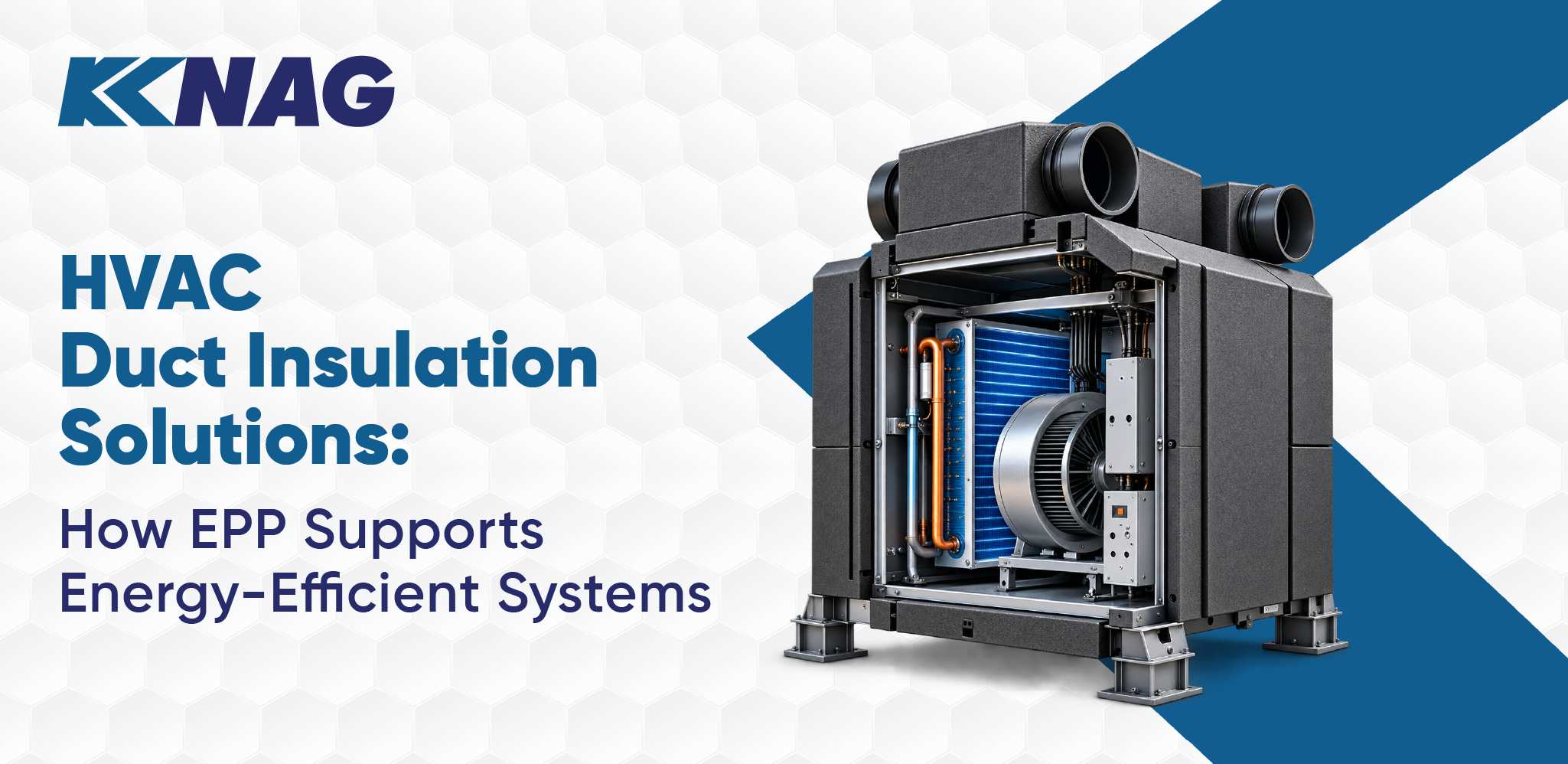
Heating, Ventilation and Air Conditioning (HVAC) efficiency depends on more than chillers, heat pumps or air-handling units. The duct network carrying conditioned air also needs to manage heat transfer, moisture and air movement. When ducts pass through unconditioned spaces, inadequate insulation can allow heat gain or loss before the air reaches its destination. Gaps at joints and fittings add another source of loss.
India’s Energy Conservation and Sustainable Building Code (ECSBC) 2024 sets energy performance requirements for applicable commercial and office buildings, including requirements for ductwork and plenum insulation. The required insulation performance depends on factors such as duct location and system type. Project teams should consult the applicable code provisions when selecting insulation materials.
Expanded Polypropylene (EPP) is a lightweight foam that combines low weight with thermal and acoustic insulation, impact resistance and mouldability. This blog covers where EPP fits in duct insulation and what to check before specifying it.
Table of Contents
- 01. Why Duct Insulation Is Essential in Commercial and Industrial HVAC
- 02. What is the Role of EPP in HVAC Duct Insulation Solutions
- 03. How EPP Compares with Other Duct Insulation Materials
- 04. Key Benefits of EPP for HVAC Insulation
- 05. Applications of EPP in Air Conditioning, Ventilation and Industrial HVAC
- 06. Fire Performance of EPP
- 07. Selecting EPP-Based Duct Insulation
- 08. Customised EPP Solutions for HVAC Manufacturers
- 09. Future Opportunities for Lightweight EPP Insulation
- 10. Conclusion
- 11. FAQs
Why Duct Insulation Is Essential in Commercial and Industrial HVAC
Duct insulation manages the temperature difference between conditioned air and its surroundings. A cooled-air duct passing through a warm space gains heat while a heated-air duct loses heat in colder surroundings. ASHRAE lists energy conservation and condensation control among the main objectives of mechanical insulation. Its duct design guidance also covers temperature change and acoustic performance.Condensation is the second concern. It can occur when a cold duct surface falls below the dew point of the surrounding air. Vapour retarders or extra insulation are sometimes required to control it. Gaps at joints undermine any insulation layer.
Insulation cannot compensate for air leakage. Gaps around joints and connections are a separate source of energy loss, so insulation sealing and installation need to be considered together in HVAC duct insulation solutions. In commercial and industrial buildings that fall under the code, these checks are part of meeting energy efficiency requirements rather than an optional upgrade.
What is the Role of EPP in HVAC Duct Insulation Solutions
Expanded Polypropylene (EPP) is an expanded foam with a closed-cell structure that limits heat transfer. It is about 95 per cent air, which gives it very low weight.EPP duct insulation works differently from wrap-on materials. Rather than adding a layer around a metal duct, EPP is moulded into self-supporting ducts, fittings, plenums and housings in which the wall itself insulates. One European supplier’s grey EPP duct has a 16 mm wall, a density of 30 kg/m³, a thermal conductivity of 0.041 W/m·K and an operating range of minus 30 °C to plus 60°C. ALNOR specifies approximately 0.039 W/m·K for its EPP ventilation ducts and fittings. Values vary with material grade, density and processing conditions.
Acoustic insulation is a second contribution. EPP duct and plenum components dampen noise generated inside the airway K. K. Nag’s Custom EPP Solutions capability includes design, prototyping, mould manufacturing and production support. These capabilities allow EPP insulation solutions to be developed for a specific component and equipment envelope.
How EPP Compares with Other Duct Insulation Materials
No single material wins on every measure. EPP is not the lowest conductivity option. Phenolic duct panels reach about 0.021 W/m·K against roughly 0.039 to 0.041 W/m·K for EPP duct components. Glass wool, nitrile rubber and cross-linked polyethylene (XPE) fall between at roughly 0.032 to 0.039 W/m·K. EPP sits at the upper end of that range. Because thermal resistance equals thickness divided by conductivity, a higher conductivity means a thicker wall is needed for the same R-value.
EPP offers other advantages. It can be self-supporting, impact-resistant and moisture-resistant and can be moulded into shapes that combine ducting, fittings and insulation in a single component. Choose EPP where component geometry, durability and integration matter alongside thermal conductivity. Choose a different material where the lowest possible conductivity or a non-combustible rating is the deciding factor.
| Material | Thermal conductivity (W/m·K) | Moisture behaviour | Fire behaviour | Where it fits and main limitation |
|---|---|---|---|---|
| EPP duct and fitting grades | About 0.039 to 0.04 | Closed cell. Resistant to moisture and biologically neutral | Grade dependent. Grey duct range rated B1 under DIN 4102. Flame-retardant grades exist. |
Moulded self-supporting ducts, fittings, plenums and housings.Higher conductivity than phenolic so wall thickness needs checking. |
| Glass wool duct wrap | 0.032 to 0.039 | Fibrous. Does not act as a vapour barrier so depends on a foil facing | Non-combustible | Wrap over metal ducts. Fibres irritate skin, eyes and the respiratory system during handling. Not typically used for chilled applications. |
| Nitrile rubber (NBR) | About 0.033 to 0.034 | Closed cell with high vapour resistance. No extra vapour barrier needed | Product specific. Class O products are available. | Flexible sheet or tube applied over ducts and pipes. No structural role |
| XPE (cross-linked polyethylene foam) | About 0.032 to 0.038 | Closed cell. Water absorption under 1 per cent by volume | Product specific. Early fire hazard indices quoted under AS 1530.3 | Flexible foil-faced wrap. No structural role |
| Phenolic pre-insulated panels | About 0.021 | Over 90 per cent closed cell and non-wicking. Relies on the integrity of the foil facing. | B-s1, d0 under EN 13501-1 | Fabricated into rectangular pre-insulated ducts by trained fabricators. Lowest conductivity in this comparison |
Key Benefits of EPP for HVAC Insulation
Four benefits recur across EPP duct, plenum and housing applications.Lightweight construction and lower system load. Because EPP is about 95 per cent air, components are light to transport and easier for installers to handle. FLOWAIR reports EPP casings of 23 to 36 kg for its LEO Cool units and 75 to 82 kg for its EPP-housed OXeN heat recovery unit. Where the casing or duct also insulates, the same part limits heat gain and loss which can reduce space conditioning loads. These are the practical gains behind lightweight insulation solutions.Moisture resistance. EPP is resistant to moisture and biologically neutral which helps limit microbial risk in humid ventilation systems. Unlike metal parts it does not rust. Cold ducts still need vapour control at joints and penetrations.
Durability: EPP does not take a permanent set under heavy loads and recovers from repeated impacts.
Design flexibility: EPP can be moulded into enclosures, piping and distribution boxes of almost any shape.
Moulded plenum boxes can have aerodynamic internal shapes that reduce airflow resistance and factory-fitted gaskets for airtight connections. Moulded unit frames can be shaped to avoid thermal bridges.
These benefits explain why EPP is considered among the polymer insulation materials suited to ducts and housings.
Applications of EPP in Air Conditioning, Ventilation and Industrial HVAC
Air conditioning systems: EPP is used for moulded housings and internal components. Medium to high density EPP grades now replace older and heavier metal housings in HVAC components.
Ventilation networks: EPP is used for self-supporting duct systems, fittings and plenum boxes in mechanical ventilation with heat recovery.
Industrial HVAC setups: Where weight, acoustic control and corrosion resistance matter, EPP offers a lighter alternative to steel in equipment construction.
| Application | EPP part | Key benefit | Image to add |
|---|---|---|---|
| Mechanical ventilation ducting | Round EPP duct with 45° and 90° fittings | Self-supporting. Thermal and acoustic insulation in one wall. Grey range rated B1 under DIN 4102. | EPP duct run with fittings |
| Plenum and distribution boxes | Moulded expansion boxes with spigots | Thermal and acoustic insulation. Factory-fitted gaskets for airtight connections. | Plenum box with spigots |
| Heat recovery units | Moulded housing and internal frames | Frames shaped to avoid thermal bridges. Lighter unit weight. | EPP heat recovery housing |
| Air conditioning units | Moulded housings and internal parts | Replaces heavier metal housings. Thermal and acoustic insulation. | Moulded air conditioning component |
| Industrial HVAC enclosures | Moulded casings for heating and ventilation units | Lighter casing and corrosion resistance. | EPP casing for a ventilation unit |
Fire Performance of EPP
Fire behaviour depends on the grade of EPP. Standard polypropylene foam is not flame retardant by default. Flame-retardant EPP grades are available and the choice of grade should follow the fire requirement of the project.
EPP bead manufacturers offer halogen-free flame-retardant grades that pass UL 94 HF-1. Another manufacturer lists halogen-free flame-retardant EPP for construction and HVAC use.
A further grade, such as BASF’s Neopolen P 9230 D, complies with the FMVSS 302 flame rating at a thickness of 13 mm. For finished ventilation components, fire-retardant EPP duct systems can achieve a B1 rating under DIN 4102, while suppliers such as BPC Ventilation offer flame-retardant EPP bends rated to GB 8624 Class B1 with EN 13501-1 Class B testing underway.
Specifiers should ask for the fire classification report for the exact grade, density and thickness and check it against the test standard that the project requires.
Selecting EPP-Based Duct Insulation
Material selection should begin with the application. Engineers should evaluate the following.
- Thermal requirements: The required thermal resistance for the duct location, operating temperature and applicable code. Thickness follows from thermal resistance divided by conductivity.
- Moisture exposure: Closed-cell EPP resists moisture but condensation control still depends on vapour control and sealed joints and penetrations.
- Fire performance: Confirm the fire classification of the specific EPP grade against project regulations.
- Operating temperature: Check the working range of the grade. One EPP duct range is rated from minus 30 °C to plus 60 °C.
- Mechanical loading: Vibration, compression and impact. EPP recovers from repeated impacts.
- Geometry and installation: Curved ducts, transitions, housings, gaskets and jointing.
This assessment helps manufacturers choose thermal insulation materials for HVAC according to actual system requirements.
Customised EPP Solutions for HVAC Manufacturers
HVAC manufacturers often need components designed around specific equipment configurations, space constraints and functional requirements. EPP suits this because it can be moulded into complex, application-specific geometries.Coordination between material selection, component design, tooling and production is therefore important.
K. K. Nag brings over 60 years of polymer manufacturing experience and supports customised EPP development through design, prototyping, tooling and manufacturing. Its engineering approach can support component design, material selection, in-house tool development, prototype evaluation, value engineering and series production.
This approach helps manufacturers turn material properties into practical HVAC duct insulation solutions for specific components and operating requirements.
Future Opportunities for Lightweight EPP Insulation
Energy-efficient buildings need attention to duct insulation alongside equipment efficiency, controls, duct sealing and envelope performance. ECSBC 2024 updates energy efficiency thresholds compared with ECBC 2017 and adds sustainability measures.
Heat recovery ventilation is one clear opportunity. EPP has become a leading material for heat recovery units because it serves both the external framework and the internal structure.
The focus is on finding where EPP is a technically suitable and manufacturable option rather than replacing conventional insulation in every application.
Conclusion
Effective duct insulation helps manage heat transfer, condensation and temperature change in HVAC systems. Performance depends on the insulation material as well as thickness, duct location, vapour control, sealing and installation.
EPP insulation solutions combine moderate thermal conductivity with low weight, moisture resistance, impact recovery and moulded design flexibility. They are strongest where one part must insulate and hold its shape. Other materials lead on conductivity or non-combustibility so the choice should follow the application.
For manufacturers exploring HVAC energy efficiency solutions, an application-specific approach can show where EPP fits within wider system design.
FAQs
Q1. What is HVAC duct insulation?
HVAC duct insulation is a thermal insulation layer or material used around or within ducts to help control heat transfer between conditioned air and the surrounding environment. It also helps manage surface condensation and, depending on the material and system design, can contribute to acoustic control.
Q2. Why is duct insulation important for HVAC systems?
Duct insulation limits unwanted heat gain or loss as conditioned air moves through the distribution network. In unconditioned spaces, poorly insulated ducts can lose 10 to 30 per cent of the energy used to heat and cool the air. Insulation also helps control condensation on cold ducts.
Q3. What factors should be considered when selecting HVAC duct insulation?
Consider the required thermal resistance for the duct location and applicable code, together with operating temperature and humidity. Check moisture and condensation control and the fire classification required by the project. Allow for mechanical loading and acoustic needs. Finally, consider geometry, jointing and sealing because gaps at joints undermine any insulation layer.
Q4. What thickness of duct insulation is needed?
Thickness depends on the thermal resistance that the code requires for the duct location and on the conductivity of the material. Thermal resistance equals thickness divided by conductivity. As an illustration, a 25 mm wall at 0.039 W/m·K gives about 0.64 m²·K/W. Confirm the required value in ECSBC 2024.
Q5. Is EPP fire retardant?
It depends on the grade. Flame-retardant EPP grades exist, including halogen-free grades that pass UL 94 HF-1 and ventilation duct ranges rated B1 under DIN 4102. Standard EPP is not flame retardant by default, so request the fire classification for the exact grade and thickness.
Q6. Does EPP resist moisture and condensation?
EPP is resistant to moisture and biologically neutral. Condensation on cold ducts is still controlled by vapour control and sealed joints and penetrations.
Q7. What materials are used for HVAC duct insulation?
Common duct insulation materials include glass wool and nitrile rubber. XPE foam and phenolic pre-insulated panels are also used. EPP can be considered where a lightweight, moisture-resistant and moulded insulating component is needed.
Q8. Can EPP be used in HVAC and ventilation systems?
Yes. EPP is used for ventilation ducts, fittings, plenum boxes and heat recovery unit housings. Suitability depends on the component design and on the thermal, mechanical, moisture and fire performance required.
Q9. Can EPP be customised for HVAC applications?
Yes. EPP can be moulded into enclosures, piping and distribution boxes of custom shapes that match the equipment layout. K. K. Nag supports customised EPP development through design, prototyping, tooling and manufacturing.

Featured Blogs

Role of EPP Solutions in Mining and Construction Equipment Cabins
Expanded Polypropylene (EPP) offers lightweight and impact-absorbing material solutions for mining and construction equipment cabins. From seat cores and headrests to other interior components, EPP can support [...]
HVAC Duct Insulation Solutions: How EPP Supports Energy-Efficient Systems
Heating, Ventilation and Air Conditioning (HVAC) efficiency depends on more than chillers, heat pumps or air-handling units. The duct network carrying conditioned air also needs to manage heat [...]

Rotomoulded Septic Tanks and Bio-Toilets for Modern Sanitation
Rotomoulded septic tanks and bio-toilets are seamless, polymer-based sanitation systems engineered through rotational moulding. Used across rural, urban and industrial sites, they replace concrete structures by offering lightweight [...]

How EPP Improves Automotive Acoustics and NVH Performance
Summary: EPP automotive components help manage automotive NVH by reducing vibration transfer, controlling panel resonance, filling cavities and preventing buzz, squeak and rattle. As a lightweight material, EPP [...]
Get in Touch with Us
We look forward to connecting with you!


