
How to Calculate Savings from Switching to Reusable Polymer Solutions
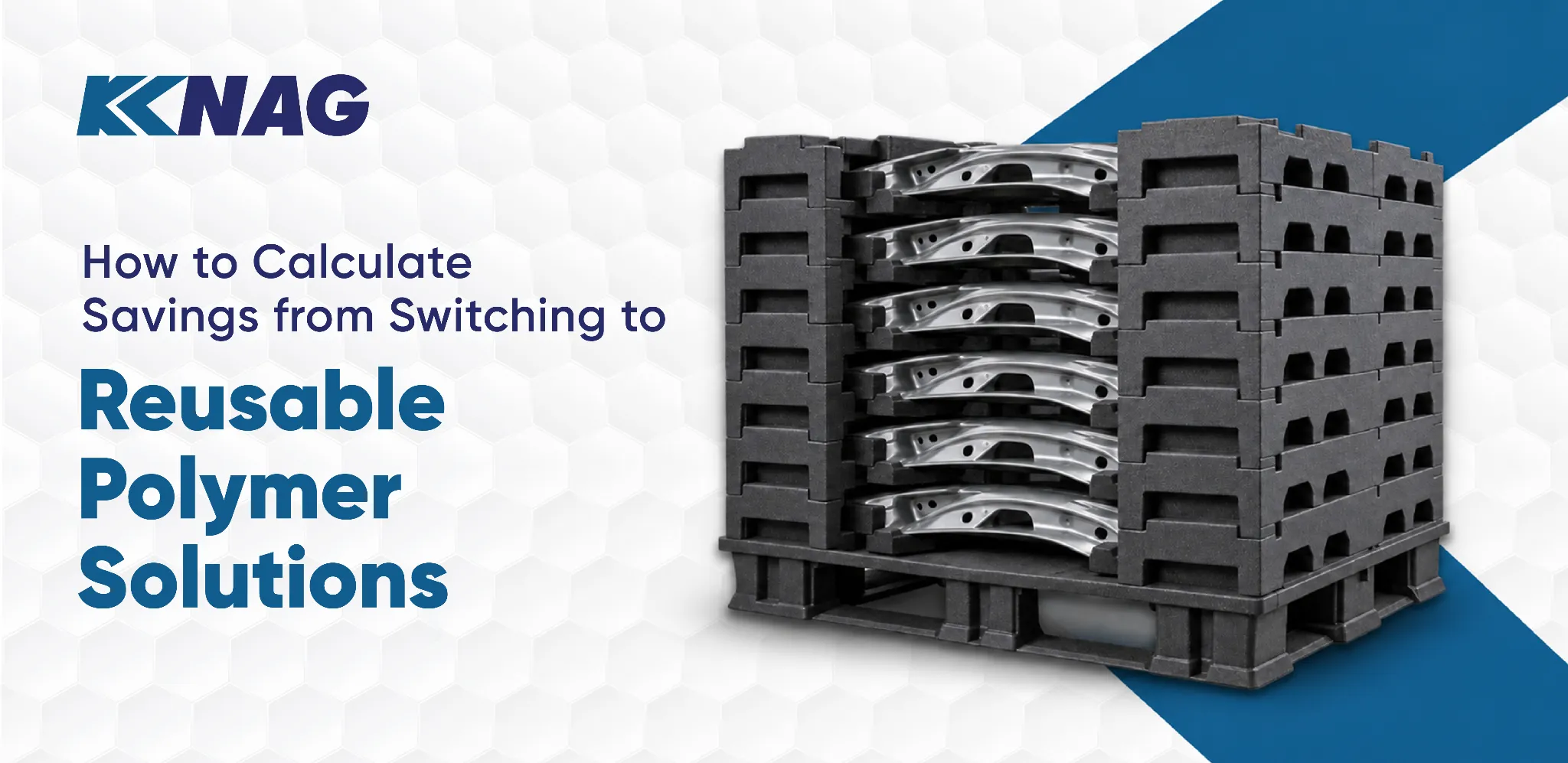
Many businesses compare a disposable box with reusable packaging by looking only at the price of one unit. A corrugated box may appear cheaper than an EPP container or an HDPE crate at first glance. However, this comparison ignores how often each solution is purchased, how much waste it generates and how effectively it protects the product.
The more useful question is not, “Which packaging option costs less per unit?” It is, “What does each packaging system cost across its entire useful life?”
That is the basis for calculating the cost savings of reusable polymer packaging.
Table of Contents
The Single-Use Packaging Cost Baseline
The cost of single-use packaging extends beyond its purchase price. Every shipment creates a new packaging expense and the total cost can increase further when damage, disposal and repacking are considered.
A practical baseline should include:
1. Packaging Cost Per Shipment
This includes the purchase price of the corrugated box, disposable insert or other single-use packaging material.
2. Damage and Rejection Costs
If products are damaged during transit, businesses may incur costs related to:
- • rejected products
- • repairs or replacements
- • reverse logistics
- • customer dissatisfaction
- • production delays
A stronger packaging system can reduce some of these costs by improving product protection.
3. Disposal and Waste Handling
Single-use packaging must be collected, segregated, recycled or disposed of after use. These activities may involve labour, waste management and handling costs.
4. Reordering Frequency
Disposable packaging is consumed during every shipment.
This creates a recurring expense that is often overlooked when comparing single-use packaging with returnable packaging solutions.
The Reusable Packaging Cost Model
Reusable industrial packaging has a different cost structure. The initial investment is usually higher, but the cost is distributed across multiple trips.
The main components include:
Handling cost
Handling requirements should also be considered when evaluating reusable packaging. Bulky or heavy packaging may require additional labour, forklifts or other handling equipment for loading, unloading and movement within the facility. These handling requirements can affect the overall cost of each packaging cycle.
Initial Packaging Cost
This may include the cost of the packaging itself, mould tooling and design development. For example, a custom EPP packaging system or HDPE crates may require an upfront investment that is higher than a corrugated box.
Expected Reuse Cycles
The number of times the packaging can be used is central to any reusable packaging cost savings calculation.
The actual number depends on the material, design, handling conditions and logistics environment. A well-designed returnable transit packaging system may be used across multiple cycles. However, the expected number of reuse cycles should be determined based on the specific packaging design, application, handling and transport conditions rather than a generic assumption.
Maintenance and Cleaning
Some systems may require cleaning, inspection or minor maintenance between cycles. These costs should be included in the calculation.
Reverse Logistics
Reusable systems must return to the point of origin or another designated location. The cost of collecting and transporting empty packaging should therefore be included where applicable. The basic amortised packaging cost can be calculated as:
Amortised cost per trip = Initial reusable packaging cost ÷ Expected reuse cycles
A more complete calculation can then include maintenance and reverse logistics costs per cycle.
The Actual Savings Formula
A simple formula can help businesses compare packaging options:
Savings per shipment = (Single-use packaging cost + disposal cost + avoidable damage cost) − (Reusable packaging cost ÷ reuse cycles + maintenance cost per cycle + return logistics cost per cycle)
Illustrative Example
Consider a business shipping 10,000 components annually. Assume the reusable packaging travels on a closed-loop route where empty packaging can be returned at a manageable cost.
| Cost Factor | Single-Use Packaging | Reusable Packaging |
| Initial packaging cost | ₹150 per shipment | ₹15,000 per unit |
| Expected reuse cycles | 1 | 100 |
| Amortised packaging cost | ₹150 | ₹150 |
| Disposal cost per shipment | ₹20 | ₹0* |
| Maintenance cost per cycle | ₹0 | ₹10 |
| Return logistics cost per cycle | ₹0 | ₹5 |
| Estimated damage-related cost | ₹30 | ₹10 |
| Estimated total cost per shipment | ₹200 | ₹175 |
*Represents disposal cost during normal reuse cycles and does not represent zero end-of-life cost.
In this illustrative example, the reusable system saves ₹25 per shipment after accounting for maintenance and return logistics.
At 10,000 shipments annually:
Annual packaging cost savings = ₹25 × 10,000 = ₹2,50,000
The actual savings will vary based on packaging cost, reuse cycles, maintenance requirements, damage rates and the distance and efficiency of the return route. For long-distance or one-way shipments where returning empty packaging is expensive or impractical, single-use packaging may remain the more economical option.
This is why businesses should evaluate reusable packaging ROI using their actual shipment routes and recovery model rather than comparing packaging prices alone.
Hidden Savings Beyond Direct Cost
The most significant benefits of reusable packaging are not always visible in the initial calculation.
Reduced Damage and Rejection Rates
When appropriately designed for the application, rigid polymer packaging and custom protective inserts can provide more consistent protection, depending on transport conditions and handling requirements. EPP dunnage, for example, can be designed around the shape of a component to reduce movement during transit.
This is particularly useful for high-value automotive and industrial parts where even a small reduction in damage can significantly affect the overall cost savings.
Lower Packing Labour Costs
Custom dunnage packaging can improve packing consistency. Operators may reduce the need to cut, fold or manually arrange loose cushioning materials.
A well-designed custom EPP dunnage system can provide designated cavities for individual components, helping speed up packing and unpacking operations.
Improved Space Utilisation
Stackable reusable systems can improve storage and transport efficiency. Packaging designed for specific products may also reduce unnecessary void space.
Sustainability and ESG Value
Reducing single-use packaging consumption can support corporate sustainability objectives. According to Circularise, reusable polymer systems can also provide measurable data for internal environmental reporting.
K. K. Nag’s sustainability initiatives, including its RecyCole programme, demonstrate how material recovery and recycling can support broader waste reduction goals. For businesses evaluating cost savings from reusable packaging, reduced packaging waste can be considered alongside direct financial savings.
When Reusable Packaging Does Not Pay Off
Reusable packaging is not automatically the right choice for every logistics route.
A reusable system may be less economical when:
- • shipments are made only once.
- • the destination is extremely distant.
- • return logistics are expensive.
- • packaging cannot be recovered reliab>
- • shipment volumes are too low to justify tooling.
- • the packaging requires frequent replacement due to harsh handling.
For example, a one-way export shipment with no practical return route may make disposable packaging more suitable.
The business case depends on shipment frequency, route design, expected reuse cycles and recovery systems. A proper evaluation should consider all these factors before making the transition.
Making the Business Case for Reusable Packaging
The decision to adopt reusable polymer packaging should be based on the total cost of ownership rather than the initial purchase price.
Businesses should compare:
- • packaging cost per trip.
- • expected reuse cycles.
- • disposal costs.
- • damage and rejection rates.
- • labour requirements.
- • cleaning and maintenance.
- • reverse logistics.
- • packaging waste.
Depending on the application, solutions may include EPP foam dunnage, LLDPE packaging, HDPE crates, custom dunnage or integrated returnable dunnage systems.
K. K. Nag develops reusable packaging solutions for industrial applications using materials such as EPP, HDPE and LLDPE. The right solution depends on the component, transit conditions, number of cycles and logistics model.
For businesses evaluating the transition to reusable industrial packaging, calculating the potential cost savings against actual shipment volumes and handling conditions is the most practical starting point. A well-designed system can reduce recurring packaging costs, protect products more effectively and support a more efficient closed-loop supply chain, where packaging is collected, returned and reused between defined supply-chain participants, thus supporting sustainability practices.
FAQs
01. What are 10 common examples of reusable packaging materials?
Ans: Common reusable polymer packaging materials include EPP, HDPE, LLDPE, PP, ABS, PET, PC, PU, TPE and Nylon (PA). Selection depends on factors such as impact resistance, weight, chemical exposure, temperature and expected reuse cycles. EPP, HDPE and LLDPE are particularly suited to reusable industrial packaging applications.
02. What are the primary types of plastic polymers used in industrial manufacturing?
Ans: The primary types are PET, HDPE, PVC, LDPE, Polypropylene (PP), Polystyrene (PS), and custom engineered resins like Expanded Polypropylene (EPP). K. K. Nag specialises in converting advanced polymers like EPP, EPS and LLDPE into high-performance industrial products.
03. What are some real-world examples of industrial polymer packaging solutions?
Ans: Examples include protective EPP dunnage trays, stackable HDPE totes, custom foam inserts, rotomoulded chemical tanks, and insulation containers. K. K. Nag designs and manufactures tailored polymer solutions that optimise supply chain protection and reduce total cost of ownership.
04. What are 10 practical ways industrial plastics can be reused across supply chains?
Ans: Methods include multi-trip dunnage trays, returnable totes, closed-loop material recycling, structural void filling, modular storage, protective component housings, pallet spacers, fluid containment, secondary sorting bins and scrap re-granulation. K. K. Nag advances plastic circularity through durable designs and sustainable recovery programs like RecyCole.
Q5. How do reusable polymer solutions help businesses lower their long-term packaging costs?
Ans: Reusable polymer containers distribute their initial cost across multiple logistics cycles can reduce per-trip expenses and disposal fees, and prevent transit damage. K. K. Nag manufactures heavy-duty EPP and HDPE packaging engineered to maximise ROI across closed-loop supply chains.

Featured Blogs

Rotomoulded Septic Tanks and Bio-Toilets for Modern Sanitation
Rotomoulded septic tanks and bio-toilets are seamless, polymer-based sanitation systems engineered through rotational moulding. Used across rural, urban and industrial sites, they replace concrete structures by offering lightweight [...]

How EPP Improves Automotive Acoustics and NVH Performance
Summary: EPP automotive components help manage automotive NVH by reducing vibration transfer, controlling panel resonance, filling cavities and preventing buzz, squeak and rattle. As a lightweight material, EPP [...]
How to Calculate Savings from Switching to Reusable Polymer Solutions
Many businesses compare a disposable box with reusable packaging by looking only at the price of one unit. A corrugated box may appear cheaper than an EPP container [...]
How K. K. Nag Builds Circularity into Polymer Manufacturing
The way manufacturers evaluate polymer products is changing. The question is no longer limited to whether a material can be recycled. Businesses are also considering how long [...]
Get in Touch with Us
We look forward to connecting with you!


