
EPP Dunnage Solutions for High-Value Glass
Summary
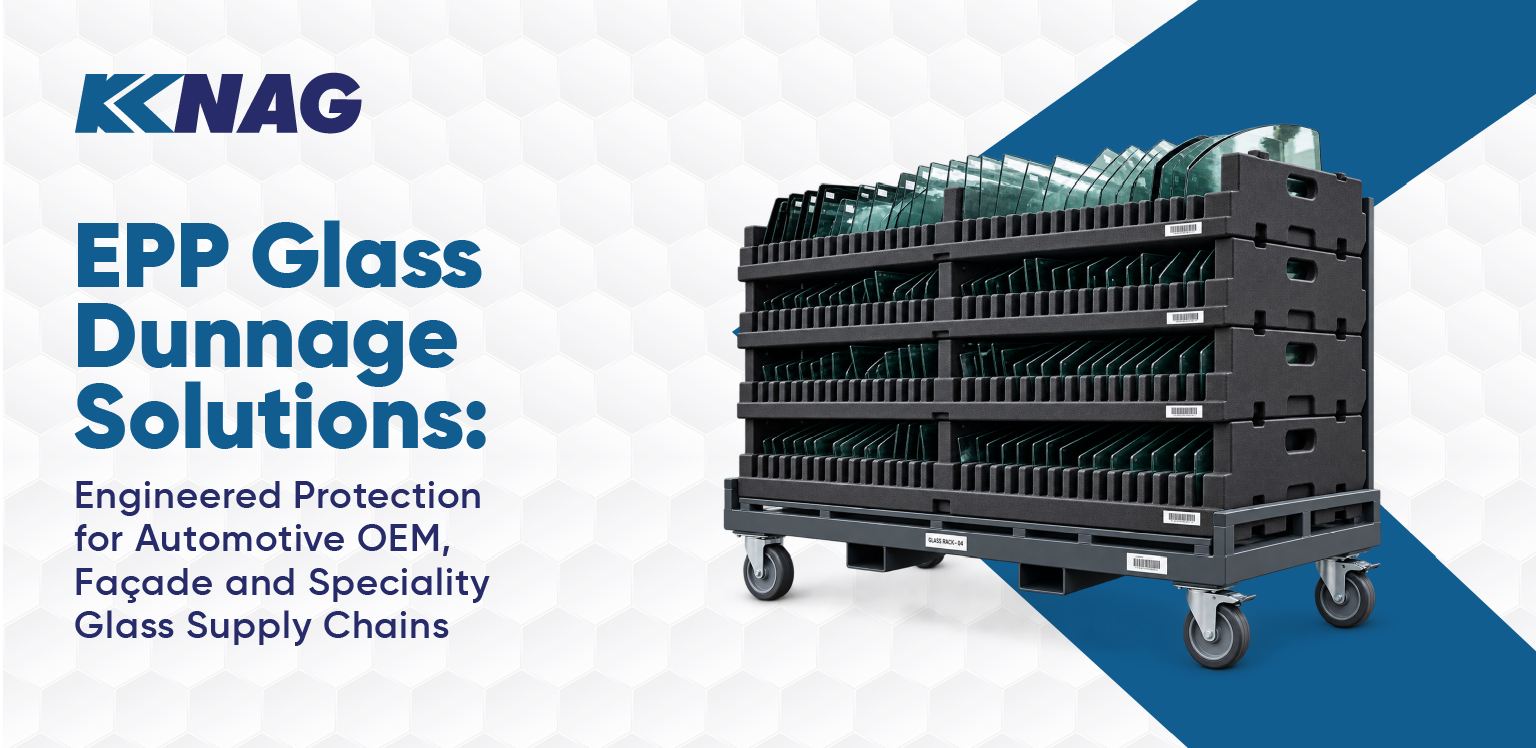
EPP glass dunnage is a lightweight, reusable packaging solution that protects high-value glass from impact, scratches, edge damage and movement during transport through custom-fit cushioning and separation.
Glass is one of the most demanding materials to transport. Whether it is an automotive windshield with embedded sensors, a large-format façade panel destined for a high-rise, a solar module heading to a rooftop installation or a precision optical component bound for a laboratory, every sheet carries significant value and significant fragility. A single scratch, edge chip or micro-crack during transit can mean the difference between a delivered product and a rejected one.
For decades, the glass industry has relied on metal A-frames, Ethylene Propylene Diene Monomer (EPDM) rubber spacers, foam strips and strapping to move glass from plant to site. These methods have served their purpose, but the glass being produced today is thinner, larger, more precisely coated and increasingly integrated with technology. Conventional glass dunnage systems are struggling to keep pace.
This is where engineered Expanded Polypropylene (EPP) glass dunnage solutions step in. With over 30 years of expertise in EPP engineering, K. K. Nag has developed custom EPP dunnage solutions that address the protection, handling and sustainability demands of modern glass supply chains.
Table of Contents
Why Modern Glass Demands More from Its Dunnage
Industry data indicates that up to 10% of utility glass is damaged during shipment, with this figure rising further in international transport. Damage often does not become visible until installation or end-use, making claims processing more complex and project delays harder to manage.
Modern automotive windshields integrate ADAS (Advanced Driver Assistance Systems) sensors and cameras. Façade glass may carry low-emissivity coatings that can be damaged by abrasion. Solar modules combine tempered glass with photovoltaic cells that can be affected by excessive flexing. Each glass type demands a level of transit protection that conventional systems were not designed to deliver.
The Limitations of Conventional Glass Dunnage Systems
- 1) Metal A-frames: Metal A-frames are heavy, adding to freight weight and making manual handling more demanding. Their fixed geometry does not adapt to varying glass sizes without inconsistent additional padding. When load shifts occur during transit, rigid metal frames transmit dynamic forces directly to the glass rather than absorbing them.
- 2) EPDM spacers: EPDM spacers degrade over time from heat and repeated pressure, making them far less dimensionally consistent than moulded foam. This causes uneven weight distribution and dangerous point-loading, which can permanently mark coated or precision glass.
- 3) Strapping and foam strips: Strapping and foam strips generate localised pressure at contact points. If strips compress unevenly, the glass surface beneath is exposed to stress concentration, increasing the risk of surface marking and edge chipping.
Beyond physical protection, conventional systems present supply chain challenges: poor container utilisation, expensive return logistics for heavy metal frames, limited automation compatibility and significant single-use packaging waste.
How Engineered EPP Glass Dunnage Solves These Challenges
EPP is a closed-cell foam that can compress under impact and recover its shape, making it suitable for repeated-use logistics applications.
-
- 1) Impact absorption: EPP distributes and dissipates shock energy progressively, rather than transmitting it to the glass surface. This is especially important during road transport on varied terrain and sea freight, where continuous vibration accumulates fatigue stress over extended journey times.
- 2) Precision surface protection: Custom-moulded EPP contacts glass at precisely defined zones, distributing load evenly and avoiding pressure concentration. Its smooth, non-abrasive surface does not mark or scratch coated glass, which makes it suitable for low-emissivity glazing, optical glass and ADAS-integrated windshields.
- 3) Custom-fit design: EPP glass dunnage solution from K. K. Nag are precision-moulded to match the exact geometry of each glass panel or batch. This tight fit helps minimise movement within the pack, reducing the risk of friction-induced scratches during transit.
- 4) Lightweight handling: EPP’s low density adds minimal weight to the overall pack, improving handling ergonomics and enabling better container utilisation per shipment.
- 5) Moisture resistance: EPP’s closed-cell structure provides high resistance to moisture absorption. It is critical for sea freight and humid transit environments where traditional foam degrades and can transfer contaminants to glass surfaces.
EPP vs Conventional Systems at a Glance
| Parameter | Metal A-Frame / EPDM | Foam Strip / Strapping | Engineered EPP Dunnage |
| Shock Absorption | Low | Moderate | High |
| Surface Protection | Risk of pressure marks | Risk of abrasion | Smooth, even contact |
| Custom Fit | Fixed geometry | Approximate | Precision-moulded |
| Return Logistics | Heavy, expensive | Mostly single-use | Lightweight, 100+ cycles |
| Moisture Resistance | Frame corrodes | Foam absorbs moisture | Zero moisture absorption |
| Sustainability | High carbon, heavy | High single-use waste | Recyclable |
Custom EPP Solutions by Glass Type
- 1) Automotive Windshield Dunnage: Automotive windshield dunnage uses dedicated cavities that cradle each windshield at its edges, keeping the optical zone contact-free. Multi-part EPP packs hold multiple windshields per returnable unit, optimising container fill rates.
- 2) Façade Glass Dunnage: Façade glass dunnage uses EPP edge protectors and corner guards to support large panels at their most vulnerable points while absorbing transit shock. EPP separators eliminate sheet-to-sheet contact.
- 3) Solar Module Dunnage: Solar module dunnage distributes support load uniformly along the glass surface, minimising flex and reducing the risk of micro-cracking that can affect module performance.
- 4) Optical and Speciality Glass Dunnage: Optical and speciality glass dunnage holds components without contact at optically active surfaces, with suitable chemical resistance that can help minimise the risk of contaminant transfer to the glass during transit or storage.
The Sustainability Case
Returnable EPP glass dunnage can help reduce single-use packaging waste across repeated delivery cycles. EPP is recyclable at the end of its service life and its multi-trip durability means far less packaging waste is generated per panel delivered.
K. K. Nag’s GreenCo-certified manufacturing operations mean that customers investing in EPP glass packaging are working with a solutions partner whose processes align with their own environmental commitments.
Conclusion
Conventional glass dunnage systems were designed for a simpler era. As glass becomes more sophisticated, the limitations of metal frames, EPDM spacers and strapping become more costly. Engineered EPP glass dunnage solutions from K. K. Nag offer precision-moulded, returnable and sustainable transit protection that is built to match the complexity of the glass it carries.
To discuss a custom EPP glass dunnage solutions for your supply chain, contact the K. K. Nag team.
FAQ
Q1. What is EPP glass dunnage and how is it used in automotive OEM supply chains?
Ans: EPP glass dunnage is a reusable protective packaging system made from Expanded Polypropylene (EPP) foam. In automotive OEM supply chains, it is designed to securely position windshields, windows and other glass components during storage, handling and transportation, reducing movement, impact and surface damage.
Q2. How does EPP glass dunnage protect façade and speciality glass during transport?
Ans: EPP glass dunnage provides cushioning and separation between fragile glass surfaces, helping absorb shocks and limit movement during transportation. Custom cavities and support points can help distribute loads across the glass assembly, reducing the risk of scratches, edge damage, breakage and contact during repeated handling.
Q3. What makes EPP a suitable material choice than foam or wood for glass packaging?
Ans: EPP offers a useful combination of lightweight construction, impact absorption, resilience and reusability for glass packaging. Compared with rigid wood, EPP can provide cushioning around delicate surfaces, while its closed-cell structure supports moisture resistance and repeated use. Custom moulding also allows the packaging to match different glass geometries.
Q4. How does reusable EPP glass dunnage support packaging inventory management compared with single-use packaging?
Ans: EPP glass dunnage is designed for repeated transport cycles, reducing dependence on disposable packaging and supporting more efficient packaging inventory management. Its durability and recoverability can help lower packaging replacement requirements, while returnable systems allow dunnage to circulate between suppliers, OEMs, warehouses and assembly locations.

Featured Blogs
Rotomoulded Septic Tanks and Bio-Toilets for Modern Sanitation
Rotomoulded septic tanks and bio-toilets are seamless, polymer-based sanitation systems engineered through rotational moulding. Used across rural, urban and industrial sites, they replace concrete structures by offering lightweight [...]
How EPP Improves Automotive Acoustics and NVH Performance
Summary: EPP automotive components help manage automotive NVH by reducing vibration transfer, controlling panel resonance, filling cavities and preventing buzz, squeak and rattle. As a lightweight material, EPP [...]
How to Calculate Savings from Switching to Reusable Polymer Solutions
Many businesses compare a disposable box with reusable packaging by looking only at the price of one unit. A corrugated box may appear cheaper than an EPP container [...]
How K. K. Nag Builds Circularity into Polymer Manufacturing
The way manufacturers evaluate polymer products is changing. The question is no longer limited to whether a material can be recycled. Businesses are also considering how long [...]
Get in Touch with Us
We look forward to connecting with you!


