
The Role of EPS Trays in Plant Tissue Culture and Agri-Biotech
Summary
EPS trays support plant tissue culture and agri-biotech applications by providing thermal insulation, moisture management, structural support and hygienic handling for plantlets during hardening, acclimatisation, transport and nursery propagation.
Plant tissue culture and agri-biotech laboratories across India operate under exacting operational parameters. Micropropagation demands stringent contamination control, precise moisture management and root-zone thermal isolation. Traditional nursery propagation trays made from thin vacuum-formed plastics or earthenware offer limited thermal insulation, making it harder to maintain stable root temperatures inside climate-controlled growth rooms.
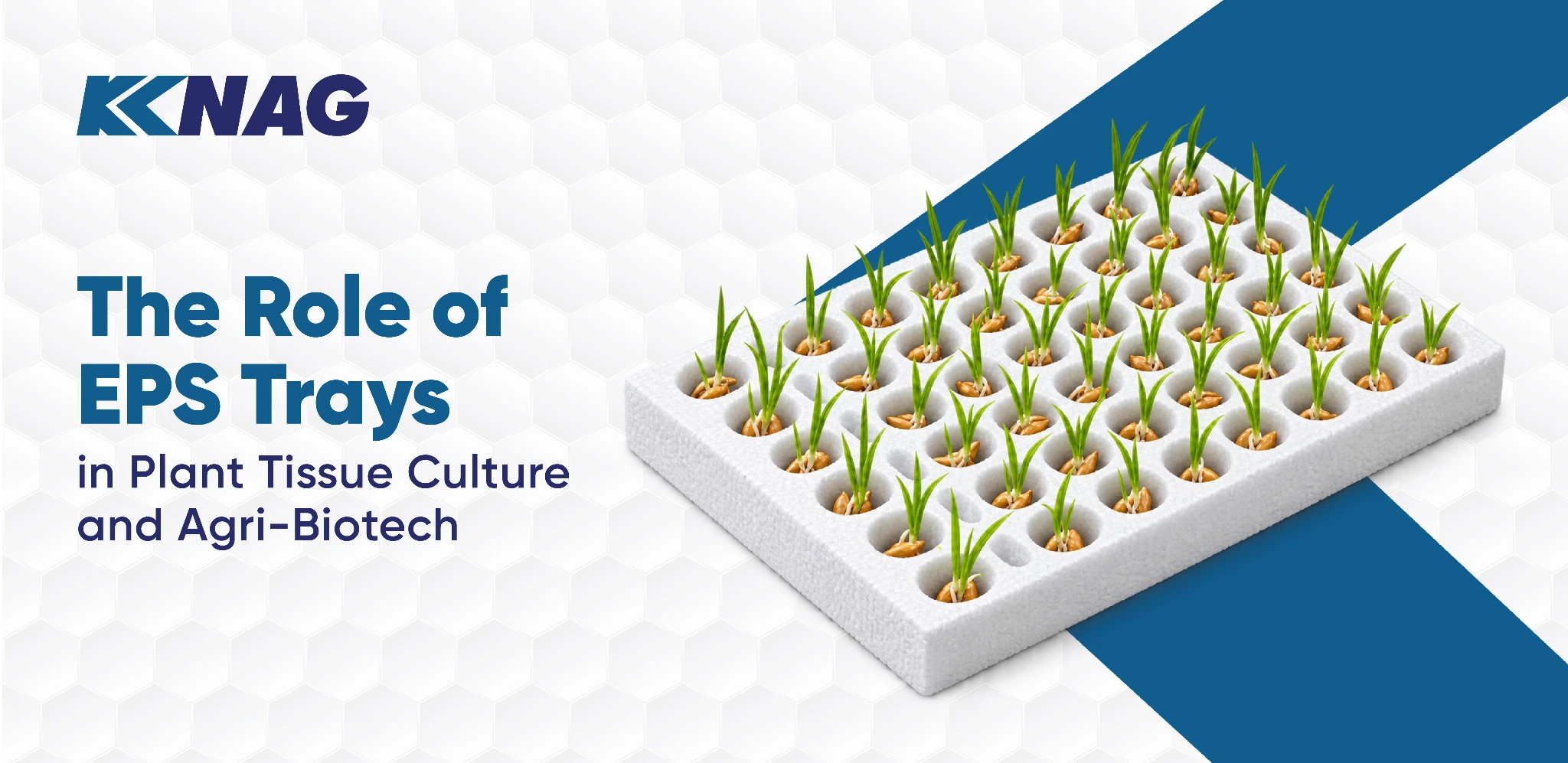
To overcome these physical limitations, commercial tissue culture facilities and horticultural research centres are increasingly adopting specialised Expanded Polystyrene (EPS) micropropagation trays. Engineered by an experienced expanded polystyrene manufacturer, custom EPS trays provide the structural rigidity, thermal protection and hygienic surface safety needed to support plantlet health during critical hardening phases.
Table of Contents
- 01. What Are the Environmental Demands of Plant Tissue Culture?
- 02. How EPS Trays Optimise Thermal Stability and Contamination Control
- 03. Performance Comparison: EPS Trays vs Conventional Nursery Trays
- 04. Key Applications of EPS Trays in Agri-Biotech Workflows
- 05. How K. K. Nag Supports India’s Agri-Biotech and Tissue Culture Labs
What Are the Environmental Demands of Plant Tissue Culture?
Micropropagation involves cloning elite plant germplasm in sterile nutrient media. Crops such as banana, sugarcane, bamboo, orchids and potato minitubers undergo initial multiplication in test tubes before transferring to primary ex vitro acclimatisation.
This hardening stage represents the most vulnerable phase in a plantlet’s lifecycle. Micro-plants transitioning from heterotrophic growth in glass vessels to autotrophic growth in soil plugs lack fully developed root systems and cuticle layers. Ambient temperature drops or surface contamination during this transition can cause high mortality rates across entire crop batches.
EPS is composed of 95 to 98% air trapped within a closed-cell cellular structure. This physical composition provides structural support while acting as a natural insulator against external temperature changes.
In high-volume commercial crops like banana, sugarcane and export-grade orchids, reducing ex vitro mortality during acclimatisation directly protects lab investments. Thermal protection during root development supports uniform plug establishment and batch consistency in commercial facilities.
How EPS Trays Optimise Thermal Stability and Contamination Control
Maintaining root-zone stability requires materials that resist external temperature shifts and help limit conditions favourable to microbial build-up. EPS trays deliver several operational benefits over conventional nursery plastics:
- 1) Thermal Insulation Across Growth Chambers: Root development in tissue culture plantlets depends heavily on root-zone thermal consistency. With a low thermal conductivity ranging between 0.030 and 0.040 W/m·K, EPS trays prevent sudden ambient temperature shifts from reaching delicate root networks. This thermal buffer reduces transplant shock when saplings move between incubation rooms, greenhouse bays and open shade nets.
- 2) Biological Inertness and Contamination Prevention: Fungal pathogens and bacterial blooms represent a constant threat in high-humidity acclimatisation facilities. EPS is chemically inert, non-toxic and moisture-resistant. It does not rot, absorb nutrient fluids or harbour fungal spores, establishing a hygienic barrier that protects delicate plant plugs.
- 3) Balanced Moisture Retention Without Waterlogging: The closed-cell structure of EPS prevents moisture absorption through the tray walls. Water remains in the rooting medium rather than soaking into the container, helping nursery technicians maintain precise irrigation regimes while reducing the risk of root rot or anaerobic soil conditions.
- 4) Minimal Plasticiser Leaching: Unlike low-grade recycled plastics that may release residual chemicals under high humidity or ultraviolet lighting, EPS is formulated without added plasticisers. The inert polymer surface helps limit chemical transfer into sensitive agar formulations or organic growth substrates.
- 5) Custom Engineering for Automation and Root Guidance: Custom-moulded EPS trays can be engineered with internal vertical ribs to prevent root circling and promote lateral air-pruning. Moulded drainage paths ensure efficient water runoff, while standardised outer dimensions accommodate automated potting, irrigation and automated tray-handling equipment.
Performance Comparison: EPS Trays vs Conventional Nursery Trays
Evaluating EPS trays against standard vacuum-formed PVC or rigid injection-moulded plastic trays highlights clear operational differences across key laboratory metrics:
| Operational Parameter | Conventional PVC/PET Trays | Custom EPS Micropropagation Trays |
| Thermal Insulation | Minimal; heat transfers rapidly to root plugs | High; low thermal conductivity, protects roots |
| Microbial Safety | Smooth surface can trap surface moisture and fungi | Inert closed-cell foam resists fungal and bacterial growth |
| Root Zone Stability | Susceptible to rapid day/night temperature swings | Maintains consistent microclimate around root plugs |
| Structural Integrity | Prone to bending and cracking during manual handling | Rigid cellular structure supports full plug weight without flexing |
| Chemical Safety | Potential for additive or plasticiser leaching | Chemically inert with low VOC emissions |
| Freight and Weight | Moderate weight; higher shipping footprint | Extremely lightweight; can help reduce transportation costs |
| Material Circularity | Mixed resins; difficult to recycle mechanically | Recyclable through standard polymer streams |
Key Applications of EPS Trays in Agri-Biotech Workflows
Custom EPS configurations support multiple stages within modern agricultural research and commercial plant propagation supply chains:
- Primary Hardening Trays: Moulded plug cavities hold individual coco-peat or peat-moss plugs securely, preventing root entanglement between adjacent tissue-culture plantlets.
- Secondary Nursery Acclimatisation: Deep-cavity EPS trays support secondary root expansion for woody species, bamboo and fruit tree rootstocks before field planting.
- Cold-Chain Plantlet Shipping: Combining protective EPS packaging with thermal insulation properties helps commercial laboratories ship acclimatised plantlets across long distances while reducing the risk of thermal degradation.
- Protective Inter-Lab Transport: Specialised agri-biotech packaging cradles glass culture vessels and liquid media containers during transport between preparation rooms, autoclaves and growth chambers.
How K. K. Nag Supports India’s Agri-Biotech and Tissue Culture Labs
Maximising plantlet survival during micropropagation requires high-precision packaging engineered for contamination control and root-zone thermal isolation. Lightweight Expanded Polystyrene (EPS) provides the physical insulation and hygienic surface properties needed to protect delicate root structures and reduce ex vitro transplant stress across sensitive acclimatisation phases.
As an EPS pioneer in India since the early 1970s, K. K. Nag operates five manufacturing facilities across Pune, Puducherry, Sriperumbudur and Thiruvallur. Leveraging in-house mould engineering capabilities, K. K. Nag manufactures custom EPS trays tailored precisely to partner cavity counts, root drainage profiles and structural specifications. To assist business partners in achieving sustainability targets, post-use EPS components can also be recovered and processed through RecyCole mechanical recycling.
Whether you require high-density plug trays for commercial micropropagation or custom insulated containers for inter-lab transportation, K. K. Nag’s tooling team works directly with your facility parameters. Contact K. K. Nag today to discuss custom mould engineering, sample prototyping and scalable volume production.
FAQ
Q1. What are EPS trays and why are they used in plant tissue culture?
Ans: EPS trays are lightweight, mouldable trays used to support plant material during propagation and nursery operations. In plant tissue culture and agri-biotech, they can provide organised support for seedlings or plantlets while offering cushioning, thermal insulation and moisture management during handling and movement.
Q2. How do EPS trays help maintain sterility during agri-biotech processes?
Ans: EPS trays can support organised handling of plantlets, but the tray itself does not guarantee sterility. Sterility in tissue culture depends primarily on aseptic techniques, sterilised equipment, controlled environments and appropriate culture media. EPS trays may be used as secondary handling or support equipment where their design and intended use are compatible with the process.
Q3. What makes EPS trays different from regular nursery trays for plants?
Ans: Unlike conventional nursery trays for plants, EPS trays provide additional thermal insulation and cushioning due to their cellular foam structure. Their lightweight construction can also make handling easier. However, the suitability of EPS depends on factors such as plant species, propagation method, tray geometry, drainage requirements and growing conditions.
Q4. Can EPS trays be used as nursery seedling trays for large-scale plant propagation?
Ans: Yes, EPS trays can be used as nursery seedling trays when their cell size, drainage, dimensions and structural properties are suitable for the propagation process. They can help organise seedlings during early growth and handling. For large-scale propagation, tray durability, irrigation compatibility, stacking, cleaning and overall cost should also be considered.
Q5. Are EPS trays a good option for biotech packaging of sensitive plant materials?
Ans: EPS trays can be considered for biotech packaging where lightweight cushioning, thermal insulation and organised positioning are required. Their suitability depends on the sensitivity of the plant material, required temperature and humidity conditions, sterility requirements and transportation duration. For sensitive tissue-culture material, the complete packaging system should be evaluated rather than the tray alone.
Q6. Can EPS trays be customised for different plant species and tissue culture applications?
Ans: Yes. EPS trays can be customised in terms of dimensions, cell configuration, depth and geometry to suit different propagation requirements. Custom designs can accommodate variations in plant size, root development and handling processes, making them adaptable to different nursery and agri-biotech applications.
Q7. How do EPS trays help reduce transplant shock during the hardening stage?
Ans: EPS trays help to minimise transplant stress by providing physical support and thermal insulation around young plants during handling and acclimatisation. However, transplant shock is primarily influenced by changes in humidity, temperature, light, irrigation and growing conditions. Tray design can support the process but cannot independently prevent transplant shock.

Featured Blogs
Rotomoulded Septic Tanks and Bio-Toilets for Modern Sanitation
Rotomoulded septic tanks and bio-toilets are seamless, polymer-based sanitation systems engineered through rotational moulding. Used across rural, urban and industrial sites, they replace concrete structures by offering lightweight [...]

How EPP Improves Automotive Acoustics and NVH Performance
Summary: EPP automotive components help manage automotive NVH by reducing vibration transfer, controlling panel resonance, filling cavities and preventing buzz, squeak and rattle. As a lightweight material, EPP [...]

How to Calculate Savings from Switching to Reusable Polymer Solutions
Many businesses compare a disposable box with reusable packaging by looking only at the price of one unit. A corrugated box may appear cheaper than an EPP container [...]
How K. K. Nag Builds Circularity into Polymer Manufacturing
The way manufacturers evaluate polymer products is changing. The question is no longer limited to whether a material can be recycled. Businesses are also considering how long [...]
Get in Touch with Us
We look forward to connecting with you!


