
How Polymer Solutions Support Battery and Energy Storage Supply Chains
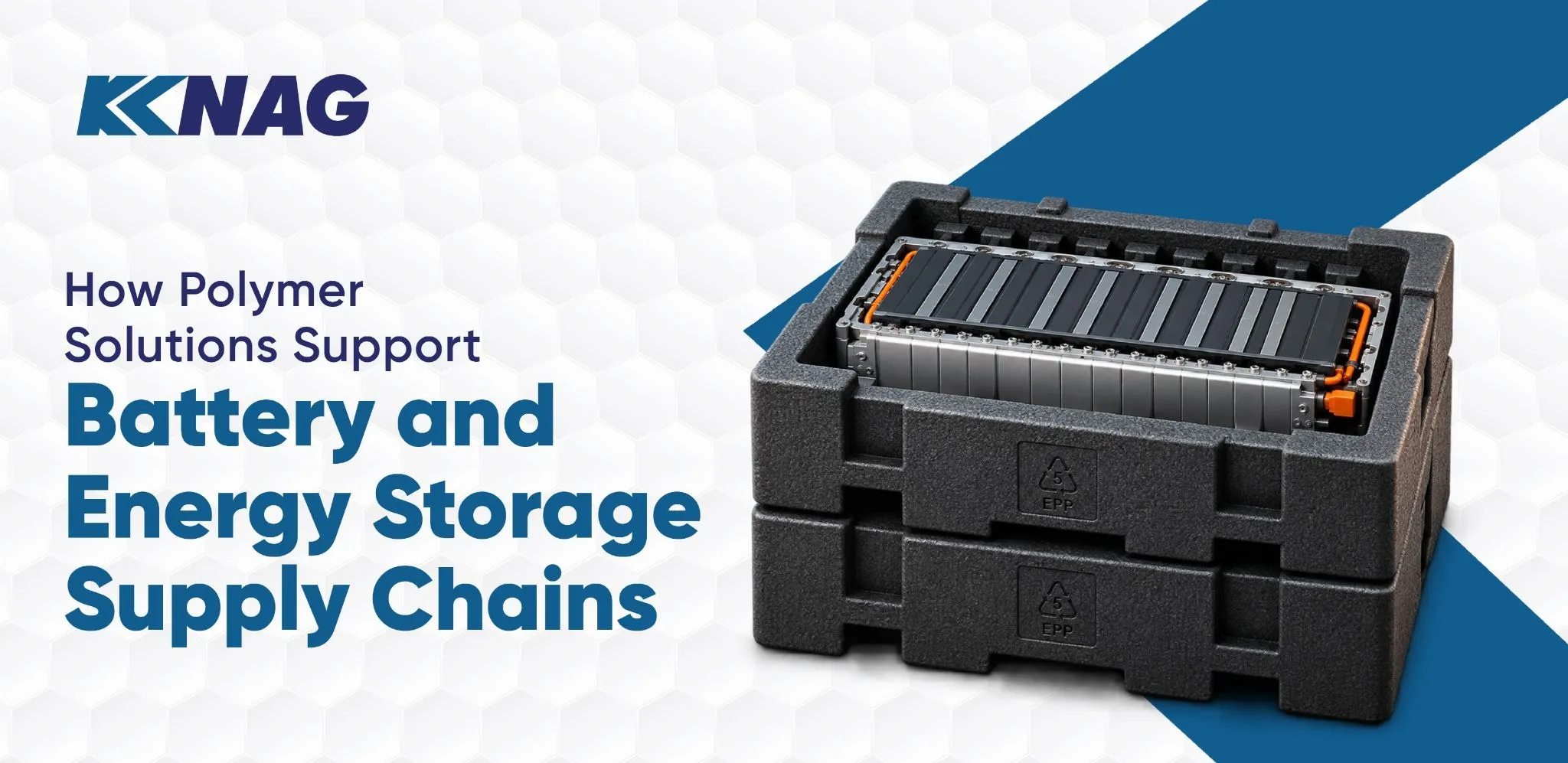
Custom Expanded Polypropylene (EPP) solutions, including dunnage, trays and reusable transport packaging, can support the handling and transportation of lithium-ion battery cells, modules and components across electric vehicle supply chains.
Table of Contents
- 01. Why Battery and Energy Storage Supply Chains Need Better Protection
- 02. Understanding the Battery Supply-Chain Journey
- 03. How Polymer Solutions Support Battery Handling and Transportation
- • Custom EPP Battery Dunnage
- • Battery Trays and Protective Inserts
- • Reusable Transport Packaging
- • Battery Covers and Protection Components
- 04. Why Lightweight Packaging Matters in Battery Logistics
- 05. Selecting the Right Polymer Material for Battery Applications
- 06. How Custom Packaging Design Supports Operational Efficiency
- 07. What the Future of Energy Storage Means for Polymer Solutions
- 08. K. K. Nag’s Expertise in Custom Battery Dunnage
- 09. Conclusion
The growing adoption of electric vehicles and renewable energy storage systems is changing how batteries are manufactured, handled and transported. As production scales, manufacturers are paying closer attention not only to battery performance but also to how sensitive components move safely through the supply chain.
A battery cell or module may pass through multiple handling and transportation stages before reaching its final assembly location. During this journey, repeated movement, vibration and loading can create challenges, particularly when components require precise positioning and protection from mechanical impacts.
This is where polymer solutions can play an important role. Materials such as Expanded Polypropylene (EPP) can be engineered into customised dunnage, protective trays and reusable packaging systems to support specific handling and transportation requirements.
For battery manufacturers and OEM suppliers, selecting the right battery packaging solution involves balancing component protection, packaging weight, design requirements and operational efficiency.
Why Battery and Energy Storage Supply Chains Need Better Protection
A battery component may travel through several stages before it becomes part of an electric vehicle or an energy storage system. It may move between production lines, storage areas, suppliers and assembly facilities, with each movement introducing different handling requirements.As battery manufacturing expands, managing these movements efficiently becomes increasingly important.
According to the International Energy Agency’s Global EV Outlook 2026, global electric vehicle battery deployment reached approximately 1.2 TWh in 2025, increasing by almost 30% compared with 2024.
Growth in stationary battery storage is also contributing to demand for battery components and supporting manufacturing infrastructure.
For manufacturers, this means that packaging must do more than hold components during transit. It should support the way batteries are handled, stored and transferred throughout the production process.
This is where engineered polymer solutions can play a role, particularly for components requiring impact cushioning, precise positioning and repeated movement.
Understanding the Battery Supply-Chain Journey
Battery supply chains involve multiple stages, each with distinct packaging and handling requirements.
The journey can broadly be understood as follows:
Battery Cell and Component Manufacturing → Internal Plant Handling → Storage → Supplier-to-OEM Transportation → Vehicle or Energy Storage Assembly
1. Battery Cell and Component Manufacturing
During manufacturing, battery cells and associated components must be handled according to their dimensions, weight and sensitivity. Cells may be cylindrical, prismatic or pouch-shaped, with each format requiring different support and positioning arrangements.
Custom trays and inserts can help maintain separation between components and reduce unwanted movement during handling.
To protect battery terminals, recessed pockets and dedicated locating contours are moulded into the tray geometry to keep sensitive terminal ends shielded from accidental impact or contact with adjacent cells. Using non-conductive, closed-cell polymer grades also provides reliable electrical isolation between neighbouring components, reducing the risk of short circuits when properly specified for the cell chemistry. In addition, sealed, lint-free moulded surfaces prevent dust, moisture and particulate contamination from settling on exposed cell surfaces or contact points during internal transfers.
However, the packaging must also account for terminal protection, contamination control and any requirements associated with the cell chemistry.
2. Internal Plant Handling
Battery components may move repeatedly between manufacturing, inspection and assembly stations. Packaging used at this stage should be compatible with the plant’s handling procedures, whether components are transferred manually or through automated systems.
Custom-moulded trays and dunnage may help maintain consistent component positioning, particularly where repeatable loading and unloading are required.
3. Storage and Inventory Management
Storage systems must accommodate component dimensions, permitted stacking loads and environmental requirements.
Where suitable, customised polymer trays can help organise components and maintain separation during storage.
However, storage arrangements for lithium-ion batteries must also consider applicable fire safety, electrical isolation and temperature-control requirements.
4. Supplier-to-OEM Transportation
When battery components move between manufacturing facilities and Original Equipment Manufacturers (OEMs), packaging must account for vibration, handling impacts and the expected transportation conditions.
For lithium-ion cells and batteries, applicable dangerous-goods transport requirements must be addressed separately from the choice of cushioning material.
5. Vehicle or Energy Storage Assembly
At the final assembly stage, packaging should support efficient component retrieval and movement to the required workstation.
Reusable inserts or trays may be useful where components are repeatedly supplied between facilities operating within a defined logistics network.
How Polymer Solutions Support Battery Handling and Transportation
Different battery supply-chain activities require different types of protection. While Expanded Polypropylene (EPP) is relevant for cushioning and returnable dunnage, other thermoplastics may be considered where greater rigidity, structural support or customised enclosure geometry is required.
The choice depends on whether the component is used for transportation, internal handling or as part of the finished battery system.
1. Custom EPP Battery Dunnage
Expanded Polypropylene (EPP) is a lightweight, closed-cell polypropylene foam used in applications requiring cushioning and impact energy absorption.
Suitable EPP grades can deform under certain loading conditions and recover sufficiently for repeated handling.
For battery transportation, custom EPP dunnage can be moulded to accommodate specific component dimensions and contact points.
This may help limit movement inside the outer container and reduce direct contact between adjacent components.
However, impact performance depends on the foam density, component geometry, load distribution and severity of handling conditions.
A customised battery packaging solution should therefore be evaluated through representative handling and transport tests rather than relying solely on general material properties.
2. Battery Trays and Protective Inserts
Battery trays and inserts help organise components during movement between production stages. Depending on the application, they may be designed with individual cavities, supporting surfaces or locating features.
EPP can be considered where cushioning and low weight are priorities.
For applications requiring relatively rigid trays, suitable polypropylene (PP), high-density polyethylene (HDPE) or other engineering thermoplastics may also be evaluated.
Material selection should account for stiffness, loading, temperature exposure, chemical compatibility and production requirements.
Electrical properties require particular attention. Conventional EPP or polyethylene should not automatically be considered electrostatic-discharge-safe or suitable for preventing electrical short circuits without appropriate material specifications and validation.
3. Reusable Transport Packaging
Battery components may travel repeatedly between suppliers and assembly facilities.
In such cases, reusable packaging can be worth evaluating as an alternative to disposable protective materials. Custom EPP dunnage may retain useful cushioning performance over multiple handling cycles, depending on material grade, loading and operating conditions.
A returnable packaging system can also include rigid outer containers, pallets and replaceable inserts.
However, the commercial benefits of reuse depend on more than packaging durability. Manufacturers must consider return transportation, cleaning, inspection, storage and replacement rates.
For closed-loop supply chains with predictable movement between facilities, these factors can make reusable packaging a practical option.
4. Battery Covers and Protection Components
Not all polymer components in the battery ecosystem are intended for shipping.
Certain polymer materials may also be used in covers, spacers and protection components within vehicles or energy storage assemblies.
For example, EPP may be considered for selected cushioning or spacing functions, while moulded thermoplastics may be evaluated for rigid covers and housings.
These applications differ significantly from protective transport packaging.
Battery-integrated components may require validation for flammability, electrical insulation, chemical exposure, mechanical loading and operating temperature.
A material suitable for reusable transport dunnage should not automatically be assumed suitable for a battery enclosure or a component performing a safety-critical function.
Why Lightweight Packaging Matters in Battery Logistics
Battery modules and packs can be heavy, making the weight of associated handling equipment an important consideration.
Although packaging represents only part of the total load, reducing unnecessary packaging weight may help make empty containers and handling assemblies easier to manoeuvre.
EPP offers a relatively low-density structure compared with many solid materials, allowing protective inserts to be designed without adding substantial mass.
The actual weight advantage depends on the required cushioning performance, foam density and the construction of the alternative packaging system.
For example, replacing a heavy protective insert with a suitably engineered EPP component may reduce the empty packaging weight.
However, lower weight should not come at the expense of adequate protection.
Manufacturers must evaluate the complete packaging system, including the outer container, lifting method, maximum permitted load and handling conditions.
Selecting the Right Polymer Material for Battery Applications
No single polymer material is suitable for every battery packaging or protection requirement. EPP, EPS, polypropylene and polyethylene offer different combinations of properties, making application-specific material selection important.
| Material | Relevant Characteristics | Potential Applications |
|---|---|---|
| Expanded Polypropylene (EPP) | Lightweight foam with grade-dependent cushioning, recovery and durability | Custom battery dunnage, protective inserts and reusable transport packaging |
| Expanded Polystyrene (EPS) | Lightweight foam offering cushioning and shape-specific moulding | Selected one-way protective packaging applications |
| Polypropylene (PP) | Thermoplastic offering application-dependent stiffness, durability and chemical resistance | Rigid handling trays, dividers and moulded components |
| High-Density Polyethylene (HDPE) | Relatively stiff polyethylene with grade-dependent impact and chemical resistance | Selected containers, handling components and moulded covers |
| Linear Low-Density Polyethylene (LLDPE) | Polyethylene used in suitable rotational moulding applications | Custom hollow containers and selected non-safety-critical handling components |
Material selection should consider the expected load, number of handling cycles, component dimensions and environmental conditions.
For battery-related applications, electrical behaviour and thermal performance may also be critical.
For example, EPP can provide impact cushioning, but it should not be presented as a fire barrier or a complete electrical protection system unless the particular grade and component have been tested and approved for those functions.
The final material should be selected according to the requirements of the complete application.
How Custom Packaging Design Supports Operational Efficiency
A standard container may be adequate for some components, but complex battery geometries often require more precise support. A customised insert can be designed around the dimensions and handling requirements of the component it carries.
For example, a tray may incorporate dedicated cavities to help maintain separation between battery components while providing appropriate support during movement.
Where manufacturing processes involve automated handling, the packaging design may also need to accommodate robotic grippers, alignment features or specific loading orientations. Important design considerations include:
- Component dimensions and permitted clearances for precise fitment and stability
- Foam density, cushioning behaviour and compression loads to absorb shock during transit
- Maximum packaging weight and stacking requirements to optimise logistics space and load capacity
- Handling equipment and automation compatibility for seamless integration with robotic grippers and assembly lines
- Temperature and environmental exposure limits, including flame-retardant compliance (such as UL 94 standards)
- Reuse cycles, inspection and replacement procedures to maintain long-term structural integrity
- Transport and safety compliance, ensuring alignment with UN 38.3 testing requirements for lithium-ion battery transport safety and dangerous goods packaging regulations
- Quality management systems supported by standards such as IATF 16949 and ISO 9001
For reusable EPP dunnage, dimensional consistency becomes particularly important because the insert must maintain an appropriate fit after repeated handling.
Careful mould development, material selection and production control can help manufacturers address these requirements.
What the Future of Energy Storage Means for Polymer Solutions
Battery demand is expanding beyond passenger electric vehicles. Stationary energy storage systems are increasingly being considered for renewable energy integration, electricity networks and commercial energy infrastructure.
As these applications develop, manufacturers may require protective packaging for different cell formats, larger modules and specialised system components. This could create opportunities for customised energy storage packaging, particularly in manufacturing and transportation.
Reusable EPP dunnage, rigid polymer trays and application-specific protective inserts may help address selected handling requirements. However, future demand will not be limited to packaging. Battery systems also require components designed for electrical isolation, thermal management, mechanical protection and long-term operation.
These functions have different technical and regulatory requirements. Materials should therefore be selected and validated for their specific role rather than relying on general polymer characteristics.
K. K. Nag’s Expertise in Custom Battery Dunnage
With over six decades of polymer engineering experience, K. K. Nag Private Limited creates custom EPP dunnage for industrial, automotive and battery applications.
In a lithium-ion battery packaging project initiated in 2024 for an Indian manufacturer supplying a Japanese EV brand, K. K. Nag developed a custom EPP assembly to improve cushioning, fitment and handling. The engineering team optimised the material density from 27 g/L to 23 g/L and implemented modified tooling, cooling fixtures, fastening straps, foam sheets and polypropylene parts to control shrinkage and ensure dimensional accuracy.
With management systems certified to IATF 16949, ISO 9001, ISO 14001 and ISO 45001, subject to confirmation of the applicable certification scope and manufacturing facility, K. K. Nag supports the development and manufacture of customised EPP battery dunnage and reusable battery handling solutions.
Conclusion
As battery and energy storage supply chains expand, protecting components during manufacturing, handling, storage and transportation remains an important operational requirement. Customised polymer solutions, particularly EPP dunnage and protective inserts, can help manage movement, cushioning and handling requirements across selected stages of the supply chain.
However, the effectiveness of a packaging system depends on its complete design, including material grade, component geometry, loading conditions and applicable transport requirements. For manufacturers developing a battery packaging solution, the focus should be on selecting materials and designs that match the practical requirements of the product and logistics process.
K. K. Nag’s experience in custom EPP battery dunnage provides a relevant foundation for supporting these application-specific requirements.
Explore K. K. Nag’s EPP manufacturing capabilities or connect with the team to discuss customised battery packaging and handling solutions.
FAQs
1. What Polymer Materials Are Used in Battery Packaging?
Expanded Polypropylene (EPP), Expanded Polystyrene (EPS), polypropylene (PP) and polyethylene grades may be used for different battery packaging and handling applications. The choice depends on cushioning requirements, stiffness, component weight, handling conditions and applicable safety requirements.
2. Why Is EPP Used for Battery Dunnage?
EPP offers a lightweight cellular structure with grade-dependent impact absorption and recovery. Custom-moulded EPP inserts may help support components and limit unwanted movement during handling and transportation.
3. Can Battery Packaging Be Reused?
Yes, certain packaging systems can be designed for repeated use. Suitability depends on material durability, packaging condition, expected handling cycles and the availability of an organised return logistics system.
4. Does EPP Packaging Make Lithium-Ion Batteries Safe for Transportation?
No. EPP can provide mechanical cushioning, but it does not replace applicable dangerous-goods packaging requirements, electrical protection measures or battery-specific transport testing. Compliance must be assessed for the complete shipment.
5. Can Polymer Materials Be Used for Energy Storage Components?
Yes. Suitable polymers may be used in selected covers, spacers, protective inserts and handling components. However, battery-integrated parts require validation against their specific mechanical, thermal, electrical and safety requirements.
6. What Should Manufacturers Consider When Selecting Battery Dunnage?
Manufacturers should assess component dimensions, cushioning needs, electrical properties and expected loading conditions to ensure proper protection. They must also account for expected handling cycles and applicable transport regulations before finalising the dunnage design.

Featured Blogs
How Polymer Solutions Support Battery and Energy Storage Supply Chains
Custom Expanded Polypropylene (EPP) solutions, including dunnage, trays and reusable transport packaging, can support the handling and transportation of lithium-ion battery cells, modules and components [...]
How EPO Supports Lightweight and Durable Drone Component Design
EPO foam can support lightweight drone designs through moulded wing sections, fuselage components and aerodynamic parts. Its formulation-dependent stiffness, impact behaviour and dimensional stability can help manufacturers [...]
Why D2C and E-Commerce Brands in Germany Are Considering EPP Protective Packaging
This blog explores how EPP packaging helps German D2C and e-commerce brands reduce product damage, optimise shipping costs and support reuse. It compares EPP with EPS, [...]
Role of EPP Solutions in Mining and Construction Equipment Cabins
EPP supports mining and construction equipment cabin performance through impact absorption, vibration damping and thermal insulation. Its lightweight structure helps improve operator comfort while supporting noise [...]
Get in Touch with Us
We look forward to connecting with you!

