
The Role of Rotomoulded Flotation in Offshore Wind and Marine Infrastructure
Offshore renewable energy is ushering in a new phase of growth as countries invest in cleaner power generation and strong coastal infrastructure. Alongside offshore wind farms, marine industries are expanding ports, aquaculture facilities and offshore logistics networks that depend on dependable floating systems. These environments expose equipment to continuous wave action, saltwater, ultraviolet radiation and mechanical impact, making durability a critical design requirement.
While rotomoulded flotation products are not intended to replace the primary structural foundations of offshore wind turbines, they serve a vital function in supporting the wider marine ecosystem. These engineered parts, which range from marine buoys and pipe floats to floating work platforms and monitoring systems, provide consistent buoyancy and a long service life under some of the harshest operating conditions on the planet.
Table of Contents
- 01. Growth of Offshore Renewable Energy and Marine Infrastructure
- 02. Why Marine Flotation Performance Matters
- 03. Applications of Rotomoulded Marine Flotation Solutionsr
- 04. How Rotomoulding Delivers Durable Marine Components
- 05. Why Choose K. K. Nag for Marine Rotomoulding Solutions
- 06. Conclusion
Growth of Offshore Renewable Energy and Marine Infrastructure
The rapid expansion of offshore wind is revolutionising marine engineering across Europe and other coastal markets. While fixed-bottom installations remain dominant, floating offshore wind is enabling projects in deeper waters with stronger and more consistent wind resources. According to the International Renewable Energy Agency (IRENA), floating offshore wind had around 270 MW of operational capacity globally in 2023, while the global project pipeline had already reached 244 GW, highlighting the sector’s strong long-term potential.
As projects move further offshore, support systems such as navigation equipment, maintenance platforms and floating structures must perform reliably in harsh marine conditions. Mooring systems vary by water depth, with catenary systems used below 200 metres, hybrid and semi-taut systems between 200 and 800 metres and taut systems beyond 800 metres.
Industry forecasts from Mordor Intelligence show this momentum, with floating offshore wind capacity projected to grow from 0.54 GW in 2026 to 4.13 GW by 2031 at a 50.08% CAGR. Another forecast from Future Market Insights estimates the market could reach USD 7.48 billion by 2035. With IRENA estimating that renewable energy capacity additions must average 975 GW annually until 2030 to stay on track for the 1.5°C target, demand for durable marine support systems and engineered flotation solutions will continue to rise.
Why Marine Flotation Performance Matters
Marine flotation products must withstand prolonged exposure to saltwater, UV radiation, wave impact and operational stress. Effective solutions require reliable buoyancy, impact resistance, UV stability and corrosion resistance for long service life.
Research by the University of Strathclyde on floating offshore wind identifies corrosion-fatigue as a critical challenge for offshore structures, while synthetic fibre mooring systems are being explored for their reduced corrosion susceptibility and suitability in deep-water applications. Within this ecosystem, rotomoulded flotation solutions support marine operations by improving buoyancy management, reducing maintenance requirements and enhancing equipment reliability.
Applications of Rotomoulded Marine Flotation Solutions
Marine Buoys
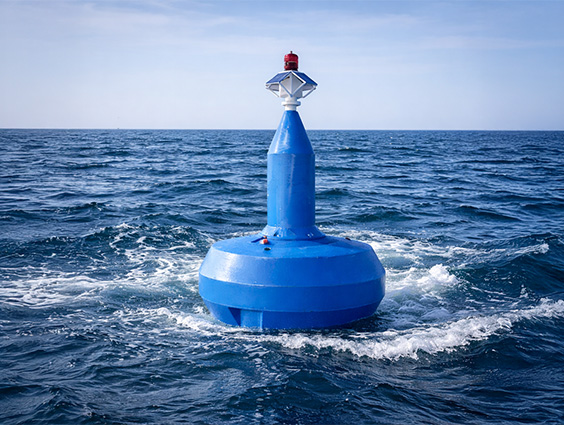
Marine buoys remain one of the most common applications for rotomoulded flotation products. Navigation buoys, marker buoys and mooring buoys require stable buoyancy, excellent visibility and resistance to continuous wave impact. They are typically manufactured from UV-stabilised, marine-grade polyethylene (LLDPE/MDPE), which offers excellent resistance to seawater, corrosion and ultraviolet degradation. Depending on the application, buoyancy modules may also be foam-filled to provide fail-safe flotation even if the outer shell is damaged.
Floating Platform Components
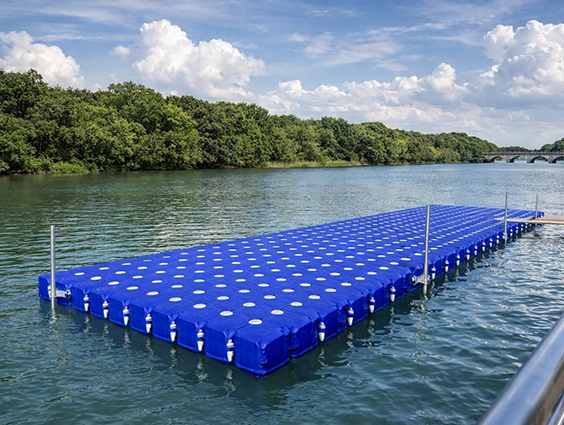
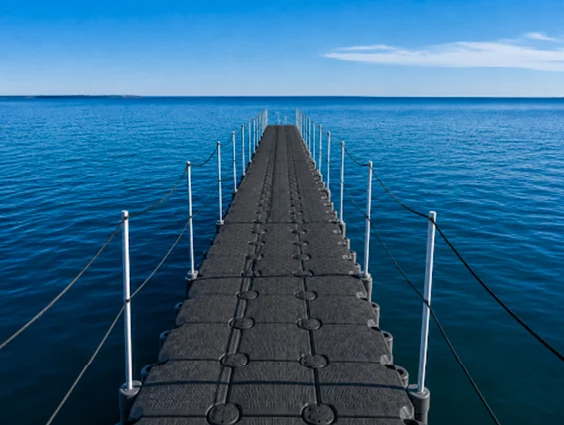
Maintenance pontoons, floating walkways and access platforms rely on durable floating platform components that can withstand harsh marine exposure. Rotomoulded polyethylene provides high impact resistance, corrosion resistance and low maintenance, while lightweight construction simplifies transportation and installation. These characteristics make it well suited for long-term deployment in offshore environments.
Pipe Floats and Boom Floats
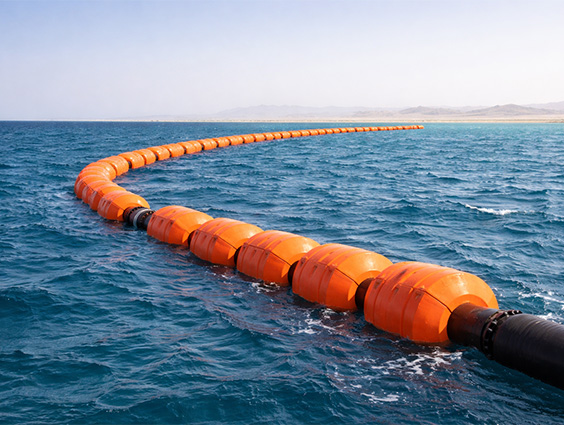
Pipe floats provide buoyancy for offshore pipelines and dredging operations, while boom floats support oil spill containment and environmental protection systems. Rotomoulding enables customised buoyancy, integrated attachment points and consistent wall thickness to meet project-specific performance requirements. UV-stabilised polyethylene ensures reliable performance despite prolonged exposure to saltwater, sunlight and changing weather conditions.
Marine Support Structures
Rotomoulded components also support aquaculture systems, offshore monitoring equipment, cable protection systems and inspection platforms. Manufactured from corrosion-resistant polyethylene, these components offer excellent durability, low maintenance requirements and reliable performance throughout extended deployment cycles. Their lightweight yet robust construction also simplifies handling during installation and servicing.
Standards and Certifications
Marine flotation products are typically designed and manufactured in accordance with recognised marine and navigation standards, depending on their intended application.
- IALA (International Association of Marine Aids to Navigation and Lighthouse Authorities): Provides recommendations for navigation buoy colours, markings and optical performance to support safe marine navigation.
- Bureau of Indian Standards (BIS): Relevant BIS specifications may be considered for materials and finished rotomoulded products, depending on the application.
- Indian Register of Shipping (IRS): Rules and guidance may apply where marine classification or inspection is required for flotation systems and associated mooring hardware.
Project documentation typically includes engineering drawings with tolerance call-outs, material certificates, UV stabiliser specifications, buoyancy calculations, test records and certificates of conformity, helping secure reliable performance and durability in demanding offshore environments.
How Rotomoulding Delivers Durable Marine Components
Rotational moulding is ideal for outdoor and marine applications because it creates smooth hollow components with uniform wall thickness and fewer weak points. The process heats and rotates plastic resin inside a mould, forming durable one-piece products without welded joints.
Rotomoulded flotation products made from polyethylene offer resistance against saltwater, UV exposure, chemicals and impact from waves or handling. This makes them suitable for marine buoys, pipe floats, pontoons and other flotation systems requiring solid buoyancy and long service life. The process also enables customised shapes, moulded-in features and controlled buoyancy. While polyethylene is not designed for primary load-bearing structures, its durability, corrosion resistance and low maintenance requirements make rotational moulding products a practical choice for marine support applications.
Rotomoulding does have practical limitations. Polyethylene offers lower stiffness than fibre-reinforced plastics or aluminium and is therefore not suitable for highly rigid primary structural components. Dimensional tolerances are also less precise than machined metal systems.
Why Choose K. K. Nag for Marine Rotomoulding Solutions
With 60+ years of expertise in polymer engineering, K. K. Nag Private Limited develops marine polymer solutions and custom moulded products for demanding standards and certifications in offshore and marine applications. Its rotomoulding capabilities support the production of durable flotation products, including marine buoys, jet ski docks, kayaks, canoes and boats.
We work closely with OEMs from concept development through production, offering in-house tooling development, design support and value engineering to optimise product performance and cost efficiency. Our integrated manufacturing capabilities enable complex geometries, moulded-in features, controlled wall thickness and application-specific buoyancy, ensuring every solution is Through application-focused design, tooling and manufacturing expertise, K. K. Nag Private Limited offers a range of solutions with optimised buoyancy, integrated features and long-term reliability in challenging marine environments.customised to operational requirements.
Backed by integrated manufacturing and engineering expertise, K. K. Nag Private Limited delivers rotomoulded solutions designed for long service life, low maintenance and reliable performance across offshore, marine and flotation applications.
Conclusion
The continued growth of offshore renewable energy and marine infrastructure is increasing demand for dependable flotation technologies that can withstand challenging sea conditions. Rotomoulded flotation products offer reliable buoyancy, corrosion resistance, ultraviolet stability and long service life, making them ideal for marine buoys, floating platforms and offshore support systems.
Supported by deep polymer engineering expertise, K. K. Nag Private Limited partners with OEMs to develop customised flotation solutions that combine engineering precision with operational reliability. Offshore industries are advancing and innovative rotomoulding is key to enhancing marine infrastructure.

Featured Blogs
Rotomoulded Septic Tanks and Bio-Toilets for Modern Sanitation
Rotomoulded septic tanks and bio-toilets are seamless, polymer-based sanitation systems engineered through rotational moulding. Used across rural, urban and industrial sites, they replace concrete structures by offering lightweight [...]
How EPP Improves Automotive Acoustics and NVH Performance
Summary: EPP automotive components help manage automotive NVH by reducing vibration transfer, controlling panel resonance, filling cavities and preventing buzz, squeak and rattle. As a lightweight material, EPP [...]
How to Calculate Savings from Switching to Reusable Polymer Solutions
Many businesses compare a disposable box with reusable packaging by looking only at the price of one unit. A corrugated box may appear cheaper than an EPP container [...]
How K. K. Nag Builds Circularity into Polymer Manufacturing
The way manufacturers evaluate polymer products is changing. The question is no longer limited to whether a material can be recycled. Businesses are also considering how long [...]
Get in Touch with Us
We look forward to connecting with you!


