
EPS Solutions for 5G: Building Lightweight and Reliable Telecom Infrastructure
The global rollout of 5G networks is transforming industries by enabling faster connectivity, lower latency and support for emerging technologies such as the Internet of Things (IoT), autonomous systems and smart cities. Behind every 5G deployment is a vast network of equipment that must operate reliably in diverse outdoor environments while remaining easy to transport, install and maintain.
This is where EPS solutions for 5G infrastructure can play a critical role. Expanded Polystyrene (EPS) offers a combination of lightweight construction, thermal insulation and design flexibility, making it suitable for a variety of telecom applications. From equipment protection to customised support structures, EPS helps manufacturers improve both performance and operational efficiency.
Table of Contents
Why 5G Infrastructure Demands Smarter Material Solutions
The expansion of 5G networks requires the deployment of thousands of base stations, small cells and supporting equipment across urban and rural environments. Unlike previous generations of telecom infrastructure, 5G often relies on a greater number of compact installations positioned closer to users.
These installations must withstand:
- prolonged exposure to sunlight, rain and temperature variations
- transportation across multiple installation sites
- repeated maintenance and servicing
- vibration during logistics and installation
- changing environmental conditions throughout their service life
At the same time, equipment manufacturers aim to minimise overall system weight to simplify installation and reduce transportation costs.
This combination of durability and weight reduction has increased the importance of lightweight EPS components that support reliable long-term performance.
K. K. Nag Product Ecosystem for 5G Networks
To solve real challenges in the 5G rollout, K. K. Nag provides specialised, high-performance telecom packaging and functional infrastructure solutions. By moving away from generic protection, our engineering team ensures that sensitive network hardware is fully isolated from environmental and physical stress.
EPS Telecom Packaging and Protective Solutions
Our EPS telecom packaging options are engineered to survive severe handling during domestic transit and international distribution. Leveraging high-density formulations, K. K. Nag develops robust telecom equipment packaging arrays that absorb repetitive drop energy and structural vibrations without transferring stress to inner circuit assemblies.
Custom Moulded EPS Components and Insulation Products
Outdoor network installations are continuously vulnerable to solar radiation and rapid thermal changes. K. K. Nag manufactures specialised insulation products and custom EPS packaging parts that act as thermal barriers. These structures shield sensitive electronics inside equipment enclosures, maintaining stable internal temperatures and preventing premature component degradation.
Real-World Applications in 5G Telecom Infrastructure
K.K. Nag’s EPS protective packaging is deployed across critical junctions of the overall 5G infrastructure layout, protecting components from factory floors directly to outdoor mast mounts.
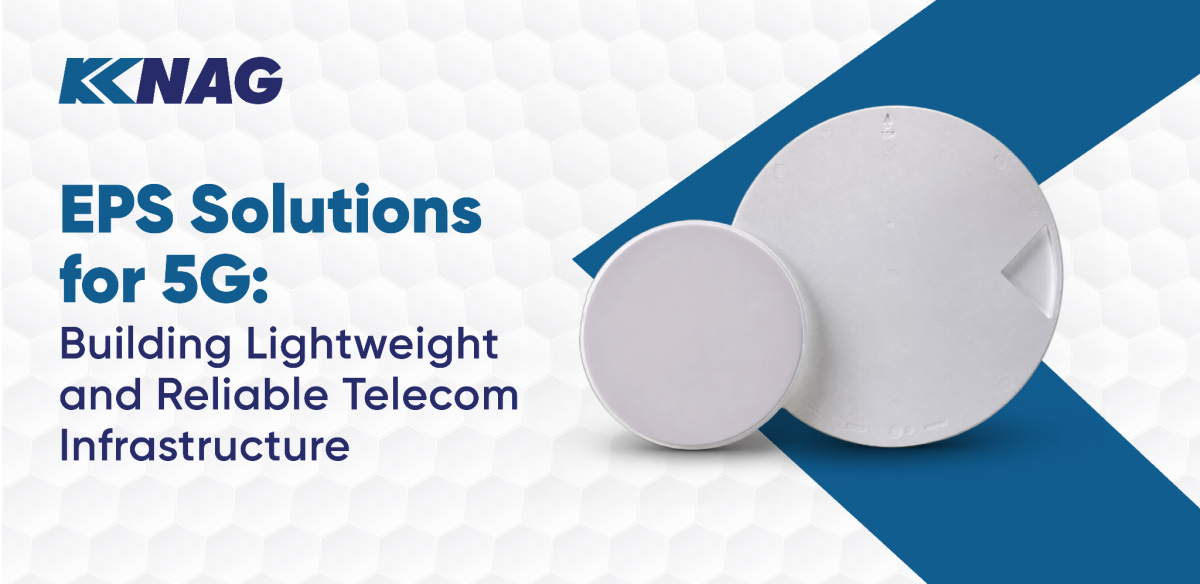
The Radome: A key structural use case for EPS inside active 5G infrastructure is the production of specialised Radomes. Because high-density EPS features excellent electromagnetic transparency, it can be custom-moulded into protective, weatherproof radar covers that shield sensitive microwave transceivers from wind, ice and rain without obstructing high-frequency 5G signal propagation.
Base station equipment packaging: High-density protective enclosures designed to securely isolate multi-layered transceiver units during long-distance transit loops.
Antenna packaging: Precision-moulded transit nests that prevent scratches, deformation or mechanical misalignment of directional 5G antenna matrices.
Small cell equipment packaging: Compact, highly cushioned structural wraps built specifically to facilitate the rapid deployment of localised small cell nodes in dense urban areas.
Battery protection inserts: High-volume projects can incorporate specialised EPS inserts designed to stabilise backup power cells within master enclosures, offering a highly structural, volume-dependent alternative to traditional PE foam layouts.
Router and telecom equipment packaging: Form-fitting internal trays designed to prevent internal module shift for sensitive network routing hardware.
Electronics transit packaging: Anti-abrasion dissipative trays built to safeguard bare underlying PCB architectures before final housing assembly.
Protective corner blocks: Modular, high-density shock absorbers that fit standard equipment sizes, eliminating edge impacts inside master shipping containers.
Export packaging: Rugged, moisture-resistant shipping configurations optimised to meet global compliance criteria, shielding delicate network components from marine humidity and harsh port handling.
The Value of Custom-Moulded EPS Solutions
No two telecom products are identical. Equipment dimensions, installation methods and logistics requirements vary between manufacturers.
Custom-designed EPS solutions for 5G allow packaging and functional components to be developed around specific equipment rather than relying on standard formats.
Typical customisation options include:
- product-specific protective cavities
- customised insulation profiles
- integrated support structures
- lightweight handling fixtures
- protective corner blocks
- modular packaging systems for multiple equipment variants
Application-specific moulding also improves manufacturing efficiency by reducing assembly complexity and ensuring consistent product positioning during transit.
As one of the established manufacturers of engineered polymer solutions, K. K. Nag develops custom EPS packaging products that address application-specific requirements across multiple industries. With in-house mould development, value engineering expertise and customised manufacturing capabilities, the company supports businesses in developing EPS moulded components that balance protection, performance and production efficiency.
Choosing the Right Manufacturing Partner
Selecting the right EPS supplier involves more than evaluating material properties alone. The success of a solution depends on engineering capability, mould development expertise and the ability to customise products for specific applications.
An experienced manufacturing partner should be able to provide:
- application-specific product design
- customised mould development
- value engineering support
- dimensional consistency across production batches
- scalable manufacturing capability
- quality-focused production processes
These capabilities help ensure that protective packaging for telecom equipment performs reliably throughout manufacturing, logistics and field deployment.
Conclusion
As global 5G networks continue to expand, infrastructure manufacturers require materials that combine durability, lightweight construction and design flexibility. From telecom packaging and insulation to customised support structures, EPS solutions for 5G contribute to improving equipment protection and installation efficiency.
With advantages such as thermal insulation, shock absorption and application-specific moulding, EPS moulded components continue to support the evolving requirements of 5G infrastructure components. By partnering with experienced manufacturers capable of delivering customised solutions, businesses can develop lightweight telecom components that meet both operational and logistics requirements while supporting reliable network deployment.
FAQs
What are EPS solutions for 5G infrastructure?
Ans: EPS solutions for 5G infrastructure include protective packaging, insulation components and lightweight structural parts designed to safeguard telecom equipment during storage, transport and installation. Expanded Polystyrene (EPS) offers excellent shock absorption, thermal insulation and dimensional stability, helping protect sensitive 5G components while supporting efficient deployment and long-term reliability.
How is EPS used in telecom infrastructure?
Ans: EPS in telecom infrastructure is commonly used for protective packaging, equipment insulation and custom protective inserts for antennas, radios, power units and network components. Its lightweight, durable and impact-resistant properties help prevent damage during handling and transportation while providing reliable thermal insulation for sensitive telecom equipment.
How does EPS provide thermal protection for telecom equipment?
Ans: EPS thermal insulation helps maintain stable temperatures by reducing heat transfer between telecom equipment and the surrounding environment. Its closed-cell structure provides excellent insulation, protecting sensitive electronic components from temperature fluctuations that could affect performance, reliability and service life in indoor and outdoor telecom applications.
Can EPS packaging be customised for different telecom equipment sizes?
Ans: Yes. Custom EPS telecom packaging can be designed to fit equipment of various sizes and shapes, including antennas, routers, radio units and power systems. Precision-moulded inserts provide secure cushioning, minimise movement during transit and help protect delicate components from impact, vibration and handling damage while improving packing efficiency.
Featured Blogs

EPS Solutions for 5G: Building Lightweight and Reliable Telecom Infrastructure
The global rollout of 5G networks is transforming industries by enabling faster connectivity, lower latency and support for emerging technologies such as the Internet of Things (IoT), autonomous [...]

EPP Toys for Indoor Play Areas: Combining Safety, Durability and Design Flexibility
Indoor play spaces have evolved far beyond simple playrooms with a handful of toys. Today's schools, daycare centres, activity zones, children's museums and family entertainment centres are creating [...]
The Role of Rotomoulded Flotation in Offshore Wind and Marine Infrastructure
Offshore renewable energy is ushering in a new phase of growth as countries invest in cleaner power generation and strong coastal infrastructure. Alongside offshore wind farms, marine industries [...]

EPP for Drones: Enabling Safer BVLOS and Long-Range Operations
As drone technology advances, applications are expanding far beyond aerial photography. Across Europe and the United States, drones are increasingly being deployed for logistics, infrastructure inspection, agriculture, [...]
Get in Touch with Us
We look forward to connecting with you!


