
Rotomoulded Floating Barriers for Marine and Inland Water Applications
Summary
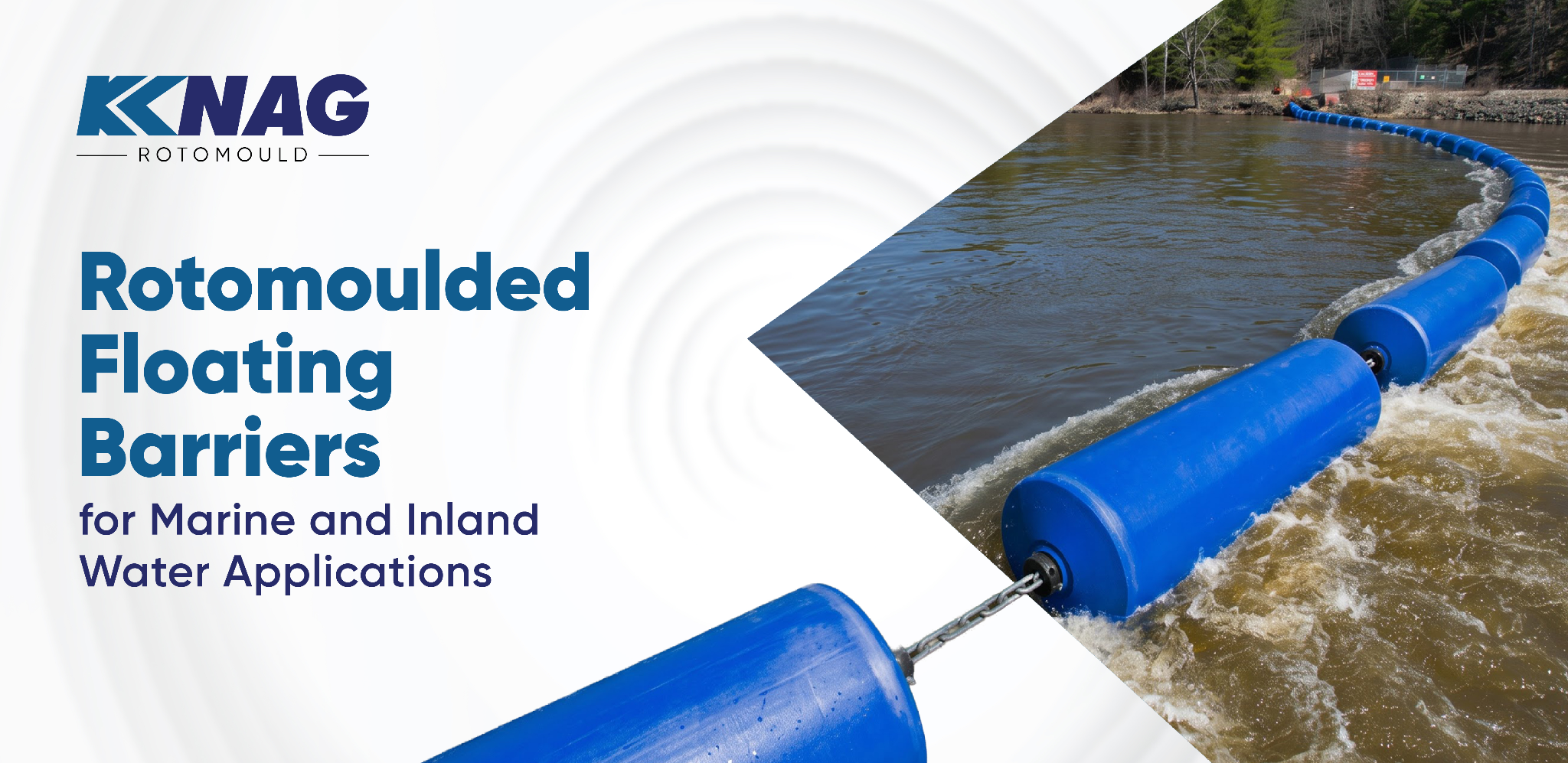
Rotomoulded floating barriers are lightweight, durable and corrosion-resistant. They help manage restricted zones, debris and water-based operations at ports, marinas, reservoirs and industrial facilities, and can be customised to site needs.
Floating barriers are used across ports, marinas, reservoirs and industrial facilities to mark restricted zones, separate operational areas and manage floating debris. However, the conditions in these environments can vary significantly.
A marine barrier may face saltwater, waves and vessel movement. A reservoir barrier may need to withstand prolonged sunlight and changing water levels. An industrial floating boom may need to manage specific types of debris near a water intake.
These varying requirements make the choice of material and manufacturing process important. Conventional steel and concrete barriers can provide structural strength but may also create challenges related to weight, corrosion, transportation and installation.
Rotomoulded floating barriers offer an alternative for applications where lightweight construction, durability, buoyancy and design flexibility are important. Their key advantage lies in the ability to develop a solution around the specific requirements of the water environment.
Table of Contents
- 01. What Are Rotomoulded Floating Barriers?
- 02. How Do Rotomoulded Barriers Compare with Conventional Options?
- 03. Key Advantages of Rotomoulded Floating Barriers
- 04. Where Can Floating Barriers Be Used?
- 05. Why Customisation Matters in Marine Barrier Design
- 06. What Should Engineers Consider When Selecting a Floating Barrier?
- 07. Built for Long-Term Performance
- 08. Conclusion
What Are Rotomoulded Floating Barriers?
Rotomoulding, is a manufacturing process used to create large hollow polymer products. The hollow construction helps create buoyancy while allowing the product to be engineered for the required dimensions, loading and operating conditions.
The process supports the production of complex shapes with seamless construction. This makes it suitable for floating products where buoyancy, durability and structural performance are important.
A floating barrier can be designed around factors such as:
- Required buoyancy
- Water conditions
- Barrier dimensions
- Connection systems
- Anchoring requirements
- Expected impact and loading
This makes rotomoulding suitable for developing application-specific floating barriers rather than relying on a single standard design.
With over 20+ years of rotomoulding expertise, K. K. Nag develops customised polymer-engineered solutions for demanding industrial applications. Its capabilities include marine flotation products, floating solar platforms and other large-format rotomoulded products.
How Do Rotomoulded Barriers Compare with Conventional Options?
The right barrier depends on the application and operating environment.
| Consideration | Steel | Concrete | Rotomoulded Solutions |
| Weight | Relatively heavy | Very heavy | Relatively lightweight |
| Corrosion | Requires protection in marine environments | Can deteriorate over time | Does not corrode like conventional steel |
| Handling | May require heavy equipment | Complex | Easier in suitable applications |
| Modularity | Possible through fabrication | Limited | Supports modular designs |
| Design flexibility | Requires fabrication | More difficult to modify | Suitable for customised shapes |
Where weight, corrosion resistance, modularity and design flexibility are important, rotomoulded water barriers can offer significant advantages.
Key Advantages of Rotomoulded Floating Barriers
Lightweight Construction
Weight directly affects transportation, installation and repositioning.
Compared with conventional steel or concrete barriers, suitably designed rotomoulded products can be easier to transport and position, depending on their size, configuration and application requirements. This is particularly useful for modular systems that need to be deployed, expanded or relocated.
For example, a port may require a temporary barrier around an area undergoing dredging or maintenance. A lightweight modular system can simplify deployment and removal once the work is complete.
Resistance to Corrosion
Marine environments expose infrastructure to moisture and saltwater. Over time, this can contribute to corrosion in conventional metal structures.
Rotomoulded floating barriers can be manufactured using suitable polymer materials such as polyethylene, selected according to the application’s performance requirements. Unlike conventional steel, these polymer solutions do not corrode in the same way, making them suitable for prolonged exposure to water and outdoor environments.
Designed For Durability
Rotomoulding can produce large hollow products with seamless construction, supporting the development of durable flotation components. However, long-term performance depends on factors including material selection, product design, manufacturing quality and the conditions in which the barrier is used.
Easier Installation and Maintenance
Floating barriers may need to be installed across large areas or in locations where access is challenging.
The relatively lightweight construction of rotomoulded products can simplify handling and deployment. Modular systems can also allow multiple sections to be connected to create longer barrier systems.
Modular sections can also simplify inspection or replacement when required. However, the overall design should be selected according to factors such as water conditions, expected loading, anchoring requirements and the intended application.
Where Can Floating Barriers Be Used?
The application determines the design requirements of the floating barrier.
Ports and Harbours
Ports are dynamic environments where vessel movement, dredging, maintenance and construction activities may take place simultaneously.
Marine barriers can help create temporary exclusion zones around specific work areas. A modular rotomoulded system can also be repositioned as operational requirements change.
Marinas and Waterfront Facilities
Marinas need to organise limited water space efficiently. Floating products can help define berthing areas, guide vessel movement and create controlled zones around docks.
K. K. Nag’s rotomoulding capabilities include marine flotation products such as marine buoys and jet ski docks. These applications require buoyancy, durability and resistance to prolonged outdoor exposure.
Reservoirs and Inland Water Bodies
Floating barriers can help mark restricted areas around dams, water intake structures and other critical infrastructure.
The design may need to account for changing water levels, UV exposure, water movement and anchoring requirements.
Industrial Facilities and Water Treatment Plants
A floating boom or trash barrier can help intercept floating material before it reaches a water intake or treatment system.
The barrier design should account for the type and volume of debris, water movement, required barrier length, anchoring method and maintenance requirements.
Why Customisation Matters in Marine Barrier Design
Water-based applications are rarely identical. A barrier used in a busy port may need to withstand wave action and vessel activity. A reservoir barrier may prioritise long-term outdoor exposure and visibility. An industrial floating boom may need to manage a specific type of debris.
Rotomoulding allows manufacturers to develop large hollow polymer products around these requirements.
K. K. Nag’s customised modular floater for the marine industry demonstrates how rotomoulding can be used to develop large-format flotation solutions. The product highlights the importance of considering factors such as size, buoyancy, load requirements, modularity and operating conditions.
What Should Engineers Consider When Selecting a Floating Barrier?
| Factor | Why It Matters |
| Buoyancy | Helps the barrier remain stable on the water |
| Water movement | Influences stability and anchoring |
| UV exposure | Affects long-term outdoor performance |
| Impact risk | Determines required durability |
| Modularity | Supports installation and expansion |
| Anchoring | Helps maintain the barrier’s position |
| Connection design | Allows multiple sections to form larger systems |
| Maintenance access | Supports inspection and serviceability |
The importance of each factor depends on the application. A reservoir barrier may have different requirements from a marine barrier used near active vessel operations.
Built for Long-Term Performance
Floating barriers and other flotation products may remain outdoors for extended periods, facing sunlight, moisture, waves, currents and temperature variations. Their long-term performance therefore depends on selecting the right polymer, product design and manufacturing process for the intended environment.
K. K. Nag’s Rotomoulding capabilities extend to marine flotation products such as marine buoys, jet ski docks and customised modular floaters. These applications demonstrate how polymer-engineered flotation solutions can be developed around requirements such as buoyancy, dimensions, loading, modularity and environmental exposure.
Conclusion
Rotomoulded floating barriers offer a practical combination of lightweight construction, durability and design flexibility.
Compared with conventional steel or concrete barriers, they can simplify transportation and installation while avoiding concerns related to rust and corrosion. Their modular construction can also support applications where barriers need to be repositioned, expanded or customised.
From ports and marinas to reservoirs, industrial facilities and water treatment plants, floating barriers can address a wide range of water-management requirements.
The right solution depends on the operating environment. Buoyancy, water movement, UV exposure, impact risk, anchoring and modularity must all be considered during development. By combining manufacturing expertise with a problem-solving approach, K. K. Nag transforms rotomoulding capabilities into practical solutions for marine and inland water applications.
FAQ
Q1. What are rotomoulded products and why are they used in marine floating barriers?
Ans: Rotomoulded products are manufactured using rotational moulding, a process that produces smooth, durable hollow components. For marine floating barrier, this construction can provide buoyancy, impact resistance and structural durability, making rotomoulded components suitable for demanding marine and water-based environments.
Q2. How does a marine floating barrier work in open water conditions?
Ans: A marine floating barrier uses buoyant floating sections connected to form a continuous barrier across the water surface. Depending on its application, the barrier can help contain floating pollutants, debris or other materials while allowing controlled movement with waves and currents.
Q3. What is a floating containment boom used for?
Ans: A floating containment boom is used to contain and control floating materials on water. Common applications include oil-spill response, debris control and protection of sensitive areas. The boom creates a physical barrier that limits the spread of contaminants and facilitates recovery or removal from the water surface.
Q4. Why are rotomoulded marine floating barriers preferred over traditional inflatable booms?
Ans: Rotomoulded marine floating barriers can offer greater resistance to punctures and impact because they use rigid, seamless components rather than air-filled structures. They can also provide consistent buoyancy and require less concern about maintaining inflation during prolonged deployment in demanding water conditions.
Q5. Are rotomoulded products suitable for both marine water applications?
Ans: Yes, rotomoulded products can be designed for both marine water applications and inland water environments. Their suitability depends on factors such as buoyancy requirements, water conditions, impact exposure, chemical resistance, UV exposure and the specific containment or barrier function.
Q6. What makes rotomoulded floating containment booms more durable than other materials?
Ans: A rotomoulded floating containment boom can be manufactured as a seamless, impact-resistant structure with no welded joints or seams that may become weak points. Material selection can also provide resistance to moisture, chemicals and UV exposure, which can supporting durability during prolonged deployment in demanding water environments.

Featured Blogs
Rotomoulded Septic Tanks and Bio-Toilets for Modern Sanitation
Rotomoulded septic tanks and bio-toilets are seamless, polymer-based sanitation systems engineered through rotational moulding. Used across rural, urban and industrial sites, they replace concrete structures by offering lightweight [...]
How EPP Improves Automotive Acoustics and NVH Performance
Summary: EPP automotive components help manage automotive NVH by reducing vibration transfer, controlling panel resonance, filling cavities and preventing buzz, squeak and rattle. As a lightweight material, EPP [...]
How to Calculate Savings from Switching to Reusable Polymer Solutions
Many businesses compare a disposable box with reusable packaging by looking only at the price of one unit. A corrugated box may appear cheaper than an EPP container [...]
How K. K. Nag Builds Circularity into Polymer Manufacturing
The way manufacturers evaluate polymer products is changing. The question is no longer limited to whether a material can be recycled. Businesses are also considering how long [...]
Get in Touch with Us
We look forward to connecting with you!


